[category]
[title]
Roopa Samariya’s exhibition brings the region’s feathered residents to life through vivid paintings, charcoal portraits and mixed-media works at Bikaner House.

Siberian cranes, flamingos, owls, pelicans and falcons: the guest list at this exhibition is quite the flock. But stealing the spotlight is the critically endangered Great Indian Bustard, Rajasthan’s state bird, found in the grasslands of Jaisalmer. Painted against a neon-coloured background stained with charcoal, the bustard’s portrait is hard to miss. Stretching from floor to ceiling, the work captures the bird mid-stride, its wings swept upwards, giving the portrait a sense of life, and motion.
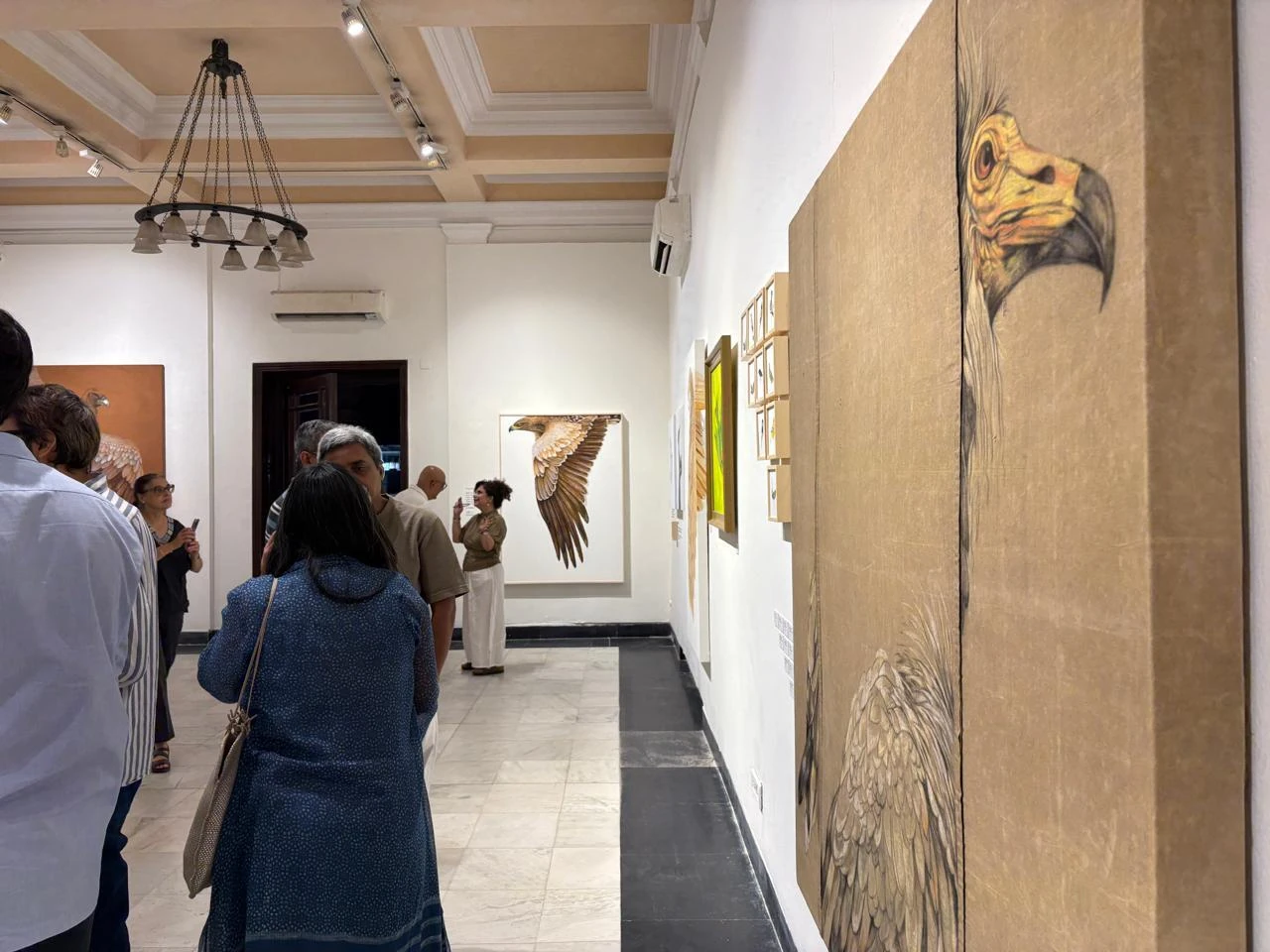
This is A Bird Called Rajasthan, an exhibition by artist Roopa Samariya. On view for a couple of days at the main gallery of Bikaner House, the exhibition brings together paintings, charcoal works and mixed-media pieces featuring wood and cloth. All the works on display draw you in with their intricate strokes of colour, while turning the spotlight on some of the most vulnerable species. So no, this is no mere roll call of Rajasthan’s birds.
Samariya’s interest in the avian world has also brought her into the orbit of ornithologist and author Bikram Grewal, photographer Nikhil Devasar, and Padma Shri award-winning wildlife filmmaker Naresh Bedi, who was also the guest of honour at the preview evening.
No binoculars or birding caps required; this is your chance to get the birding experience you deserve without actually venturing into the wild.
As you wander through the hall, expect birds with all sorts of expressions. Some might thrill you with their features, others have an... unhinged look to them, while more are just looking at you in the eye. They may not look particularly animated at first, but their expressions, beaks, feathers and wings give each one a personality of its own.
You’ll first encounter smaller frames that ease you in with portraits of species such as the Indian blue roller, Indian paradise flycatcher and trumpet finch. Mostly painted in oil on small, square canvases, these works keep things relatively lowkey, just like an the opening act!
The real spectacle unfolds in the central area of the gallery, where your eyes first meet a huge canvas painted in shades of blue and green. Titled Camouflage, the work is essentially a magnified image of a tree, with several little birds concealed within its foliage, including the Indian great peacock. Spread across two canvases that together occupy an entire wall, the painting creates an almost forest-like setting.
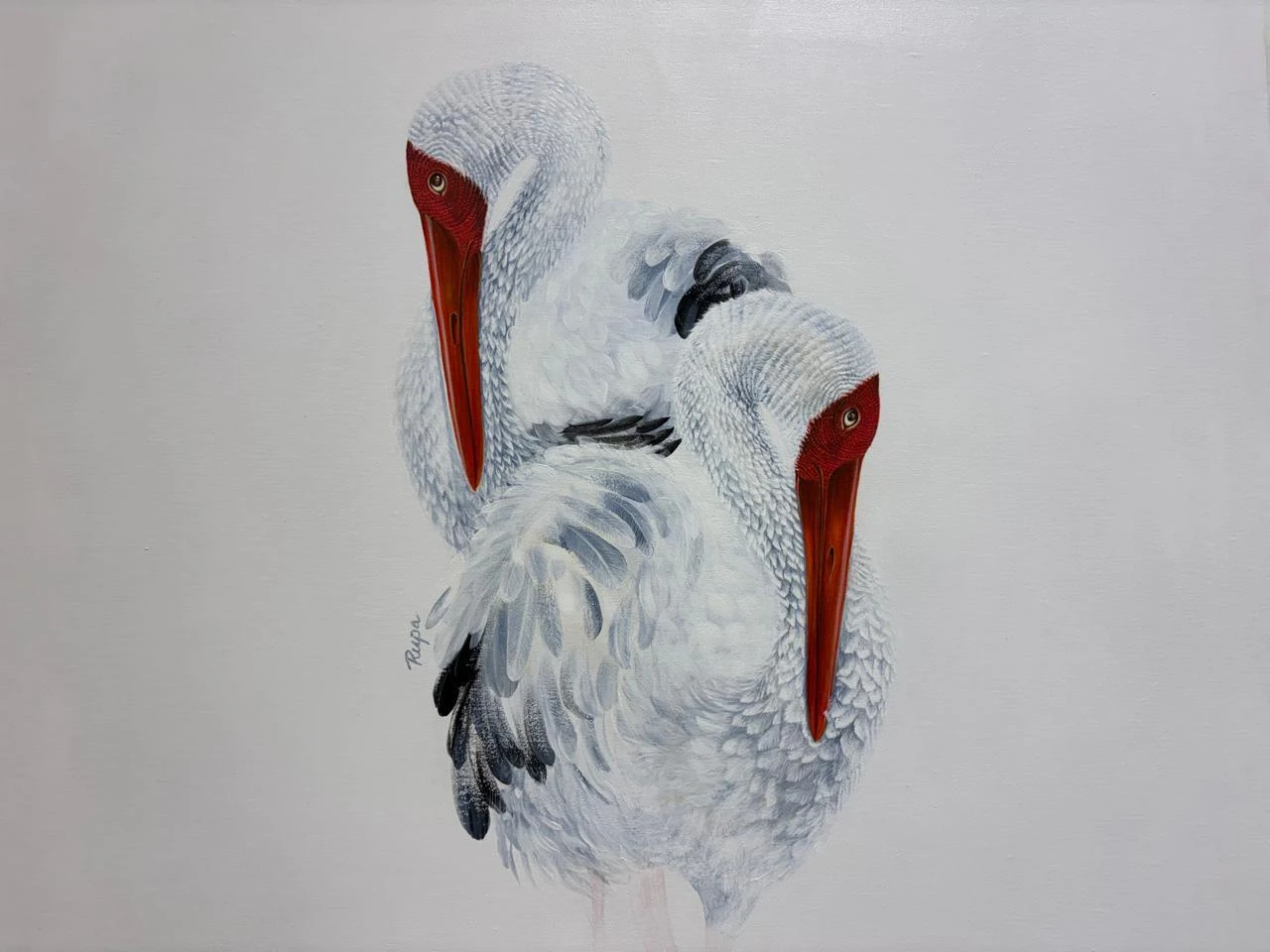
It stands in striking contrast to the other canvases; take, for instance, the painting on the directly opposite wall. Here, two birds huddle together at the centre of the frame that’s essentially white. It's only their bright red beak that is popping out (less really is more).
Move further into the gallery, and you’ll notice more of this. The colour comes from the bird rather than an elaborate background, with shades ranging from bright reds to fluorescent greens. Some works even switch things up with different materials. Take the one painted on three brown pieces of cloth stitched together. The Indian vulture is depicted across the three panels in a deliberately non-linear composition, with the stitched divisions breaking up its body and drawing attention to a particular body part.
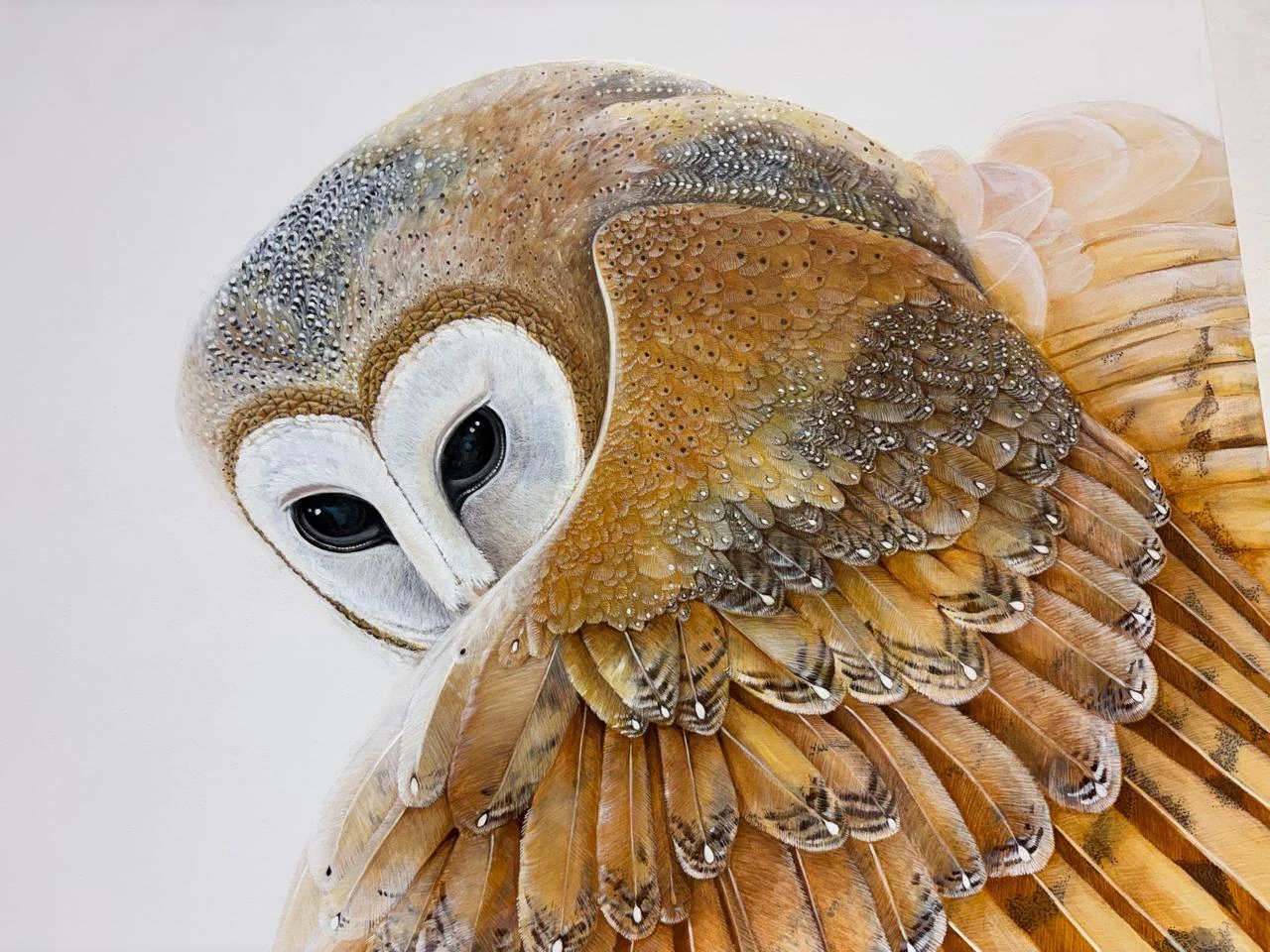
The second most striking canvas features the Indian eagle-owl, imposing and grand enough that you’ll want to take a step back to absorb the whole image without feeling overwhelmed. Rendered in brown and white, with a touch of glitter-like detailing created by little strokes of white, the work makes an impression. The third such work returns to the vulture, this time on a brown canvas. Rather than showing the bird in its entirety, the painting focuses on its open feathers, one of its most distinctive features. This is a closer look at the bird’s formidable plumage. Many other canvases also have birds mid-flight.
Painting birds may not be new, but Roopa Samariya’s work takes the art to a different level of detail. Having painted more than 600 species of Indian and international birds, the artist brings an almost research-driven approach to her subjects. After consulting a plethora of birdwatchers and ornithologists, she has developed her own understanding of how to piece together the intricate feathers of each species, especially when they are moving.
What’s equally striking is the expression she manages to bring out in her subjects. Take the pair of Siberian cranes, for instance. Although Siberian cranes are not indigenous to India, they make multiple appearances elsewhere in Samariya’s work, where a pair is depicted in a flowing composition. Clearly, these birds have earned themselves a lot of fame.
Originally from Patna, where she also grew up, Samariya’s fascination with birds began early. Sparrows were a familiar presence around her home, with her family making nests and placing them around the house. It’s a childhood connection that seems to have grown into a lifelong preoccupation. One that's worth bearing witness to whether you're a birdhead or not. Take a flight of fancy.
When: On until October 12, 2026. Mon-Sun, 10am to 7pm.
Where: Main gallery, Bikaner House, Pandora Road, Delhi
Nearest metro station: Khan Market (Violet line)
Discover Time Out original video