[category]
[title]
Satish Gujral 100: A Centenary Exhibition is live till 30 March at NGMA and reframes the artist far beyond his Partition canvases

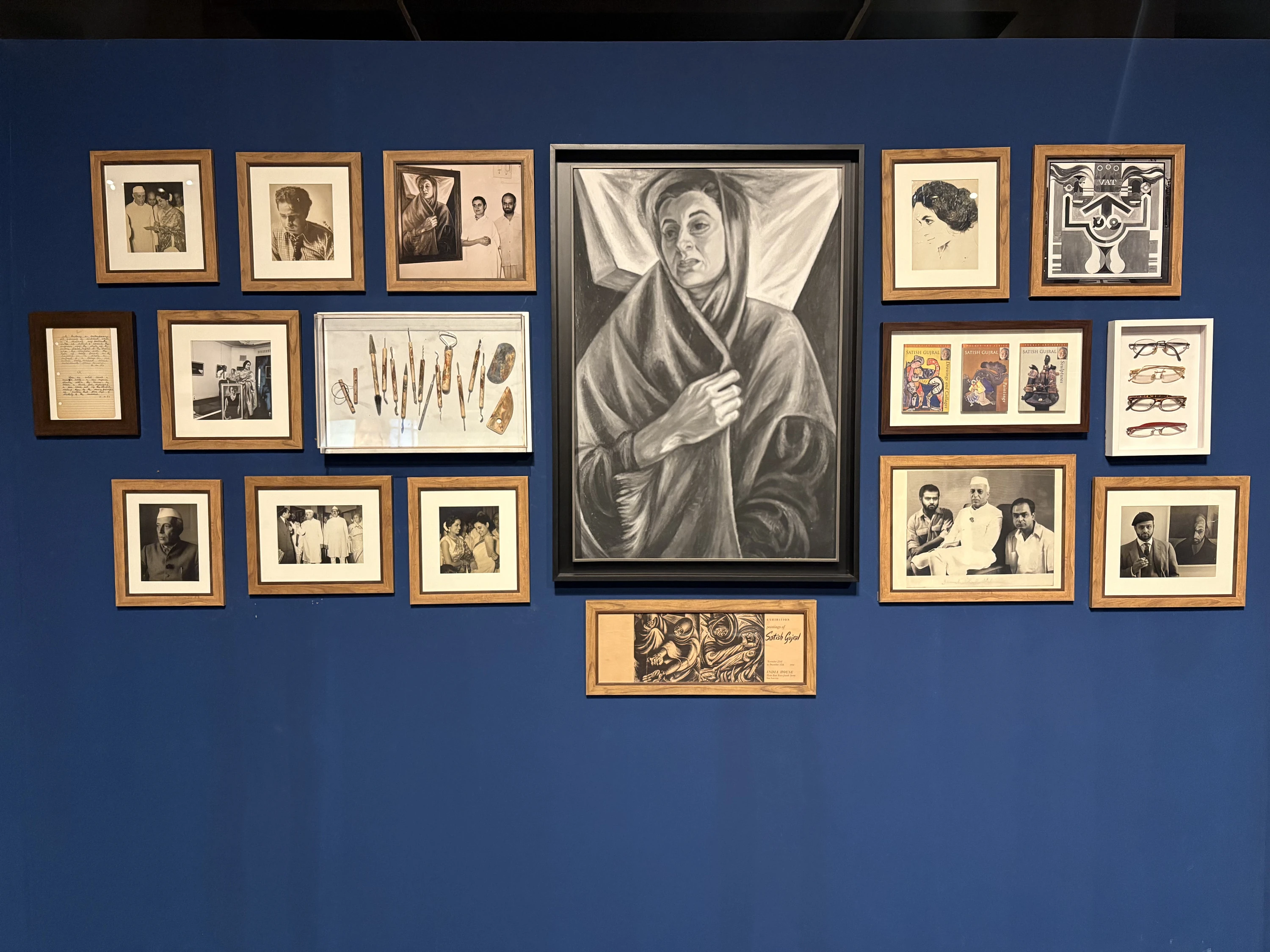
A centenary calls for something substantial when it’s someone like Satish Gujral you’re celebrating. The iconic artist, who would’ve turned 100 this year, is being honoured in Delhi with one of the most expansive exhibitions of his work to date: Satish Gujral 100, now on view at the National Gallery of Modern Art. The show brings together over 165 works spanning painting, sculpture, architecture and personal archives, and you're in luck, because it’s on until March 30.
Gujral's been one of the most defining artists to emerge from India – and for most, his work begins and ends with the Partition. This exhibition, though, is one of those rare instances that uncover the full sweep of a career: one that stretched across continents and disciplines, from his formative years in Mexico, to his experiments with industrial materials – including sculptural forms and architectural projects that reshaped bits of Delhi's skyline.
My firm view's that this is not the kind of show you dip in and out of. It's been curated with a deep sense of care – in part because it's been put up collaboratively by the Gujral Foundation (run by Gujral's son and daughter-in-law) and the Kiran Nadar Museum of Art. The displays touch on his passionate stint with architecture, the romantic life he guarded from the public eye, and his unusual habit of transforming the most ordinary things – rubber strings, wooden buttons – into art.
Without giving the best of it away, here's what to watch out for.
1.Mexico changed his scale, as well as his ambition
And guess who became his pal in Mexico? Frida Kahlo.
Early in his career, in the 1950s, Gujral flew to Mexico to work closely with renowned muralists Diego Rivera and David Alfaro Siqueiros at the Palacio de Bellas Artes. Mexico got him thinking big. Really big. I'm talking huge murals and public art. The exhibition displays several of the murals he created. It opens the eyes to how much the Mexican experience influenced his style in his later years.
2. The sculptor was as restless as the painter
Gujral’s sculptures are not dinner table centrepieces. You’ll probably have to move around them to take them in properly. What strikes you immediately are the outlandish expressions and the sleek, modernist design. Some pieces even include Braille descriptions, adding another layer of accessibility. And then there’s the question that lingers: who were these faces? Strangers he observed? People he knew? Or entirely imagined?
3. Delhi’s skyline bears his signature
By 1977, Gujral had firmly stepped into architecture. Largely self-taught, but clearly inspired by the scale he encountered in Mexico. Gujral gave Delhi its Belgian Embassy and several of its residents their private houses. The exhibition houses photographs of Gujral’s many overseas architectures: the Al Moughtara Palace in Riyadh, the Prime Minister's residence in Bahrain, the Indira Gandhi Centre for Indian Culture in Mauritius, among others.
4.He painted the political class often
A piece that jumps out at you is his portrait of freedom fighter Lala Lajpat Rai. The portrait initially raised eyebrows, but finally came to rest inside the Central Hall at Parliament. He did portraits for several Indian political giants, including Indira Gandhi and Jawaharlal Nehru.
5. He experimented with material
His experiments with metal, wood and fabric are thoroughly fascinating. There are ancient doorbells, nailed tin sheets, and iron rings. A powerful example of this engagement with material is his work responding to the 1984 anti-Sikh riots, using charred wood.
6. His wife was central to his story
Kiran Gujral was not only Gujral’s wife, but also his muse and critic. A large photograph of the couple anchors one section of the gallery. Their partnership endured until his final days, with medical equipment on one side and Kiran by his side. Together, they built an elegant home in Delhi’s Lajpat Nagar, marked by layered ceilings, angular walls and exposed brick. The exhibition suggests that this personal axis was not separate from his artistic life, but intertwined with it.
7. The tools tell their own tale
At the heart of the exhibition is an intimate section devoted to Gujral’s belongings: brushes, spatulas, instruments, recordings and photographs from across his life. There is a typewriter he used, a strikingly long paintbrush measuring some 25 inches, and vivid mixing palettes.
Where
National Gallery of Modern Art, Jaipur House, Shershah Rd, near India Gate, Delhi High Court, India Gate, New Delhi, Delhi 110003
When
11am-6pm on Tues-Fri. 11am-8pm on Sat-sun. Monday closed.
Until
March 30
Price
₹20
Discover Time Out original video