[category]
[title]
A swimming pool and a lake are a universe apart. The one that has to be conserved is also the one where you feel like you belong.


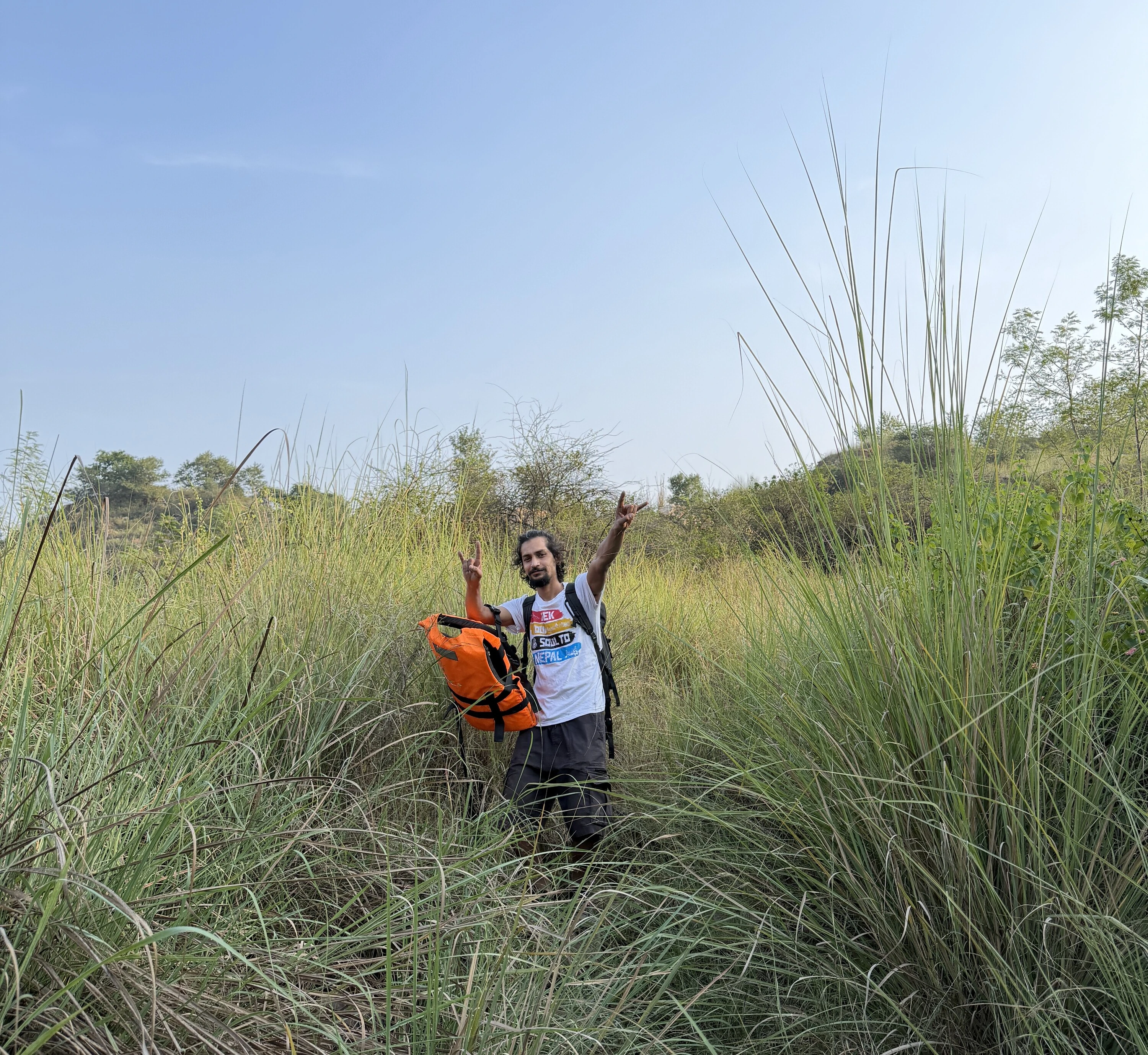
As my little group trekked through the dense foliage of the Aravallis, the sheer anticipation of reaching Mangar Lake, shrouded within the dry groves of Mangar Bani in Faridabad, might’ve killed me. Even if it was a downhill walk.
I spent it busy. I peppered our excursion leader, Sachin Sharma, with random questions.
'Don't think there are many venomous snakes here,' I said, surveying the semi-parched forest around us. 'Oh, there certainly are,' he said.
Sachin founded Delhi Outdoors this year. Every Sunday, he and a team of trained professionals take groups out to trek the Aravallis, rock climb, longboard, slackline and swim. Of all the activities on offer, I was most excited about the lake.
'Often, when we uproot rocks, we disturb the snakes resting underneath them…' Sachin continued. He mentioned the common krait, one of India's notorious Big Four venomous snakes.
I told myself to chill. Kraits are primarily nocturnal, after all. Still, I missed my shoes. A lot. The rocky terrain didn’t help.
We barely encountered a soul on our way, save for two locals who stopped to ask where we were headed. Residents of Mangar are quite protective of the water body. Rightly so.
After half an hour of negotiating slopes, scrambling over rocks, pushing through tall grasses and dodging thorny trees, the lake finally began peeking through the landscape. The ancient Aravalli rocks seemed to cradle Mangar Lake's still waters. As far as the eye could see, we had the entire landscape to ourselves. Once again, I felt my excitement spike.
'Delhiites spend their whole lives without knowing about this place, which looks nothing like the capital, even though it's just 20 kilometres away,' Sachin said. Until now, I was one of those Delhiites.
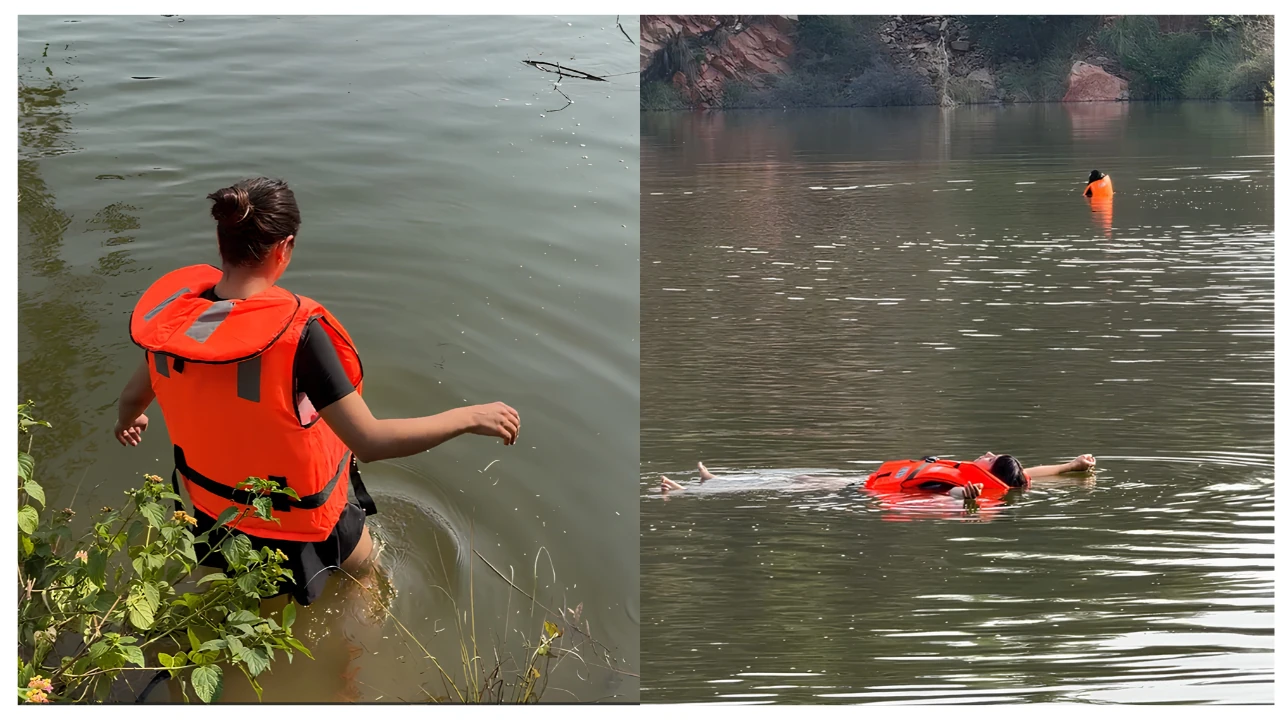
We pitched our tent on a secluded patch of white gravel. A giant rock was our makeshift seat, while an enormous rock face loomed nearby. For a split second, I was transported back to an island beach I'd visited as a child. We put our life jackets on.
There's a tried-and-tested way to get into a swimming pool: climb down the steps or hop off a platform a few feet above the water. Easy-peasy. But a natural water body, especially one as muddy as Mangar Lake, offers no such steps to ease you in. You have to feel your way into the water, one tentative step at a time. Once you're in, you might have to paddle through patches of underwater vegetation. At Mangar, that meant navigating the Vilayati Keekar (Mexican thorn), which grows extensively across Delhi's ridges. The lake was also home to tiny fish, but they were harmless – so small that I could barely feel them. Dipping my face underwater was tricky, too. Forget spotting my toes; I could barely make out what lay ahead.
But I didn’t miss swimming pools. I didn’t miss the shrill whistle of the lifeguard, the kids laughing, or the gossip ricocheting off the four walls of a swimming complex. Dress those walls up with the fanciest murals you like, but they'll never compete with the view I was gawking at.
The water was warm near the surface. But as I ventured deeper, cold currents crept up from my feet to my abdomen before rising up to my chest. Thankfully, the bright autumn sun was shining down on us.
I spent around 30 minutes in the water on my first go.
After a 15-minute break, I returned for round two, this time sticking closer to the shore. Keeping my back straight, I lifted my arms and legs and let myself float, bobbing on the water like a log of wood. Above me stretched the Aravalli hills, their rocky slopes with shrubs sprouting from crevices. Dragonflies zipped past. Birds too. No kraits! I called out to a groupmate, and my voice echoed across the lake. For a moment, it felt as though the entire place belonged to us.
A swimming pool and a lake are a universe apart. The biggest difference is that you don't have to conserve a pool.
Mangar Lake has repeatedly made the news for the threats it faces from pollution and other human activities around it. Sounds like every other lake in and around Delhi, doesn't it? We're a city with a knack for losing our lakes, ponds and wells to development and neglect. And it's not just Delhi. Cities across India have watched their water bodies disappear.
Forgive me if I sound preachy. But the first step towards protecting something is building a relationship with it. It's difficult to care about a place you've never seen. It’s time swimming in natural water bodies became a thing again.
Out of the water, changing clothes was a logistical nightmare, especially for the women. We stuffed our wet clothes into plastic bags and began the trek back. That's when a long thorn from one of the babool trees pierced my slipper. It could only graze my skin before I spotted and plucked it out. A lucky escape, really. In that moment, I missed my shoes. Again.
I first met Sachin during a rock-climbing session organised by Delhi Outdoors.
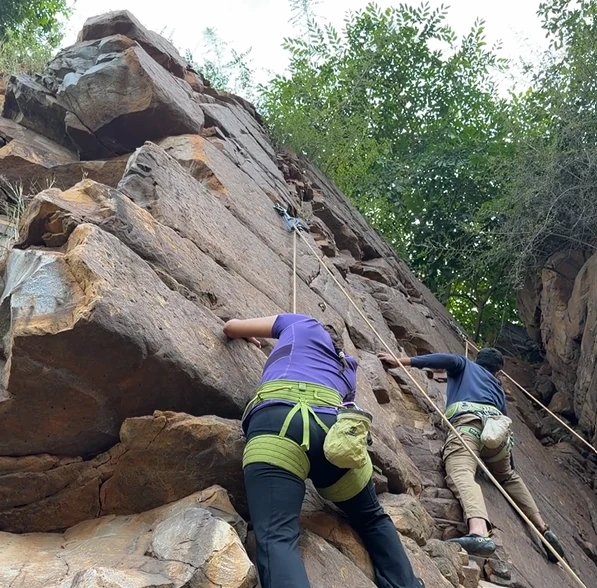
The climbing spot was tucked deeper into the Aravalli forest. Four to five routes had been set up, with anchors along several near-vertical rock faces. The crack-climbing routes were the toughest of the lot.
Before we began, Sachin took a few minutes to walk us through the basics: how belaying works, how climbers make their way to the top, foothold techniques, and why chalk powder is essential. The crew provided specialised climbing shoes to us. Lightweight and flexible, they allow your toes to manoeuvre into narrow footholds, while their soles provide the grip.
Then came the demonstration. A second-timer volunteered to go first, while the rest of us watched closely, studying every foothold and hand movement. Several people in the group had climbed here before, some for their fifth session or even more. Me? This was my first ever attempt.
The moment I took my first step onto the rock face, I understood why climbers keep harping on about a pre-warm-up. My fingers and toes were suddenly doing jobs they hadn't trained for. The second step was easier (beginner's luck), but by the third, things had got considerably more interesting. By the time I reached my sixth step, I looked down to figure out where to place my feet next.
Nothing. I couldn't spot a foothold. At that much height, falling wasn't an option. I felt like giving up.
A group of faces, tilted almost 90 degrees upwards, watched me with what I can only describe as hopeful expressions. They began calling out directions, helping me spot a crevice I'd missed. The foothold was slightly higher than I'd expected, forcing me to stretch my leg almost completely straight.
I trusted my foot and hauled myself upwards with every bit of strength I could muster. And suddenly, there it was: the marker we were supposed to touch to complete the climb. The moment I reached it, I leaned back into the climbing rope and began my descent, walking backwards down the rock face at a near-90-degree angle.
And just like that, I was back on solid ground. In harmony with gravity. The group made its way back to the main road by 5 pm, before darkness set in. All of this is what gave me the confidence to swim in a pond in the first place.
Looking back, swimming in a pond and climbing a rock face left me with a few bruises. But you know that peculiar, satisfying ache you feel after a long, physically productive day? The kind that leaves you exhausted but also rather pleased with yourself? That was the feeling. Emancipation. Discovering what the body is truly capable of.
Delhi Outdoors organises bouldering and rock-climbing sessions, often paired with a trek to Mangar Lake, every Sunday. For a more accessible climbing spot, the group sometimes heads to Sanjay Van instead. The easiest way to join the adventure is to follow them on Instagram, where they share registration links for upcoming sessions. Expect to shell out around ₹1,000 per session.
Discover Time Out original video