[category]
[title]
At NGMA Delhi, a six-decade retrospective follows one of India’s first major printmakers through etchings, paintings, watercolours and small bronzes, until November 24.

Last century, in Europe, the philosopher Walter Benjamin worried about the age of mechanical reproduction: that the copy, sold or displayed endlessly, would hollow out the artwork’s aura and its worth. Some thirty years after that seminal essay, back home in India, Anupam Sud began her life’s work in the artists’ village of Mandi, Delhi. Today, at 82, she is known as one of the country’s first pioneers of printmaking. It is laborious work. A block, plate or screen is carved and etched into, ink is slathered over it, and the whole thing is pressed onto paper (or whatever else will have it), yielding many impressions of the same image. After close inspection, some are chosen, and marked in pencil.
This is why Group 8, the printmaking collective she was the youngest founding member of at the College of Art in Delhi, raised eyebrows. Printmaking was considered repetitive, a poor cousin of the singular, unrepeatable work. Not original enough, and too expensive. Two wars had come and gone, and there was a shortage of metal. Sud herself had accidentally gotten into it through an unpopular elective at college, according to a 2011 Artetic article, and was not sure of the future. Her professor, Jagmohan Chopra, built a machine for the group from scratch. As is the case so often in a Delhi public college, a distinctly individual voice was born from a kind other hand.
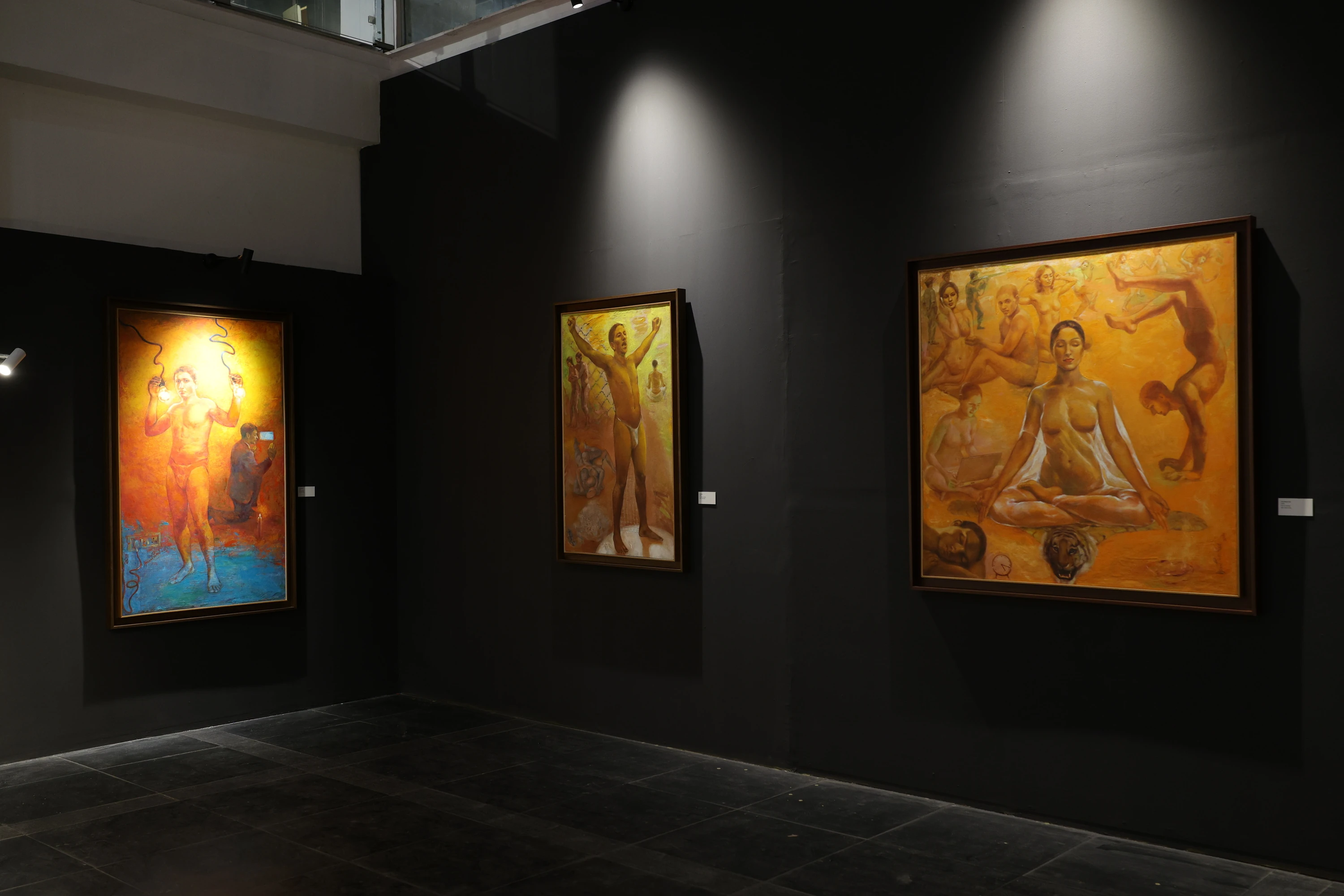
Now the National Gallery of Modern Art and Dhoomimal Gallery are presenting In the Etched Trace of Time: Six Decades of Anupam Sud, on until November 24. It gathers work from across her career: early pencil and red-and-blue sketches, paintings, etchings, watercolours, small bronze sculptures, and assorted experimental commissions. The show has no interest in marching you through the decades in orderly fashion. By the time I spoke to curator Archana Khare-Ghose, I had already noticed certain characters in Sud’s work multiplying, vanishing, and returning, across mediums and decades. Which way you turn will decide how you come to know her work, and how it grew.
There is merit, the show seems to say, in obsessing over a tiny dot or line for the eleventh time. It may end up as the perfect frame. Or it may give way to women with bats, men being tossed into frying pans, a tiger sharing space with a laptop, and a graveyard that dissolves into floating bodies. There are butterflies, helicopters, teapots, electronic circuits and the occasional skull, painted with unusually realist, physically striking detail, and the lighting of days on earth. Archana tells me that Sud has always straddled the traditional and the contemporary, bringing a fierce voice to her training in painting at the College of Art. ‘To understand art, it takes a lifetime. Your atma can get suffocated just trying to understand what is art.’ This delightful little warning greets you at the entrance, in Anupam Sud’s own words.
The enormous human figures are hard to leave alone. Women appear again and again. In Looking for Another Goddess, a woman in lipstick stares out of the canvas. In one corner, a Kali. Elsewhere, another woman holds a bat. A tiger occupies the space behind them, while patterns and unexpected details jostle for your attention. Sud’s engagement with feminism is evident, as is her wary eye on the rise of the retail store: empty Coke bottles litter one painting, like evidence.
But the show also reminds you that she refuses the word activist. Some of the figures are people she knows. The masks that cover faces in some works can be traced to a workshop in Tokyo, where she encountered Noh theatre. During the pandemic, she made a pair of paintings from an impression created by driving a car over mud in a hollow outside her house: a man, and a woman accompanied by a sparrow. I’d rather think of Sud as an artist who collects things, and lets her obsession lead her into the not-always-palatable, the not-always-reconcilable, and calls it a style.
I was equally captivated by a collaborative work made with children at Jawahar Bal Bhavan, which sits alongside animal studies, compositions on the twelve zodiac signs, and a reworking of a Ravi Varma figure. This is not someone who cared much about defining a movement.
Her technical command, it can’t be denied, is clearest in the oranges and greens of her paintings and the sequences of prints, where you can follow a single composition through successive impressions and additions of colour. A figure changes. A hand appears. Smoke curls in. A face grows more pronounced. Several impressions of works-in-progress have been preserved too, even when they are mere pencil lines.
These, too, show someone who kept testing the limits of her medium, though never for the sake of provocation. Resting, the last painting Sud made before leaving for the Slade School of Art in England, shows a graveyard, crosses, and a blue void above. Its successor, painted after her return, is Window: bodies floating before a window, together, but not clamped. Archana points out that an English education did not cause Sud to suddenly turn tail on what she had grown to draw and paint. It was always a return to the same work, the same preoccupations.
In Out of the Frying Pan into the Fire, a woman smirks as she tosses a heap of metallic-looking men into a vessel. She looks pleased with herself. It is difficult not to be pleased with her, too. Between Vows and Words plays with figures and words like instinct, tenderness, freedom and desire. And with duality, which jumped out at me because of the sheer number of works that are, at heart, about two people, from sketches to prints.
By the end, the figures feel familiar. You begin to see what you missed the first time. By the end, I feel I have met someone blunt, someone who might abruptly return to her study in the middle of tea, knowing full well that I will wait. For a retrospective that offers little explanation beyond a small introduction and the odd quote, this is tremendous.
Where: The National Gallery of Modern Art. Enter through Gate 3.
When: Until November 24, 2026.
Opening hours: Tues-Fri: 10am-6pm. Sat-Sun: 11am-8pm. Closed on Mondays and public holidays.
Entry: ₹20 for Indians, ₹500 for foreign nationals. You can book online through a scanner at the gates, so don’t worry about queues.
Discover Time Out original video