[category]
[title]
Curated by Shaleen Wadhwana, the Exhibit320 show brings together diverse works exploring Partition, migration, borders and inherited memories.

Abstract art so often gets filed under ‘incomprehensible’. Plenty of people can’t stand subjective art, the kind that refuses to hand you a manual on what to feel.
These are the gallery-goers who walk in asking: Why are there random lines on that paper? Why is this giant piece of cloth hanging from the ceiling? And the classic: What exactly am I supposed to see here?
Fair enough. Not every exhibition speaks to everyone. Sometimes, subjectivity can take viewers so far from the work that the actual theme gets lost.
Mool at Bikaner House, Delhi, sits somewhere between the abstract and the accessible. You may understand it. You may not. But above all, it asks you to feel.
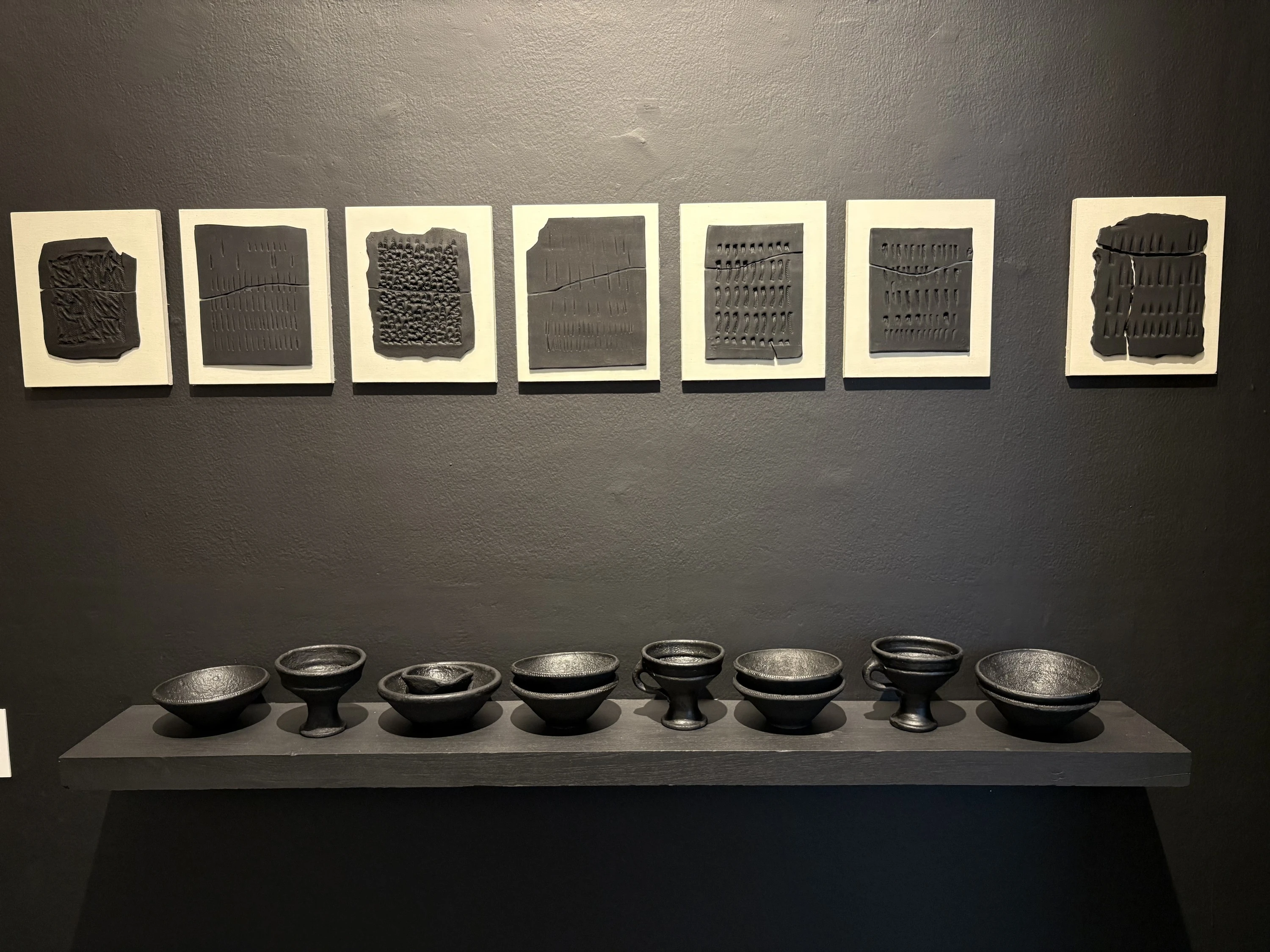
The exhibition’s biggest draw is its sheer range of media. Personal objects, indigenous textiles, mud, wood, charcoal and alloy work sit alongside ink sketches, archival photographs, watercolours, sculpture, ceramics, 3D printing and assemblages.
Spread across two floors, Mool rewards wandering rather than speedrunning. Give it 1-2 hours, and leave behind the urge to immediately decode what you’re seeing.
The exhibition’s most powerful summation comes on the second floor: a huge wall mapping different national borders. On paper, these are just lines. But for families, they can mean generations spent negotiating where, and what, home is.
At its heart, Mool (meaning 'roots' in Devanagari) is about belonging, borders and what happens when borders split families apart.
Curated by Shaleen Wadhwana and presented by Gallery Exhibit320, the exhibition brings together works by around 20 Southeast Asian artists. Each contributes an object, image or material connected to their family history.
The show is divided into four themes: Community, Soil, Body and Script, with artists including Gunjan Chawla Kumar, Arpita Akhanda, Chudamani Clowes, Mahavish Chishty, Naira Mustaq and Hema Shironi.
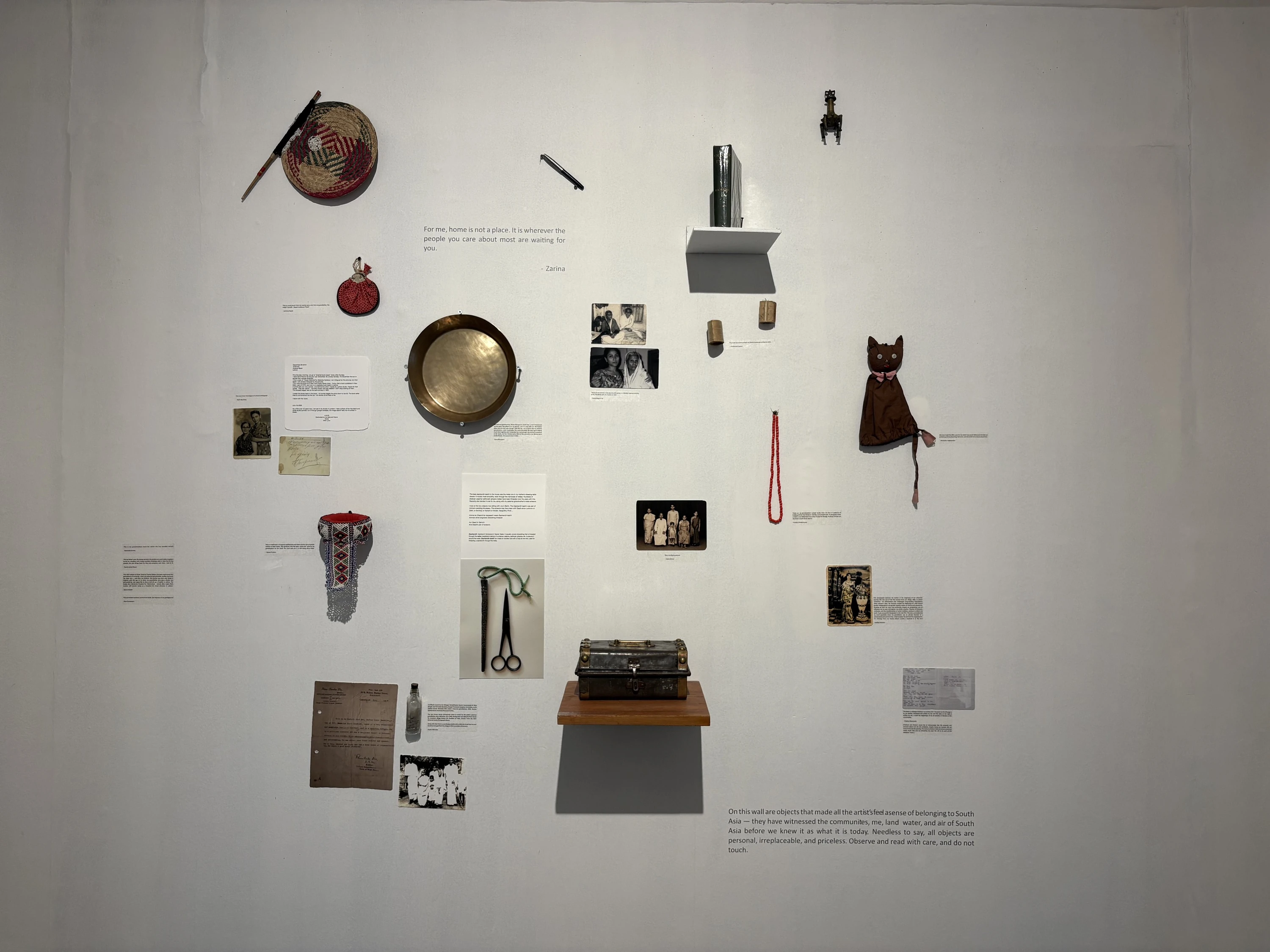
The exhibition opens with personal artefacts displayed along a white wall. Look closely, and you’ll find 20th-century combs, hand-stitched dolls, handwritten notes and cooking pots.
They’re ordinary things, yes. But removed from their homes and placed inside a gallery, they become records of families whose lives were disrupted by Partition.
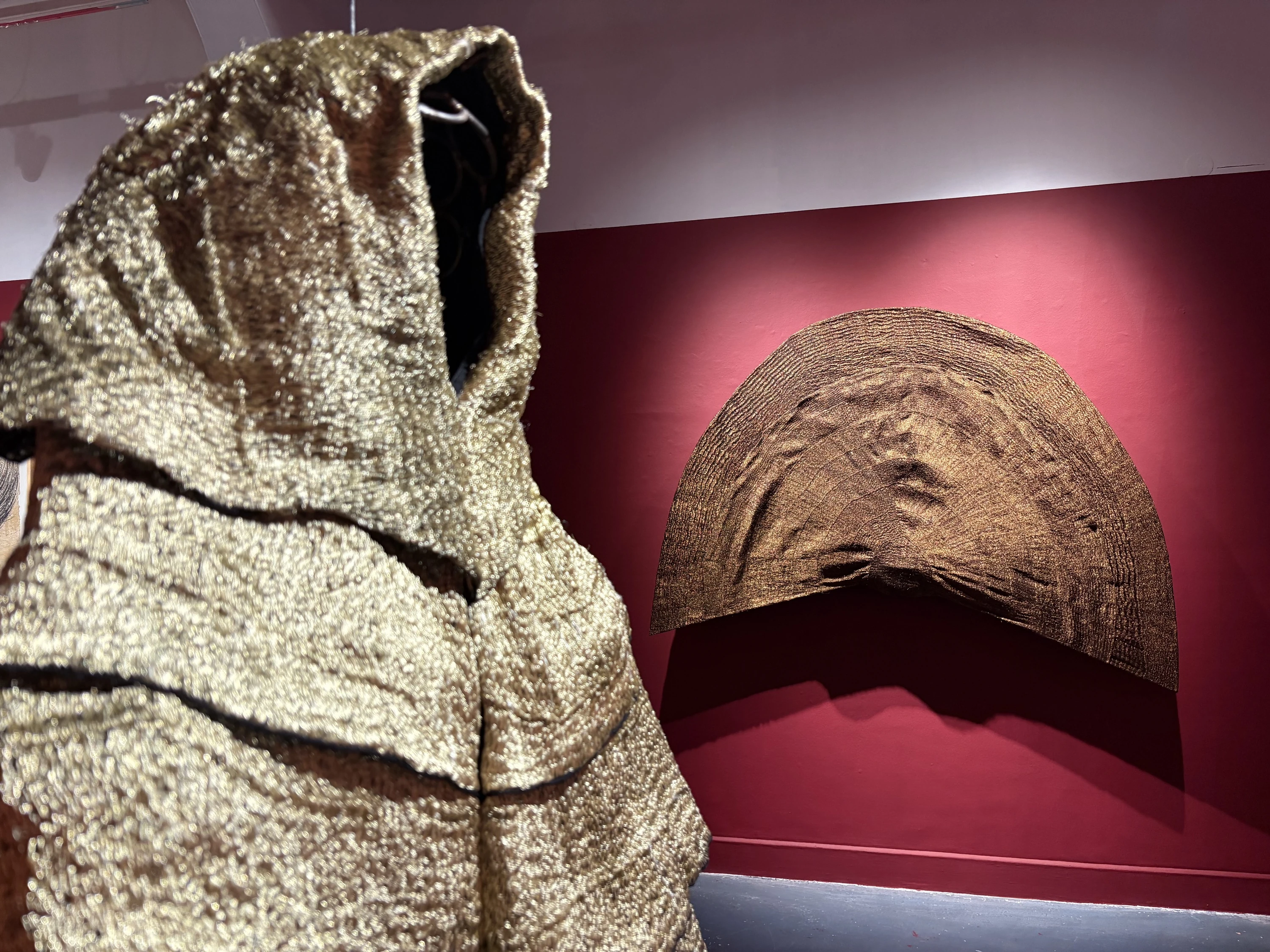
To the right of the entrance corridor, the mood shifts dramatically. A deep-red wall houses three-dimensional works, including a striking female shroud made from blades. Nearby, another work unfolds a burkha into a fan-like form, evoking ideas of freedom.
Move into the opposite hall to find charcoal works on cotton cloth that create a landscape of marks, scratches and gestures. This is exactly where you can flex your intellectual muscles the most.
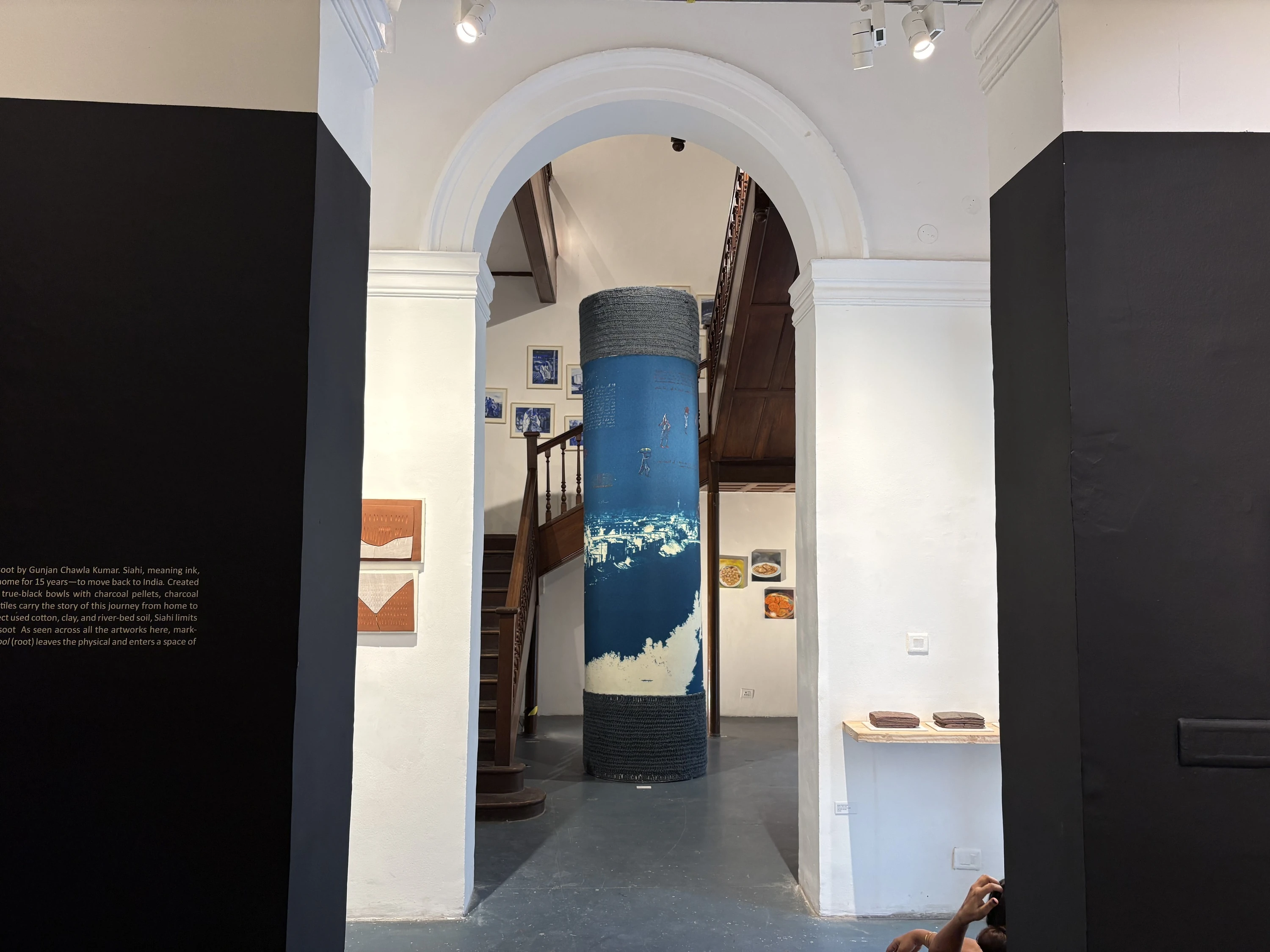
Then, almost suddenly, you encounter a floor-to-ceiling pillar surrounded by a wooden staircase. The blue wall along the staircase carries pinned sketches of caricatures you’ll find across Southeast Asia.
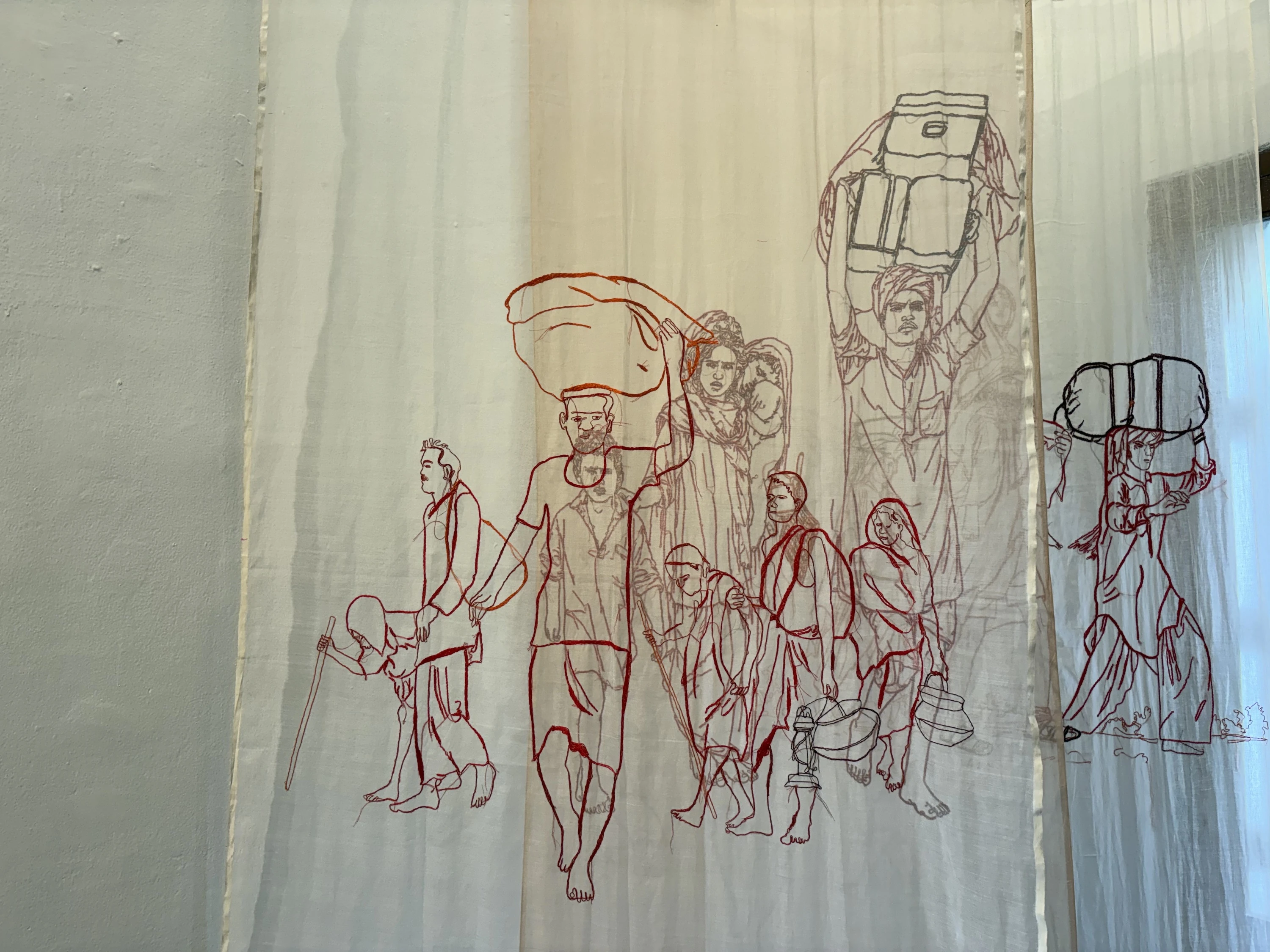
The second floor is where Mool gets heavier. At first, embroidery and weaving, along with patchwork textiles, display fragments of Southeast Asia, including Nepal, Ceylon (the former name for Sri Lanka) and Cambodia.
A complete hall on this floor is dedicated to a giant wall of maps, each depicting national borders. The one I mentioned in the beginning.
The final hall brings the exhibition to its heightened conclusion. A quilt recalls the handmade textiles of South Asian homes. Behind it, a series of photographs of a woman complicates the conventional image of a happy married life.
Understanding Mool is one thing. Feeling it is another.
The colours, weaving styles, knitting patterns, threads and fabrics carry a distinctly Southeast Asian visual vocabulary. If you’ve lived in, travelled through or grown up around this part of the world, some of these details may feel instantly familiar (or nostalgic).
A pattern might remind you of something in your grandmother’s trunk. A fabric may look like one you’ve seen at an old relative’s house. Hindi, Bengali and other regional scripts appear in between, too. An immersive sound section, in association with Upstairs, gets you be amidst the sound of running waters.
In all, familiarity is central to the exhibition. Mool doesn’t always ask you to understand Southeast Asia. It asks you to recognise its textures, colours, patterns and memories, and, for a moment, feel at home in them.
Time Out tip: Arrive hungry. The Haldiram’s store right by the gate has a generous Indian spread and a rather promising view.
When: 10am to 6pm. Until August 13.
Where: Bikaner House, Pandara Road, New Delhi–110003.
Ticket: Free (Walk in)
Discover Time Out original video