[category]
[title]
Time Out Cape Town got the inside scoop on where the photo was taken, and why it made the cover!


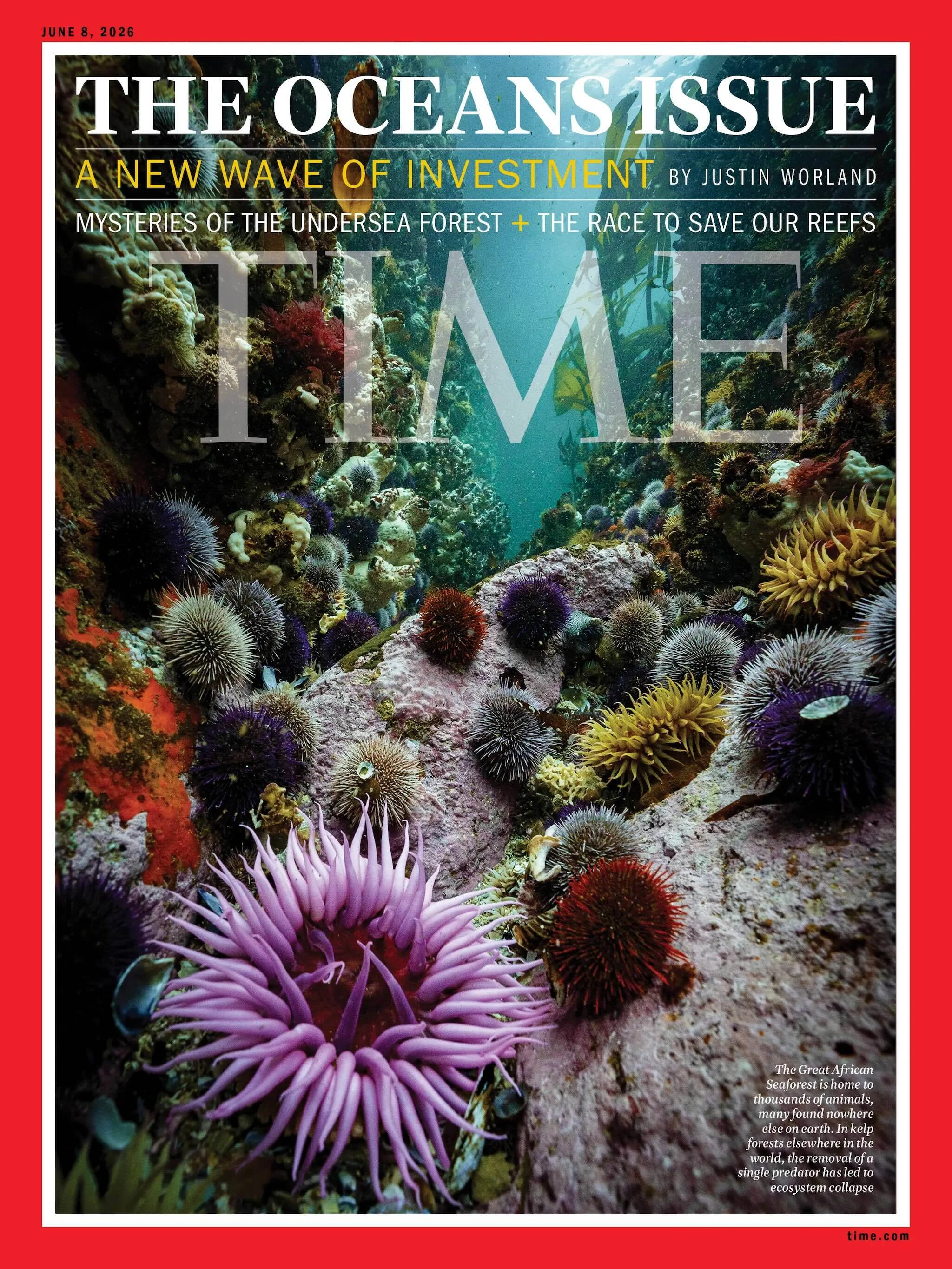
If ever there was a time to buy a copy of TIME, it’s now. This week, the Great African Seaforest – the vast underwater kelp forest that fringes the Cape Peninsula and extends north along the west coast towards Namibia – features as the cover story of TIME’s ocean-focused edition.
With a spectacular photograph by Cape Town-based freediver and underwater photographer Helen Walne, the feature – titled ‘The Power Hiding in Underwater Forests’ – puts a global spotlight on one of South Africa’s most extraordinary natural wonders.
Whether taking a dip in a tidal pool or wandering the coastline, most Capetonians rarely give the kelp forests a second thought. But this cold-water forest of sea bamboo plays host to – and supports – a remarkable diversity of sea life, from sharks, seals and cuttlefish to nudibranchs, limpets, rock lobster and abalone. With roots clinging to rocky reefs to withstand the pounding swells that hit the Cape Peninsula, these towering trunks and sunlight-soaking fronds create a three-dimensional habitat for thousands of marine species.
Fed by cold, nutrient-rich upwellings along the Cape coast, the Great African Seaforest is considered the world’s only giant sea bamboo forest, dominated by sea bamboo – Ecklonia maxima – and split-fan kelp.
It’s not the first time these kelp forests have made global headlines… this is also the underwater world made famous by the Oscar-winning documentary ‘My Octopus Teacher, which was filmed in the forests around the Cape Peninsula and introduced global audiences to the intelligence of the octopus, and the beauty and fragility of this ecosystem.
TIME’s feature looks beyond the postcard beauty, using the Great African Seaforest to explore why kelp forests matter in a warming world. Around the planet, these underwater forests are vital nurseries and feeding grounds for marine life, help sustain coastal fisheries, soften the force of rough seas along exposed shorelines and absorb carbon. But many are also under pressure from marine heatwaves, pollution and coastal development.
According to TIME, which drew heavily on the work of Cape Town-based Sea Change Project, Save Our Seas Foundation, and the 1001 Seaforest Species project, the Cape’s kelp forests have so far proven surprisingly resilient, with some research suggesting that the Great African Seaforest may even be expanding.
Before TIME’s global readers turn the page to discover the forest, they’ll be drawn in by Walne’s photograph. Here, the purple tentacles of a sea anemone seem to beckon the reader to take a deep breath and venture further: to swim through the rocky canyon – mind the sea urchins! – and dive into the fronds of the sea forest. With ethereal light from above, and a Crayola box of colour below, it’s impossible not to be entranced by the beauty of the Cape shores.
"That particular site in the forests is one I’ve been visiting for the last eight years. It’s around the back of a massive rock, and what drew me to it was the pinky-purple anemone, because it’s such an unusual colour for that area," Walne told Time Out Cape Town in an exclusive interview. "I would go and visit, and it became almost like family, or a friend. The other day I was saying to a friend, I wish we could talk, the anemone and me, so I could say ‘You’re famous!’"
Walne took the now-famous photograph at a site called A-Frame, which is close to Boulders Beach outside Simonstown.
"That site can get a bit smashy when the swell is big, so I’m not able to visit every day, but if I could, I would!" adds Walne. "But it’s a place that I visit a lot. I have these places in the sea forest that I call shrines, and I have various shrines that I repeatedly go and visit. This one is very special for me, mainly because of that anemone. It’s just such a striking colour."
What might surprise some readers is that it's not the photograph you'd expect for a story about kelp forests. Except for one frond drifting into the top-right corner, there's little of the actual forest on display. But for Walne, it makes perfect sense: "There was a big selection of images, and I think they chose this one because the feature is about the biodiversity of the great African seaforest, and that image depicts just how dense and abundant the biodiversity is in our forest. We’re so lucky to have it, because many of the sea forests around the world are struggling, and we have one of the most intact sea forests."
For Cape Town, the TIME feature places our marine wonders in front of a global audience, and reminds us that – in a city famous for its towering mountain and manicured vineyards – perhaps the greatest natural treasure lies beneath the waves.
Sign up to Time Out Cape Town's free newsletter for expert recommendations on new things to do, see, eat and drink in the Mother City. You can also follow Time Out Cape Town on Facebook, Instagram and TikTok!
Discover Time Out original video