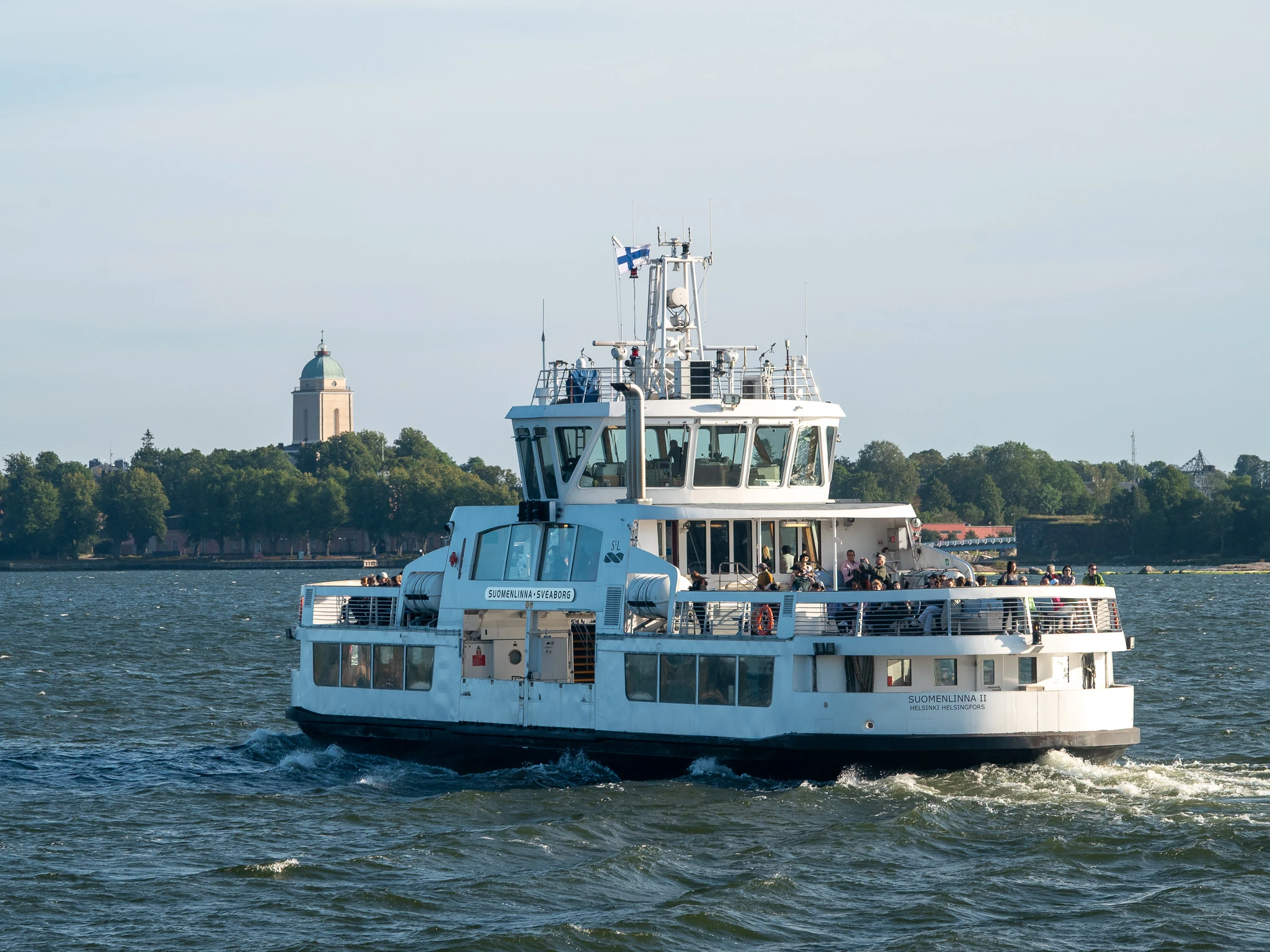
If you only have time for one sight in Helsinki, make it Suomenlinna. Originally known as Viapori, it’s the world’s largest sea fortress. In fact, you will get several attractions packed as one. You’ll tick off a UNESCO World Heritage Site, and you’ll also get to enjoy a short but glorious ferry ride from right outside the city centre. As the gulls follow your boat, the white silhouette of Helsinki Cathedral slowly fades behind you.
Once ashore, you’ll find imposing stone walls and mysterious tunnels, perfect picnic spots with sweeping sea views, a historic submarine, a handful of museums and even a small sandy beach.
Suomenlinna is like a tiny town floating in the middle of the sea. Its ramparts have guarded Helsinki since the 18th century, and today around 800 locals still live there, complete with their own nursery and primary school sheltered within the fortress walls.
How much does it cost?
There’s no entrance fee to Suomenlinna itself; you only need to pay for the ferry ride. Some of the island’s museums charge admission, but you can easily enjoy Suomenlinna free without stepping inside a single one (and most visitors do exactly that). To really get the most out of your trip, join a guided walking tour.
How do I get there?
Antti HelinFerry to Suomenlinna
The Suomenlinna ferry runs year-round from Kauppatori (Market Square), and you can hop on with a standard public transport ticket. Tickets are valid for 80 minutes, so if you’re planning to stay longer – which you almost certainly will – remember to buy another one for the return trip. The ride takes about 15 minutes. In summer, ferries depart roughly every 30 minutes, while in winter it’s about once an hour. They start running early in the morning and continue well past midnight.
Public ferries dock at the island’s north shore, but in summer private FRS waterbuses also run from Kauppatori straight to the southern tip at Kustaanmiekka (€4.60). One neat trick: take the public ferry one way and the waterbus the other to avoid walking back across the whole island.
Can you stay overnight?
Most people visit Suomenlinna by day, but it’s also possible to spend the night. Right next to the ferry pier you’ll find Hostel Suomenlinna – simple, but cosy and atmospheric.
Are there restaurants on Suomenlinna?
Yes, quite a few. The best-known is Suomenlinna Brewery Restaurant, right by the ferry pier, where you can sample local beers alongside hearty pub fare. A short stroll away, Café Vanille serves coffee and cakes in a charming wooden house. For atmosphere, though, nothing beats Cafe Bar Valimo, tucked beside the old shipyard in one of the fortress’s most evocative corners.
Why was Suomenlinna built?
This mighty sea fortress was begun in the 18th century to protect the Swedish kingdom from Russian expansion to the east. Its designer, Augustin Ehrensvärd, was an Enlightenment-era military architect who dreamed of creating not just a fortress but a whole island city, complete with harbours, barracks and a dockyard.
The dream didn’t last. When Russia attacked during the Finnish War in 1808, the defences were unfinished and the garrison undermanned. Suomenlinna surrendered without a fight, and soon Finland itself was annexed into the Russian Empire for over a century. Only after independence in 1917 did the fortress get its current name Suomenlinna, the Castle of Finland.
Been there, done that? Think again, my friend.
🙌 Awesome, you're subscribed!
Thanks for subscribing! Look out for your first newsletter in your inbox soon!
Things to see and do in Suomenlinna
Suomenlinna Church and lighthouse
Originally built as an Orthodox military cathedral crowned with onion domes, the church was converted to Lutheran use after Finland’s independence and the domes were removed. It doubles as a lighthouse, its beacon still guiding ships through the waters around the island.
Military Museum Manege
Housed in former riding stables for the fortress’s officers, this museum covers Finland’s 20th-century conflicts: the Civil War, Winter War, Continuation War and Lapland War. Exhibits focus on the experiences of ordinary soldiers and civilians, from the Lotta women’s corps and the home front to field equipment and propaganda posters. There’s also a section on Lauri Törni, the Finnish soldier decorated by three different nations: Finland, Germany and the United States.
Advertising
Suomenlinna Museum
A compact but comprehensive look at the fortress’s eventful history under Swedish, Russian and Finnish rule.
Ehrensvärd’s Tomb
Dorit Salutskij
Marked by a stone sarcophagus topped with a Greek soldier’s helmet, this is the grave of Augustin Ehrensvärd, the Swedish count, soldier and statesman who designed Suomenlinna. The helmet, bold and classical, lends the tomb an imposing, heroic air.
Advertising
Viapori Dockyard
In the fortress’s dockyard, warships were once built for the Swedish navy. These days, the same slipways are used to restore historic wooden vessels.
Submarine Vesikko
Dorit Salutskij
Completed in the 1930s, Vesikko is the only surviving Finnish submarine from the Second World War. Step inside and you’ll find the cramped interiors still radiate a distinctly claustrophobic atmosphere.
Advertising
Suomenlinna Beach
Sheltered by rocky cliffs, this small sandy beach is the perfect spot to round off a summer’s day on the island. From here, paths lead straight into the Kustaanmiekka area.
Kustaanmiekka and the King’s Gate
Jussi Hellsten / Helsinki Partners
At the far end of the island lies Kustaanmiekka peninsula, arguably the most atmospheric part of the fortress – well worth the walk. Here on the southern shore, the scenery is at its most dramatic: waves crash against the rocks, cannons stand guard and big cruise ships might glide past through the narrow strait, just a few metres away.
Across the water sits Vallisaari, a wilder counterpart to Suomenlinna. Within Kustaanmiekka itself you’ll also find the ceremonial entrance to the fortress, the King’s Gate, built to mark a royal visit by Sweden’s King Adolf Fredrik. The king never came – his loss. Suomenlinna is far too fine a place to skip.
Been there, done that? Think again, my friend.
🙌 Awesome, you're subscribed!
Thanks for subscribing! Look out for your first newsletter in your inbox soon!
Been there, done that? Think again, my friend.
🙌 Awesome, you're subscribed!
Thanks for subscribing! Look out for your first newsletter in your inbox soon!
By entering your email address you agree to our Terms of Use and Privacy Policy and consent to receive emails from Time Out about news, events, offers and partner promotions.
🙌 Awesome, you're subscribed!
Thanks for subscribing! Look out for your first newsletter in your inbox soon!