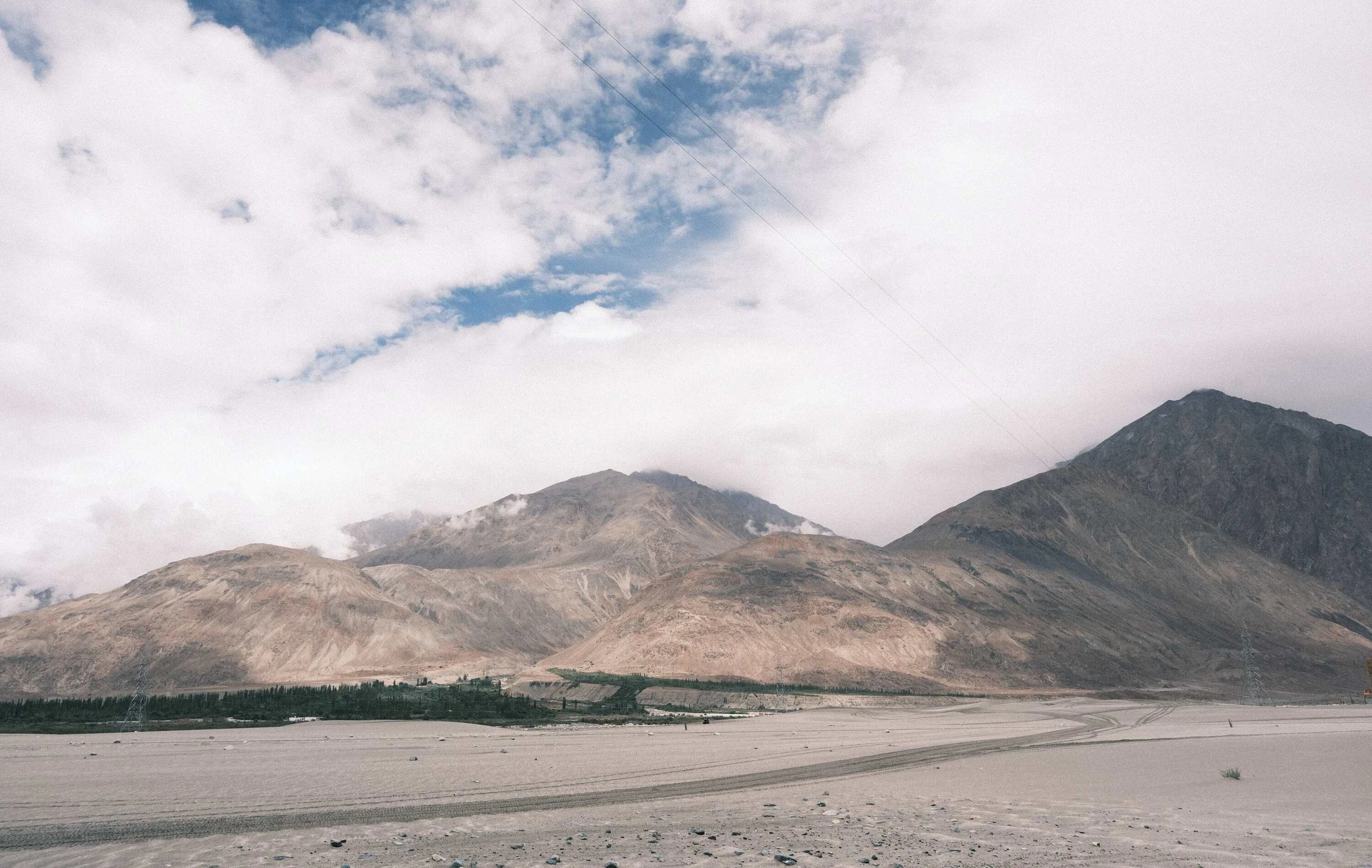
After just three days into my month-long stay in Ladakh, I realised this was no ordinary Himalayan getaway. Ladakh is far less polished than the rest of the Indian north. It's landscape after landscape of pure rugged beauty – of rogue mountains shaded brown to deep violet, of winding rivers and starlit skies, great swathes of sand and snow. And it's on this pretext that I'd say there's no better way to experience the Himalayas than on a bike.
Don't get me wrong – touring Ladakh is tough and not for rookies, especially on a bike. The weather's dry, and oxygen levels and low enough to upset your gut or trigger Acute Mountain Sickness (AMS) on day one. Facilities that a city girl like myself would take for granted, like ATMs, petrol pumps and food joints, are few and far between. There are empty stretches where you spot absolutely nobody for as for as your eyes can see. But that's precisely what makes Ladakh an outstanding destination to tour – not just for Indian travellers, but also for visitors from abroad.
And the views are, of course, the icing as well as the cherry. Towering mountains pierce through the clouds, turning golden or steel grey, depending on the light. The rivers and waterfalls are so young that they're almost foamy white, while the lakes are strikingly blue.
Why is biking the best way to soak in Ladakh?
Though Ladakh did take a few decades to get biker-ready, it's now home to some of the world's highest motorable passes, including Mig La (the world’s highest motorable road) and Khardung La.
There's a practical side to it too. Public transport can be scarce, even around the main city, so having your own wheels gives you the freedom to explore whenever and wherever you fancy. Compared to hiring a car, biking around Ladakh is easier on the wallet, too.
Photograph by Nitya ChoubeyBank of river Shyok
The best time to go biking in Ladakh
May to August is generally a good time to hit the road. This is also when the weather is particularly pleasant, with most rivers swelling after glacial melt. Some bikers might find it tempting to off-road through little streams along the way.
If you decide to ride between May and July, you’re more likely to encounter peak crowds thanks to the school summer holidays. August to September may be better if you want clearer weather and less traffic, though the rivers tend to turn muddier in this season, with relatively few episodes of rain.
Can you bike in Ladakh during the winter?
September's really the tail end of when you should be planning a biking trip to Ladakh. After that, it's far too cold, and that’s a stunt this guide won’t be exploring. It requires serious physical endurance, specialised gear, years of experience and, of course, skills.
Editor’s note:Biking in Ladakh can almost immediately feel like a bit of a boys’ club. So this guide is designed to encourage more female riders, and even senior citizens, to get on two wheels!
Been there, done that? Think again, my friend.
🙌 Awesome, you're subscribed!
Thanks for subscribing! Look out for your first newsletter in your inbox soon!
Planning your Ladakh biking trip
Prepare your body for the strenuous bike rides
Photograph by Nitya Choubey
A little preparation goes a long way, especially for bikers. Exercise your back regularly and get plenty of sleep in the days leading up to your trip. Try getting into the habit of waking up early, since most riding days should start with the sun. Start having a hearty breakfast, and include plenty of nuts for natural warmth inside your body. Once you reach Leh, give your body at least a day to acclimatise before hopping on the wheels.
Get your ILP and other permits sorted
Check whether you need an Inner Line Permit (ILP) for the routes on your itinerary. Several popular stretches pass through protected border areas and require permits. They’re generally inexpensive and quick to obtain. You can even apply through the official Ladakh ILP portal or at the district collector's office in Leh.
Advertising
Plan for routes and download maps
There are two main motorable routes into Ladakh: the Manali–Leh Highway and the Srinagar–Leh Highway. If you’re starting from Manali in Himachal Pradesh, the route is shorter but generally more rugged. The Srinagar–Leh Highway, on the other hand, is smoother and takes you through Zoji La, offering a gentler introduction to Ladakh.
Once you’ve chosen your route, download maps for offline use and carry a power bank.
Time Out tip: For easy navigation, keep an eye out for signboards put up by the Border Roads Organisation (BRO). They’re mostly practical, but occasionally philosophical too! One proverb you’ll likely spot along the road, for instance, is 'Don’t be a Gama in the land of Lama.' Wise words, because Gama refers to Gama Pehalwan, the legendary wrestler from undivided Punjab, known for his formidable strength and courage. A lama, meanwhile, is a Buddhist monk or spiritual teacher. The message is simple: however strong, brave or confident you think you are, don’t get cocky in the mountains.
Pack sturdy but light
Pack absolutely light. You might be carrying your own luggage on the bike.
Here are some essentials you can keep handy: sunscreen, oxygen-regulating medications like Diamox and a pain-relief spray. The first few days of riding might leave your back complaining.
If you’re heading to high-altitude passes such as Khardung La, where snow is common, pack disposable heating patches. Your frozen fingers will thank you for this.
Also, remember that your riding gear is just as important as the bike beneath you. Pack a good windcheater jacket and riding trousers, a sturdy, well-fitting helmet, knee and elbow pads, and high-ankle riding boots. Don’t be surprised if all this saves your life there. For the monsoon not to catch you off guard, pack a raincoat and a few plastic sheets to keep your luggage dry.
Time Out tip: As a biker, you’ll be venturing into some pretty remote territory, so carry extra cash and keep a tow rope handy.
Advertising
Are you solo biking or riding in a group?
Photograph by Nitya Choubey
You can absolutely bike solo in Ladakh, especially if it’s your second time around. But even seasoned riders are better off huddling together when tackling trickier trails, such as the Umling La pass.
One can also leave the logistics completely to someone else; guided biking tours are another option. Operators such as Deyor and Golden Eagle Expedition offer packages that typically cover accommodation, food and bike rentals, and are generally easy on the pocket. Many also let you customise your trip: from where you’d like to start to the bike you want to ride.
The biggest perk of going guided is that you get a marshal. This is a local rider who knows the terrain and routes like the back of their hand.
Some biking groups also come with a support vehicle carrying an oxygen cylinder, basic gear, a mechanic and your luggage. And when your legs, or your bike, have had enough for the day, you can simply load it onto the vehicle and call it a ride. Just make sure your support vehicle comes with a suitably hefty boot.
Find the best bike to hop on
Photograph by Nitya Choubey
Plenty of bike-rental services operate between Srinagar, Manali and Leh, so you can kick off from any of these spots. A decent 200cc-plus bike will cost you roughly ₹3,000–₹5,000 a day.
Bringing your own bike is definitely an option, too. Just remember to carry your vehicle’s Registration Certificate (RC) and insurance papers. Your reliable city bikes (think Pulsars and Hero Hondas) come in the 150cc range. These might be great for the daily commute, but Ladakh’s slopes are a different beast. For these roads, we’d recommend going for a 200cc-plus bike. The extra grunt makes mountain climbs easier, offers better ground clearance for crossing streams and is more comfortable when the road suddenly turns into boulders and rocks. If you’re travelling with a pillion, having a bike in this category becomes even more important.
The reigning favourite among operators in Ladakh is the Royal Enfield Himalayan, which is pretty much built for this terrain. The KTM 250 and 390 Adventure series are also popular choices there.
Time Out tip: Before starting your trip, spend some time getting to know your bike. Learn the basics: changing a tyre, putting the chain back on and making minor repairs. There are plenty of YouTube tutorials to help you swot up beforehand. Because once you’re stranded on a remote stretch, patchy internet may not help much.
Things to keep in mind while biking
Be ready for the long hours
Photograph by Nitya Choubey
Be prepared to spend six to seven hours on the bike every day. Our advice is that you start early to make the most of the daylight. And, ideally, reach your destination before dark.
It's important to fuel up whenever you can. There aren’t many petrol pumps across Ladakh. Leh is one of the best places to do this before heading out on longer stretches.
Thirdly, communicating with other bikers in the group can get tricky on the move. So before setting off, agree on a few simple hand signals everyone understands: for slowing down, overtaking, stopping or flagging an emergency or bad health.
The ultimate Ladakh biking itinerary
Kargil
Photograph by Nitya Choubey
Often considered the gateway between Jammu & Kashmir and Ladakh, Kargil is relatively populated compared to much of the region. The Kargil War Memorial is one of the main attractions, while Dras village, one of the coldest inhabited places in India, is another important stop along the route.
Leh
Photograph by Nitya Choubey
Give yourself at least two days to explore Leh. Stay somewhere near Leh market, where you can wander around on foot after a long day of riding and perhaps grab a drink at one of the city’s few bars, such as Lehchen.
There’s plenty to see and do, from the Leh Palace to gorgeous Shanti Stupa. On the outskirts of the city are Magnetic Hill, Sangam (confluence of the Indus and Zanskar rivers) and Gurudwara Parthar Sahib.
You’ll have to pass through Leh to reach most of the destinations mentioned below, so it makes sense to split your stay in the city around your itinerary rather than squeezing it together. Leh is also where you can stock up on pretty much everything you’ll need for the rest of your trip: from cash and fuel to biking gear and other essentials. We suggest you start your bike tour from here instead of Srinagar and Manali. This will save a lot of your stamina for the actual Ladakh landscape.
Advertising
Nubra Valley
Photograph by Nitya Choubey
Ladakh’s cold-desert landscape becomes green for a short while here, especially if you arrive in spring. One night is enough to see the famous double-humped Bactrian camels and Diskit Monastry. If you have more time, venture further out to explore the hot springs in the area.
Pangong Lake
Photograph by Nitya Choubey
Pangong Lake shot to fame after featuring in 3 Idiots. But the real splendour is beyond just that. The pristine Pangong ‘Tso’ (lake in Ladakhi) freezes over in winter. While during summers, depending on the sunlight, the lake shifts through shades of blue, green and grey.
Part of the lake lies in China. The area is sparsely populated, so accommodation is mostly limited. Don’t expect too much luxury; the conditions here are dry, remote and, well, pretty tough. One night is enough to experience Pangong’s brackish water (go sip it!). You’ll already get plenty of lake time as you ride along it towards your accommodation.
Advertising
Hanle
Image courtesy of Hanle Dark Sky Reserves
Hanle is a tiny village known for its warm homestays. Stay at any local property, where you’ll be greeted with a steaming bowl of soup or thukpa for dinner.
Try to reach Hanle early, check in and give yourself some time to rest. You’ll want your energy later, because the village is one of Ladakh’s best spots for stargazing. It is also home to an astronomical observatory used for research. You can visit the observatory, though you won’t be allowed to get personal with its magnanimous telescope.
Visit the observatory website for fun activites like night sky walk.
Tso Moriri
The road to Tso Moriri is bumpy and rocky (so a lot of off-roading!). The lake itself is the star attraction, surrounded by barren mountains. Spend a night by the lake inside a camp. You might need some extra layers of clothes in the evening hours.
Advertising
Manali
Photograph by Nitya Choubey
If you’re ending your Ladakh biking trip in Manali, the highway saves some of the last few spectacular passes like Rohtang La and Baralacha La. As you move towards Himachal Pradesh, the landscape slowly changes from Ladakh’s stark, brown mountains to greener, forest-covered hills.
Been there, done that? Think again, my friend.
🙌 Awesome, you're subscribed!
Thanks for subscribing! Look out for your first newsletter in your inbox soon!
Been there, done that? Think again, my friend.
🙌 Awesome, you're subscribed!
Thanks for subscribing! Look out for your first newsletter in your inbox soon!
By entering your email address you agree to our Terms of Use and Privacy Policy and consent to receive emails from Time Out about news, events, offers and partner promotions.
🙌 Awesome, you're subscribed!
Thanks for subscribing! Look out for your first newsletter in your inbox soon!