
[category]
[title]
As younger consumers rethink their relationship with drinking, Nabeelah Bahadur’s La Cabonada is making the celebration table more exciting, more inclusive, and considerably more delicious.


The bottles arrive empty.
By the time they leave the production line in Johannesburg South, they are bright red, blush pink, green and gold; filled, capped and labelled for weddings, dinner tables and nights out where, for once, the person not drinking alcohol gets something that does not feel like a consolation prize.
I’m standing beside Nabeelah Bahadur, a 26-year-old accountant by training who now describes herself as a manufacturer, entrepreneur and “overall hustler”.
She co-founded La Cabonada with members of her family after spotting a gap that seems obvious once somebody points it out: why are people who do not drink so often given the least interesting drink in the room?
Behind us, the process begins with properly treating the water. The bottles are cleaned, sterilised and moved along the line. Flavours are measured, machinery hisses, and every part of the process has to happen consistently.
There is something reassuringly accountant-like about the way Nabeelah approaches it all. She understands that a dream only becomes a real business when the numbers, process and product work together. But what she is building is also surprisingly emotional. It is about allowing people to participate without having to explain themselves.
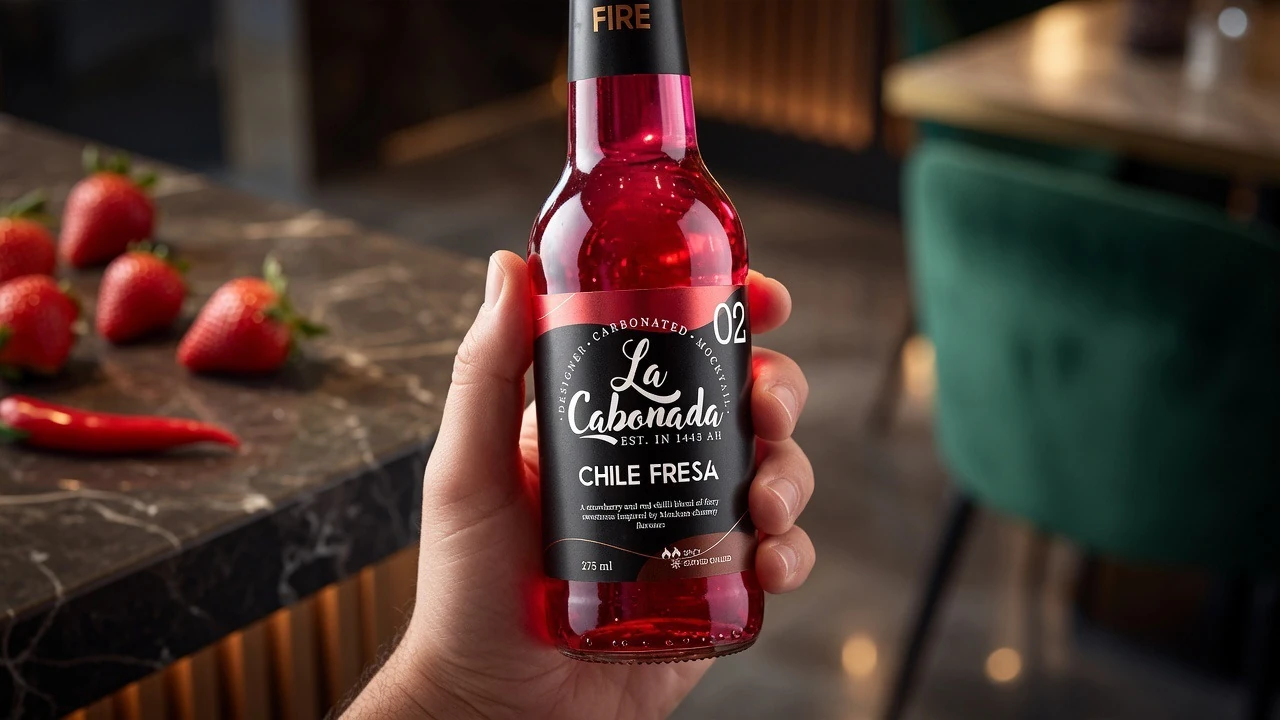
La Cabonada’s core range consists of seven ready-to-drink, non-alcoholic, halaal, and vegan carbonated mocktails, packaged in 275ml glass bottles. The flavours travel: Midnight Cherry takes inspiration from Turkey; Ispahan combines lychee and rose water; Piña Picante brings together pineapple and ginger; and Chile Fresa is built around the strawberry sweetness and chilli heat associated with Mexican chamoy.
And let me be clear: local does not automatically mean good. Supporting South African entrepreneurs cannot mean lowering the bar.
Thankfully, La Cabonada does not ask you to.
I have tasted enough disappointing mocktails to understand the problem. Too many are fruit juice in formalwear: pour it into a tall glass, punish it with mint, add a garnish and suddenly charge cocktail money.
That is not what is happening here.
My starting recommendation is the Chile Fresa. The strawberry lands first, juicy and familiar, before the chilli begins to wake everything up. It is not aggressively hot, but there is enough warmth to keep the drink interesting. The sweetness and heat move backwards and forwards as you sip it, giving you something far more complex than another brightly coloured cooldrink.
The Piña Picante has a similarly clever balance, using pineapple and ginger to create something tropical without becoming syrupy. Ispahan is softer and more floral, with rose and lychee giving it a flavour that feels elegant enough for a wedding table but still easy enough to drink straight from the bottle.
For Muslim South Africans, the importance of this goes beyond whichever wellness trend is currently winning on TikTok.
Not drinking alcohol is not necessarily a temporary challenge, a January reset or a decision made because there is an early gym session tomorrow. It can be an expression of faith and an ordinary part of everyday life.
Yet at far too many weddings, restaurants, launches and corporate functions, the person drinking alcohol is offered theatre: glassware, garnishes, smoke, ceremony and a menu full of choices. The person abstaining is offered orange juice, water or a can of something pulled from the back of the fridge.
A genuinely good halaal drink changes that dynamic from you are ‘accepted’ to you are ‘considered’.
The same applies to designated drivers, pregnant women, athletes, people in recovery, those taking medication and anyone who simply does not feel like drinking. A proper alcohol-free option should not require a medical explanation or any justification. Sometimes you just want something delicious in your hand without alcohol in it.
There is another reason Nabeelah’s story matters.
The official unemployment rate among South Africans aged 25 to 34 reached 40.6% in the first quarter of 2026. For those aged 15 to 24, it was an almost unimaginable 60.9%. Stats SA counted 4.7-million unemployed young people between 15 and 34, with more than three-quarters of them stuck in long-term unemployment.
Those numbers are not abstract to a 26-year-old trying to create a future in South Africa.
“Job hunting in South Africa feels like an extreme sport,” Nabeelah says. “You cannot wait for someone to give you a chance. You have to create it.”
Her philosophy is that when the door is locked, you do not simply keep knocking. You build another door.
It is a powerful line, but it would be easy to turn it into the kind of motivational wallpaper that ignores how difficult starting a business actually is.
Nabeelah is under no illusion about that. Manufacturing takes capital. Food and beverage businesses require compliance, equipment, packaging, logistics, reliable ingredients, distribution and the ability to survive while waiting for a retailer to return an email. Getting onto a shelf is hard. Staying there is even harder.
Her story should not be used to tell millions of unemployed young South Africans that they simply need to hustle more. It should be used to remind banks, retailers, procurement teams, investors and consumers why young local businesses need meaningful access to markets.
La Cabonada is beginning to get that access. Products from the range are listed through platforms including Checkers Sixty60, Takealot and Makro, while a Zambian distributor carries the brand beyond South Africa. Nabeelah says it is already selling in markets including Zambia, Zimbabwe, Mozambique and Botswana.
That is a significant journey for something that began with a family noticing the drinks table at celebrations was not serving everyone equally.
The future of drinking is probably not going to be completely sober or completely boozy. It is going to be about choice. It is going to include people who drink, people who do not and plenty who move between the two depending on the day.
Nabeelah saw that, and now she’s bottling it.
Follow Time Out Johannesburg on Facebook, TikTok and Instagram! While you're at it, sign up for our newsletter to receive even more of the best of your city.
RECOMMENDED:
📍 The best things to do in Johannesburg
🛏️ Where to stay in Johannesburg
🏨 The best hotels in Johannesburg
🍽 The best restaurants in Johannesburg
🍺 The best pubs and bars in Johannesburg
Discover Time Out original video