
[category]
[title]
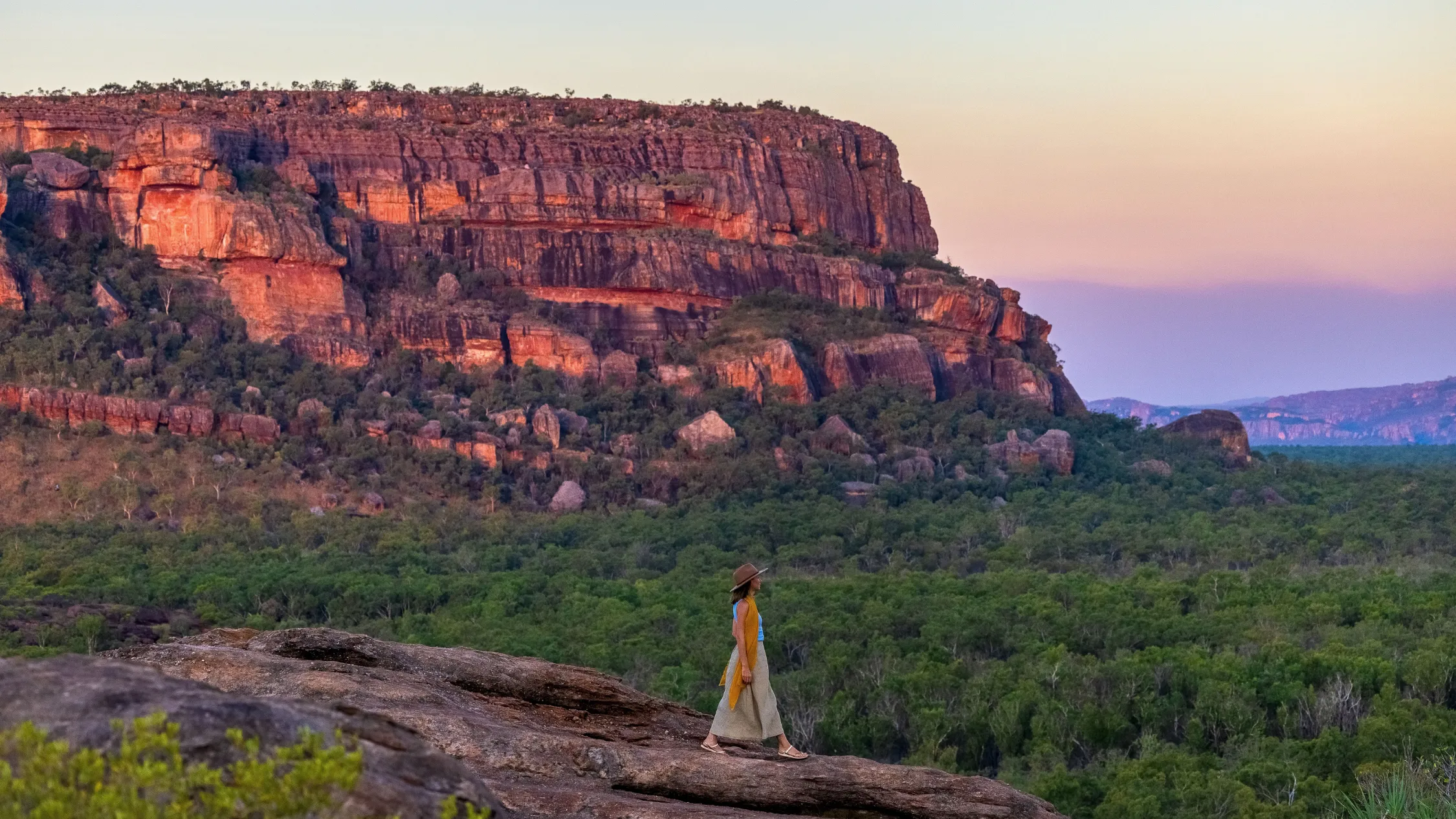
Kakadu National Park is Australia’s second largest, covering almost 20,000 square kilometres



If you’ve ever dreamt of exploring the land before time (friendly dinosaur babies not guaranteed), boy, is there a place out there for you: Kakadu National Park. Tucked into the Top End of the Northern Territory, this World Heritage-listed park has been home to the Bininj and Mungguy people, the keepers of the oldest continuous living culture on Earth, for 65,000 years.
A trip to Kakadu is one that makes you fall deep, and it will stay firmly with you long after you leave. Here’s your ultimate guide to prepare for the trip.
Kakadu National Park is located in the Top End of the Northern Territory, around 171 kilometres east of Darwin.
The drive from Darwin City to Kakadu National Park’s northern entrance takes around one hour and 45 minutes, while reaching Jabiru, the main township, takes around two hours and 45 minutes. Travelling in a 4WD (four-wheel drive) is highly recommended, as the park’s terrain can be rugged and challenging, especially during the wet season.
Kakadu is the second largest national park in Australia, behind the Munga-Thirri-Simpson Desert National Park in Queensland. It covers 19,804 square kilometres, stretching almost 200 kilometres long and more than 100 kilometres wide. To put it in perspective, Kakadu is half the size of South Korea, nearly twice the size of Switzerland or Belgium, and four times the size of Yellowstone National Park.
The Bininj and Mungguy people, the Traditional Owners, have lived in and cared for this land for more than 65,000 years, making it one of the oldest continuously inhabited areas on Earth. Within the park, you’ll find rock paintings up to 20,000 years old and rocks dating back around 2.5 billion years.
Kakadu was declared a national park in three stages between 1979 and 1991. The land’s ancient cultural heritage and natural beauty were recognised internationally in 1981 when Kakadu National Park became protected as a World Heritage-listed site.
Home to Australia’s greatest range of ecosystems, this wild land is a stunning mosaic of savannah woodlands, open forests, monsoon forests, mangrove swamps, tidal mudflats and coastal areas. The park is specifically divided into seven distinct eco-regions, including:
With its ancient rock art galleries, immense red gorges, thundering waterfalls and deep blue pools, you’ll have no shortage of ways to fill your day in Kakadu. First, stop at Bowali Visitor Centre to pick up a national park pass, before plunging into the wilds of the national park, including:
Sleeping under the stars in a World Heritage-listed national park sounds like the stuff dreams are made of – and that's because it is. Kakadu offers a mix of free and paid campgrounds, all available on a first-come, first-served basis. You can also stay in comfort at the Mercure Kakadu Crocodile Hotel, go glamping at Cooinda Lodge, relax in a safari-style suite at Anbinik Kakadu Resort, or share a budget-friendly bungalow at Aurora Kakadu Lodge and Caravan Park.
The Top End of Australia experiences six seasons, with each one bringing something wonderful to the table. The dry season from May to October is the most popular (and arguably the best) time to hit up Kakadu, with most of the attractions open and free from the big floods that come through in the wet. If you like cooler weather and low humidity, head north from mid-June to mid-August in Wurrkeng (the cold weather season), or if you like a bit more heat, go in Kurrung (the hot dry season) from mid-August to mid-October.
Most of the Kakadu region is owned by the Aboriginal Traditional Owners, who have lived on and cared for the park for more than 65,000 years. Kakadu’s Traditional Owners collaborate with Parks Australia to keep the land healthy and protect it from natural disasters, using both traditional cultural burning practices and modern scientific methods.
You can help protect the land by camping only in permitted areas, staying on designated trails and respecting wildlife habitats. Engaging with Indigenous-led cultural experiences also offers visitors the opportunity for a deeper connection to the land and a richer understanding of traditional sites and practices.
Stay in the loop: sign up for our free Time Out Australia newsletter for more news, travel inspo and activity ideas, straight to your inbox.
Discover Time Out original video