



The Hungarian capital is home to Time Out Market Budapest, the culinary and cultural hub that brings the best of the city together under one roof. Located within the historic Corvin Palace on Blaha Lujza tér, Time Out Market Budapest comprises 11 top-class dining outlets, three bars and five event spaces, for some 540 seated guests. Find out more!
What does a Michelin-starred chef eat? Can bull’s testicles be just personal taste? And when is the right time to pass the tasting spoon to the younger generation? These are just some of the topics we discuss with star chef Ákos Sárközi. Over his 30-year career, he earned his spurs at the Michelin-starred Borkonyha, explored a more playful approach at Textúra and has now opened a new chapter with Fúzió – a place where he cooks the very food he himself loves to eat.
Discover our ultimate guide to restaurants in Budapest!
Opened in September, Fúzió is the latest addition to the 11 restaurants at Time Out Market Budapest, which recently celebrated its first anniversary. This is a space where fine dining embraces the freedom of street food, and traditional Hungarian flavours blend with Michelin-quality creativity. We sit down with Ákos Sárközi to talk about his beginnings, his sources of inspiration and what the future holds.
Fúzió opened a month ago at Time Out Market Budapest. How would you assess this initial period?
Overall, very positively. That said, I still harbour some scepticism, as the teething troubles are only just starting to surface. The reception has been fantastic – the guests are lovely, and the other restaurants have been very welcoming – but I’m still constantly thinking about how we could do even better. There are still things to refine but the launch was excellent.
When did your passion for cooking begin?
I grew up in Kőbánya, eating my mother’s cooking – although I have an older sister, I was the one who always ended up helping Mum in the kitchen. I was constantly buzzing around her and I loved assisting her. That’s where my interest began but cooking only truly became a profession and a passion later on – after I’d learned the trade and started working in the industry – influenced by others.
Who, and what, had the greatest influence on you?
My first really formative head chef was Ferenc Nagy. If there was something I didn’t want to taste, he’d chase me all around the kitchen with a spoon! As a young, hot-headed cook, I often clashed with him – I apologised later, of course – but we worked together brilliantly, and I looked up to him a great deal.
Then there was Attila Bicsár, the head of Alabárdos – his attitude and temperament have stayed with me to this day. In truth, it was at Alabárdos that I became the person I am now. Attila’s love for his profession and his guidance have remained with me ever since.
Why is now the right time for Fúzió?
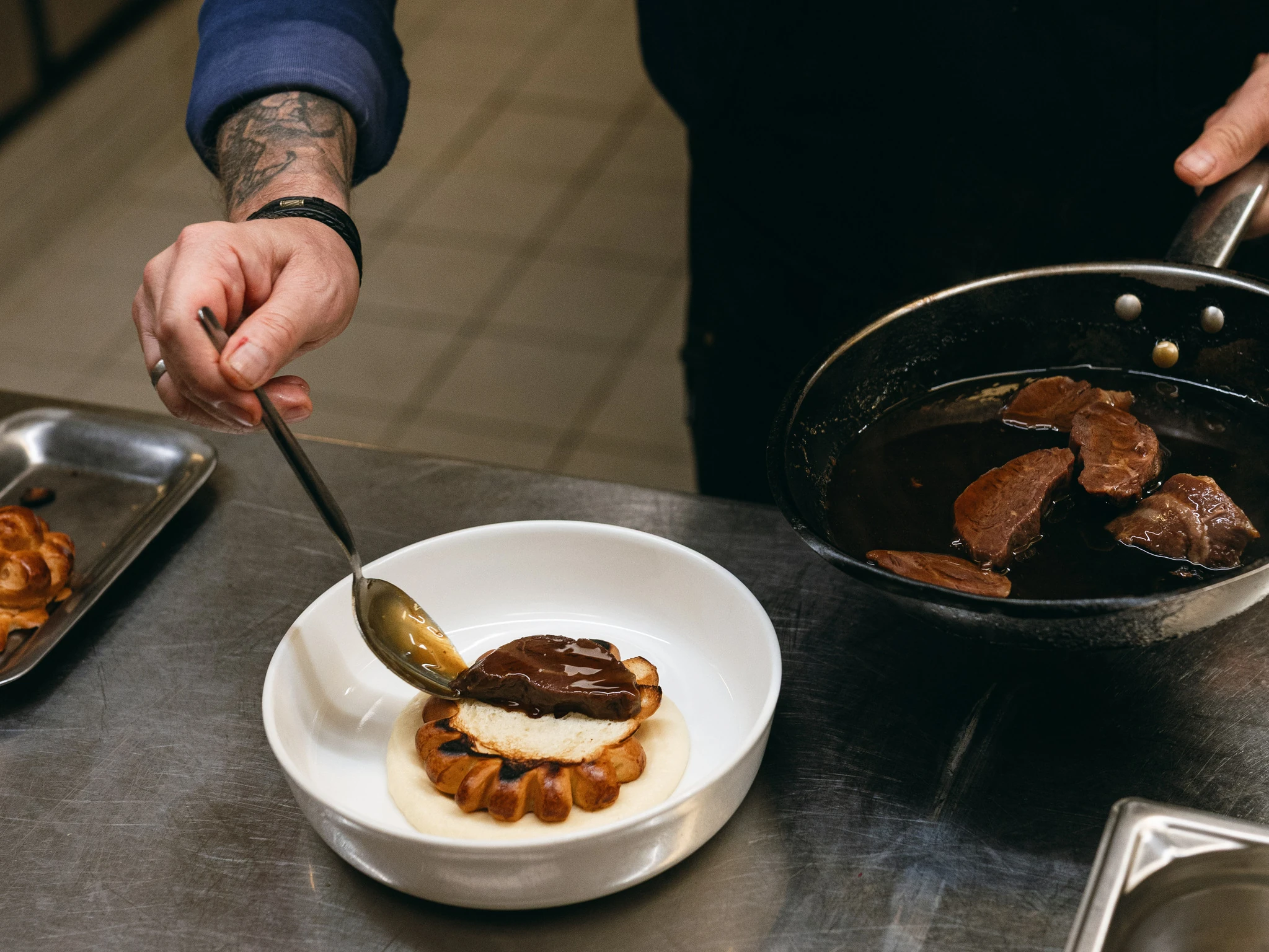
I’ve always had a strong drive to take action. Over 16 years at Borkonyha – in the world of fine dining – we achieved great success. Then came Textúra, where we brought this genre closer to guests in a bistro atmosphere. Fúzió was born from a blend of the two: the fine-dining techniques of Borkonyha and the playfulness of Textúra. This concept aligns very closely with my own personality.
Many people assume that a Michelin-starred chef only eats lobster, caviar and steak. In reality, I love simpler, street-food-style dishes – in fact, that’s mostly what I eat at home. At Fúzió, I get to present this side of myself as well.
What’s your favourite dish?
I have so many – I certainly don’t go in for fine dining at home! I love stuffed peppers, meatballs in tomato sauce with sugar and white bread, thick vegetable stews with little meatballs, simple pan-seared meats with sides, shepherd’s-style pork and various meat stews. I’m also a big fan of offal, and I’d love to champion these ingredients in my restaurants – veal tongue, for instance, is a personal favourite, and I’m keen to feature it on the menu. Perhaps the time isn’t quite right for every such dish at Time Out Market Budapest, but duck liver is already a hit, so maybe we can experiment with others over time.
What appealed to you most about the concept of Time Out Market Budapest?
It’s a unique environment where a diverse mix of restaurants, personalities and styles come together – and Fúzió fits in perfectly. Thanks to the open kitchen, we can interact directly with guests, receive feedback and gather new ideas. I love that the chef isn’t tucked away, cut off from the people. Sometimes guests share a recipe, a memory, or a dish – perhaps something they’ve held onto since childhood – and that gives us inspiration. This setting gives us greater freedom to experiment, while offering guests the chance to choose from the selections of 11 different restaurants. They aren’t tied down to a single cuisine for the entire evening.
Has any guest feedback ever led to the creation of a specific dish or a new idea?
Absolutely – and it’s not just positive feedback that we can learn from. It’s essential to listen to our guests and continuously refine our offerings – that’s our duty. While no specific dish has emerged from a guest’s suggestion at Time Out Market Budapest yet, I’ve had many conversations with the public at events such as the Gourmet Festival, which have indeed inspired new creations. At Fúzió, I want to showcase dishes that I personally enjoy eating in my everyday life – dishes I have a genuine, personal connection to. That’s one of the most exciting aspects of this concept.

What do you love most about Hungarian cuisine?
Its richness of flavours. Hungarian cuisine is characterised by intense flavours – while it is sometimes criticised for being excessive, heavy or greasy, I believe it harbours truly fantastic tastes. We have a wealth of ingredients and dishes to be proud of – from grapes and Tokaji wines to stews, goulash, chimney cake, all kinds of fruit, offal and even parsnips. As a child, I wouldn’t eat them – I only ate carrots, because I was told they would teach me how to whistle! Today, I love them, their flavour and texture can truly dazzle foreign diners.
Hungarian cuisine is so much more than just paprika. I enjoy introducing people to high-quality ingredients. Game, for instance, is already popular in restaurants, but it’s less common in home cooking – partly because you need to know how to prepare it properly. The same applies to offal.
For you, the visual presentation and creativity of a dish are always important. Does the flavour take shape in your mind first or do you already see the finished plate before you?
That always depends on the inspiration. Sometimes I know exactly the form I want to create and I seek out the ingredients to match that vision. At other times, a specific colour or palette sparks the idea. I’m a very visual person and I love showcasing ingredients in their most beautiful form. As a result, people are sometimes more willing to try things they initially assume they wouldn’t like. At dinner parties, I sometimes choose not to reveal what the guests are eating until after the meal; this way, they end up tasting ingredients they might otherwise have rejected.
Visual elements play a very important role in my life, and I often say that the paintings my wife, Évi Sárközi, creates are a constant source of inspiration for me.
So might we see beautifully presented veal tongue in the future?
Absolutely. I’ve even prepared bull’s testicles, shaping them into such a lovely red heart that even people who would otherwise never have touched them ended up trying them.
Some people hang their Michelin star on the wall; you had yours tattooed on your skin. What does it mean to you – recognition or perhaps even greater expectations?
It was my first tattoo, done by my sibling. Naturally, I was very proud of the Michelin star – it means a great deal to me – but it’s not just my achievement; it belongs to the entire team. It’s a significant milestone that we were the third restaurant in Hungary to earn it, and the first bistro. The tattoo itself is quite small, though; if you don’t know what it represents, you might not even notice it. I didn’t get it to show it off to everyone but I am proud of it. In fact, I’ve got more tattoos since then, so it’s even less conspicuous now.

If the Michelin stars, the awards and all professional accolades were to vanish tomorrow, what would you want people to remember about your cuisine?
Awards are important but you can’t afford to sit back and rest on your laurels. It’s a bit like having been wealthy once – that doesn’t guarantee you’ll stay that way nor does it mean you’re now free to become poor. For me, the greatest recognition comes from the guests. It doesn’t matter what honours, awards or accolades you’ve been given if you don’t have any guests. If I had to start completely from scratch tomorrow, as a complete novice, what would truly make me happy is if my dishes created memories. If they somehow became a part of my guests' lives, so that later on, they might recall a specific flavour, a particular occasion or a fleeting moment – that is when I would feel I had achieved what I set out to do.
Between managing multiple restaurants, making TV appearances and developing new concepts, how do you maintain your creative energy and what have you learned to delegate to others?
I believe I am an effective leader when I no longer have to do everything myself but instead find the right people for the job. I’m not egocentric; I place great value on teaching and supporting young people – after all, I, too, was given many opportunities early in my career. My role is gradually shifting everywhere and I am increasingly present in the capacity of a mentor.
At Borkonyha, I’ve been working with Csabi Puskás for 16 years. He needed guidance in the beginning, but today he is one of my best people. I give him a free hand and he is a great hope for the future. At Textúra, Máté Rozman and Zsombor Dávid also trained under me, and today they are head chefs. At Fúzió, a young chef in his twenties has just been given an opportunity. We shall see how he makes the most of it, but I firmly believe that the next generation must carry the torch. After 30 years in this profession, I no longer necessarily need to be the one in the spotlight. It makes me very happy when those I have taught achieve even greater success than I have.
Does this mean that guests at the Budapest Time Out Market won’t necessarily run into you or will you be visible there as well?
It’s currently a bit difficult to balance this with my other responsibilities, as I mostly handle logistics behind the scenes – working away from the spotlight. That said, I do try to be present as much as I can. As I mentioned, it’s important for me to talk to guests and see how the concept functions in practice.
I’m involved in many different areas: I teach, give presentations, and take part in gastro showcase productions. At the same time, it’s crucial to slow down occasionally and seek out experiences that provide fresh inspiration.

What is the most important common element shared by Borkonyha, Textúra and Fúzió?
The team. I’ve been working with my co-owners, Tamás Horváth and Zoltán Kalocsai, for nearly 17 years – a rarity these days. Each of us has our own area of focus and our teams support our work. This is how we keep moving forward and our successes are shared by all. A great team is always the most important thing.
Is there anything you’re rarely asked about but would actually enjoy discussing?
Perhaps the fact that, from the outside, being a chef and a leader might look like a dream – you receive awards, achieve success and everything seems perfect. What’s discussed less often is the sheer amount of work that goes on behind the scenes. This applies not just to chefs, but to leaders in any field. Your mind is constantly racing – you’re creating opportunities, building others up, mentoring and carrying a tremendous amount of responsibility. Often, even when you’re completely exhausted, you simply can’t switch off from work and just rest. At times, this becomes a heavy burden. While it’s certainly a positive thing that offers a great deal, the truth is that it also entails an immense amount of hard work.