[category]
[title]
Over the years, the subterranean space underwent many transformations, from a restaurant and tea room to a jazz club.


Canadian architect and artist Richard Henriquez once said, “Old buildings are like a book. You can open it and read the history of a place, of a people, of a civilisation.”
St George’s Cathedral embodies those words. Every brick has a story. History lingers in the walls, the passages and every nook and cranny.
Southern Africa’s oldest cathedral played a pivotal role in the anti-apartheid struggle. Led by the late Archbishop Desmond Tutu, St George’s was a haven for activists, politicians and anyone taking up arms against the apartheid government.
Below the ground floor, and away from prying eyes, they gathered in the building’s crypt. The meeting place was more than a refuge; it was a safe space to exchange ideas and dream out loud for a free South Africa.
Over the years, the subterranean space underwent many transformations, from a restaurant and tea room to a jazz club. Then, in 2022, a fire broke out during the early hours of a Sunday morning. An act of arson, according to Cathedral Dean Reverend Michael Weeder. A lit piece of cotton or gauze was thrown through a small, barred window near the steps of the Wale Street entrance.
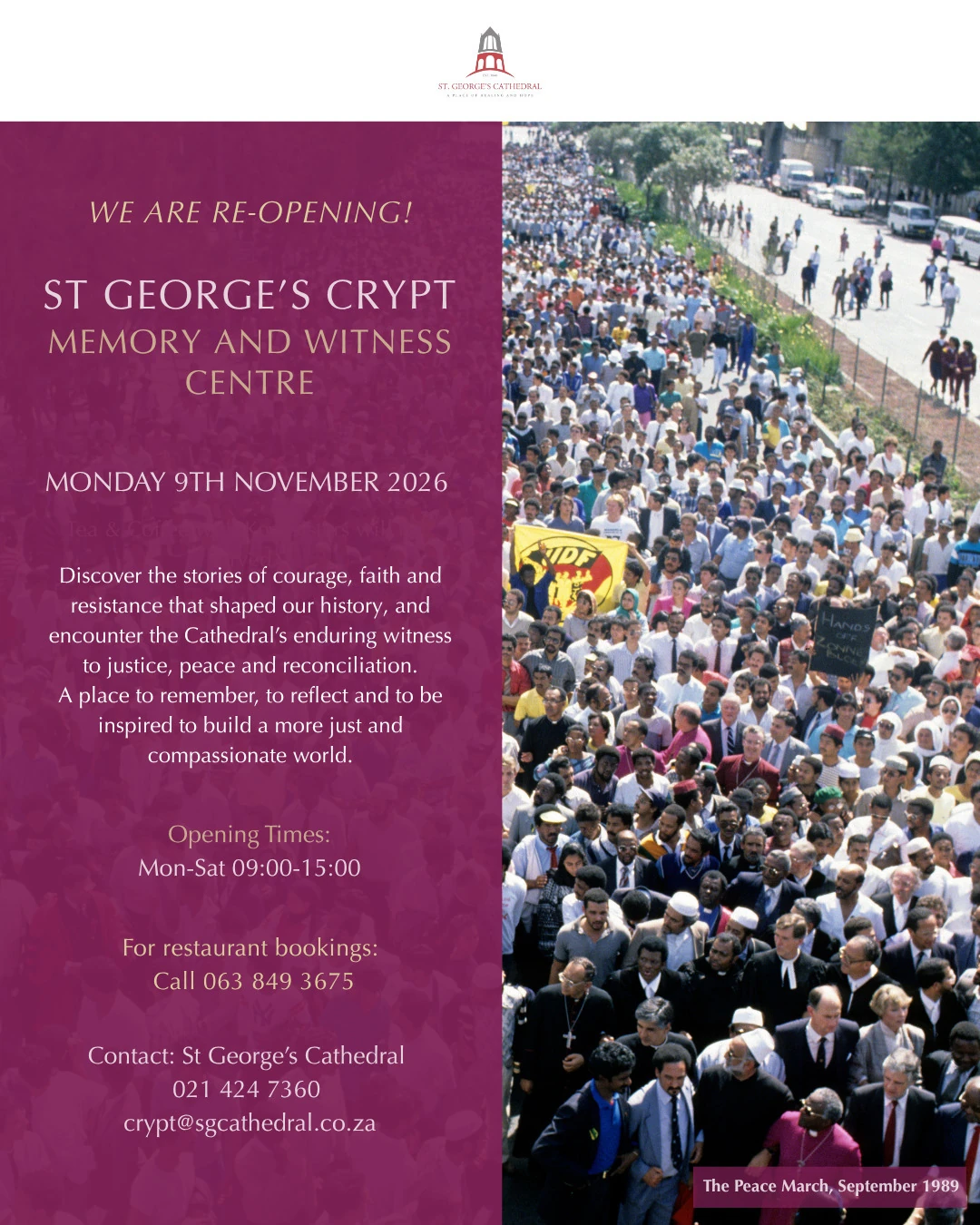
Several years later, the crypt has reopened under a new name, the Crypt Memory and Witness space.
Accompanying the reopening is an exhibition, titled ‘Glimpsing Hope, Marching for Peace.’ Paying homage to the late Archbishop Desmond Tutu and the church’s role in the anti-apartheid movement, the exhibition commemorates the Cape Town peace march in September 1989.
Through powerful images, the showing is a testament to the contributions of “people of faith to dismantling the harmful systems that have affected our country for centuries,” said Terrence Lester, Dean of Cape Town.
“The exhibition also looks at the issues of slavery, colonial occupation, and apartheid segregation, as well as the effects these systems have had on our people and country,” explained Fr Lester.
Since its closure as a platform for creatives in 2017, the Crypt Memory and Witness space once again brings history to the forefront. The exhibition gives visitors a glimpse of the people and pivotal events and moments that led to South Africa’s democratic elections in 1994. While there have been many attempts to revitalise the centre, Fr Lester said the pandemic left it in a derelict state. Thankfully, it’s now resurrected and ready to welcome local and international visitors.
Sandra Prosalendis, the exhibition’s co-curator, added, “What we are trying to show is the mass of ordinary people who want to see change and peace.” Another central theme of the exhibition is “peace and justice, and communities can bring about change,” echoed her creative partner, Lynette Maart.
Time Out fun fact: Known as The People’s Cathedral, St George’s kept its doors open to people of all races throughout the apartheid era.
Visitors are encouraged to engage with the displays and reflect on the ongoing journey to reconciliation, healing and peace not only in our city or the country but also globally. By highlighting these narratives of hope, curators Sandra and Lynette believe visitors will be motivated to contribute to the quest for justice and peace.
More info:
Sign up to Time Out Cape Town's free newsletter for expert recommendations on new things to do, see, eat and drink in the Mother City. You can also follow Time Out Cape Town on Facebook, Instagram and TikTok!
Discover Time Out original video