


[category]
[title]
There were gasps over the onions, plenty of opinions on breyani and one chicken-smoking trick I’m absolutely stealing. But Yudhika Sujanani’s Durban curry masterclass served up lessons that went well beyond the stove.


There are few things more dangerous than telling a room full of Durban women that they may have been cooking curry differently all these years.
I discovered this at Yudhika Sujanani’s Royal Feast Curry Masterclass, when a seemingly innocent pot of onions caused some of the biggest reactions of the afternoon.
Salt went in.
There were gasps.
“We don’t do it like that,” came the comments from around the room.
And that was when I knew this was going to be fun.
Because curry in Durban is personal. You have your way of making it, but chances are it started with somebody else's way. Your mother’s. Your grandmother’s. An aunt who never measured anything but somehow produced the same curry every single time.
And then there is biryani.
Everyone has an opinion on biryani.
So putting Yudhika in front of a room full of women, many of whom already cook these dishes at home, was always going to invite some commentary.
It did.
Read:The 11 best Indian restaurants in Durban
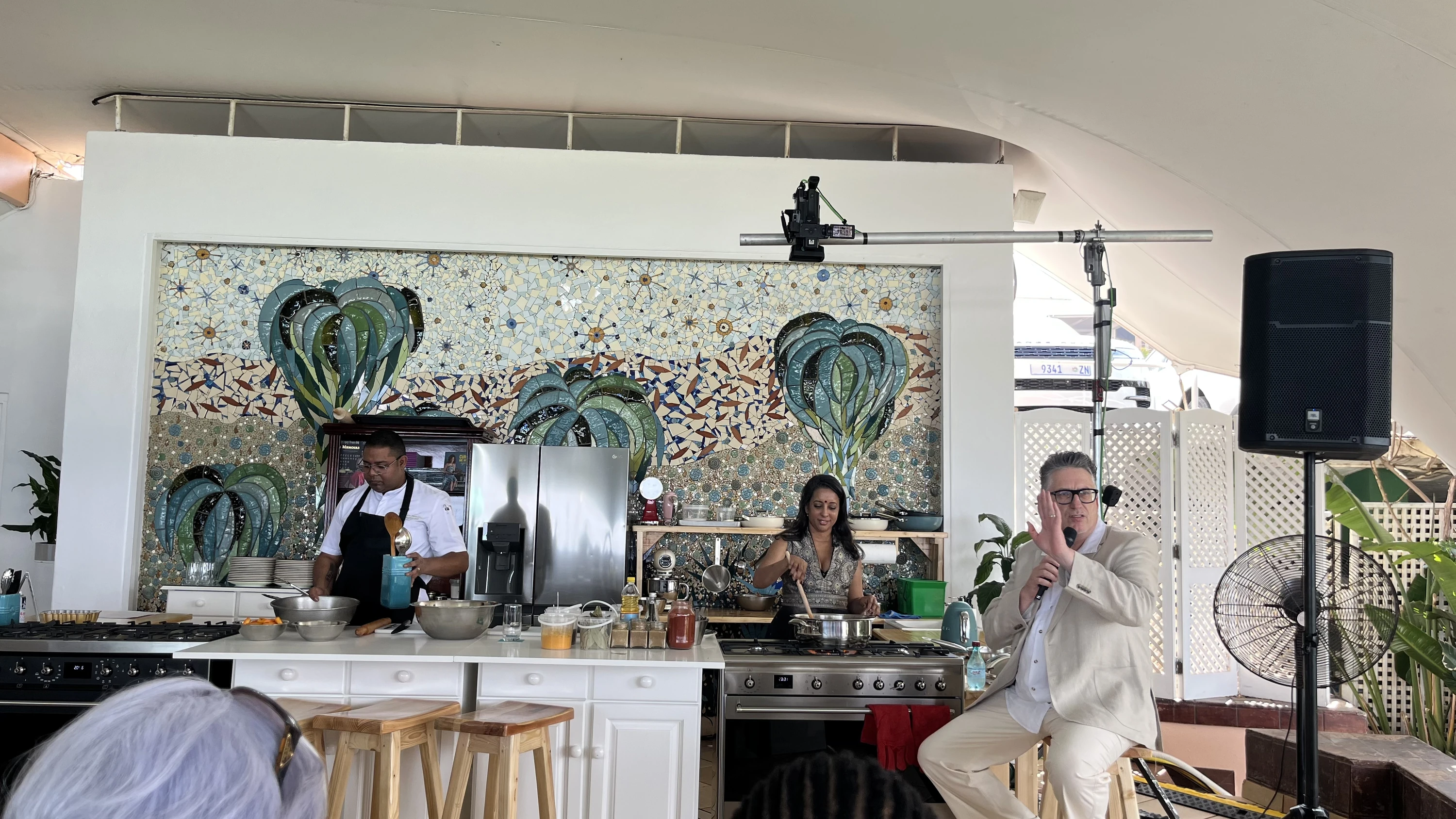
The Royal Feast Curry Masterclass at the Beverly Hills in uMhlanga was one of Yudhika's Heritage Month cooking experiences in Durban.
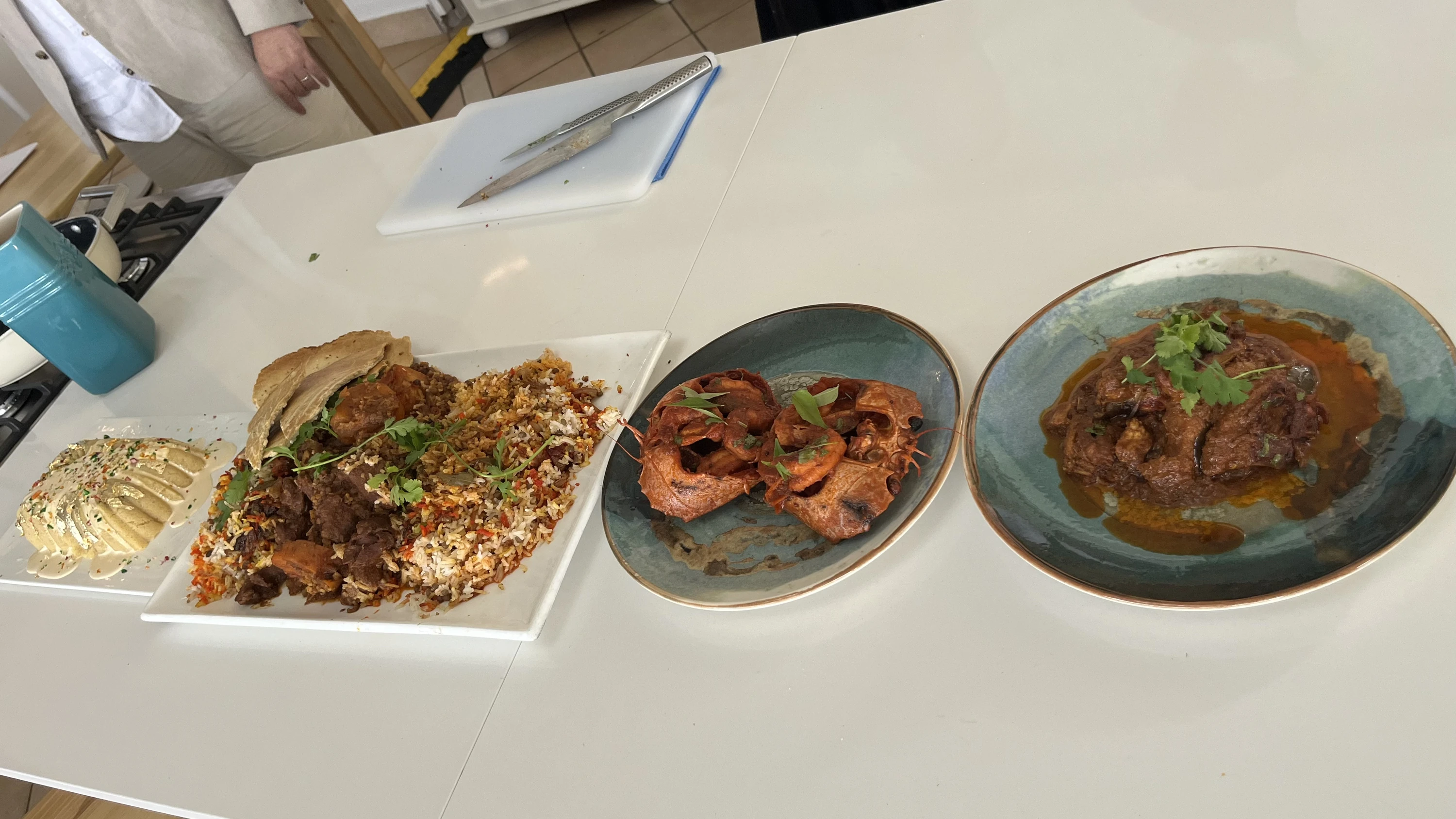
Royal Parda Lamb Biryani, Shahi Masala Chicken, Tamarind and Tomato Prawn Curry and Burfee Soji were on the menu.
The women were ready.
Quite a few had come in groups and made a day of it. There was very much a girls’ day out feeling in the room: friends around tables, plenty of conversation and, importantly, people who weren't afraid to question what was happening in the pots.
Darren Maule hosted the afternoon and, as I would discover later, nobody was safe from Yudhika's commentary. Not even Darren.
First, though, we had to deal with the onions.
Read: Learn to cook Durban dishes this Heritage Month
Yudhika's approach to curry is very much about technique.
Spice matters, obviously, but one of the points she kept returning to was what you do with the ingredients before the curry really gets going.
Which brings us back to those onions.
She added salt and allowed them to cook until properly browned. Some women in the room immediately noticed because it wasn't how they did it at home.
Then came the spices.
An audience member asked why she hadn't fried the ground spices in hot oil.
Yudhika warned against burning them.
It was another one of those moments where you could practically see people checking her method against the recipe stored in their heads.
She also cooks at a fairly high heat to start, lowering it later once liquid is introduced. Start too low, she explained, and instead of properly braising the meat, it releases water and begins to stew.
Her chicken technique had a few surprises too. For the Shahi Masala Chicken, she uses fresh cream rather than yoghurt in the marinade and doesn't drown the dish in water as it cooks.
These weren't dramatic changes, but in a room where people had been cooking curry a certain way for years, they were enough to get people talking.
I caught up with Maggie Chetty, a Durban-born and raised attendee who now lives in Cape Town and had travelled back to the city for Yudhika's masterclass.
For Chetty, many of the techniques being debated in the room came back to something familiar: how we learn to cook in the first place.
“I follow the way my mom cooked. I follow the traditional way of doing things,” she said.
But Yudhika's approach had given her a few things to think about, particularly “not putting water, having some patience [and] putting the salt at a certain time”.
“We as everyday cooks, we cook in the kitchen, so we kind of do what our mothers did,” Chetty said. “But I'm always happy to learn and to see that there is a difference in the taste.”
She was also interested in how Yudhika handled her spices and, naturally, the biryani.
“She has a different take on how you make a biryani, and I'm always willing to learn.”
Coming from someone who had grown up with Durban's food traditions and travelled from Cape Town to spend an afternoon immersed in them again, it felt like a neat summation of what was happening around us.
Nobody was leaving the room and disowning their mother's recipe.
They were simply adding a few more tricks to it.
Read: What happens when a Zulu grandmother’s recipes enter a Durban fine-dining kitchen?
Mine arrived with the Shahi Masala Chicken.
Yudhika smoked it.
I was sold.
Of all the notes I took during the afternoon, this was the technique that had me genuinely excited to get back into my own kitchen.
NEW SKILL UNLOCKED!
I'd never thought of finishing chicken this way, and watching her do it made it seem completely achievable at home.
This is why I enjoy a good masterclass. I can read a recipe. I can watch somebody make curry online. But occasionally you need to be standing there watching someone do something and think: Oh, I'm definitely trying that.
For me, this was it.
Although Yudhika's very firm position on biryani potatoes deserves an honourable mention.
They must not simply be cooked.
They must BUST.
Noted.
Somewhere between the curries, the conversation moved from how women cook to who women are expected to cook for.
Yudhika spoke candidly about two divorces, her relationships with mothers-in-law, and some of the expectations she has encountered as an Indian woman. And anyone familiar with a big Indian family will know where the conversation about food eventually leads: feeding people.
Lots of people.
There is almost always enough food for one more person. Then another. Family visits, people are invited, pots get bigger, and somehow the women are expected to make it happen.
Yudhika questioned something I'd never really heard challenged quite so plainly: why are we inviting people into our homes who don't like us? More importantly, why are women expected to cook for them?
Her position was simple. If someone doesn't like you, or you don't like them, why are they sitting at your table?
It got a laugh, of course, but I loved her stance on it.
Because she wasn't arguing against generosity or the very Indian tradition of feeding people. There was no suggestion that we should stop making enough food to feed a small village. She was questioning the obligation attached to it, particularly for women: this idea that maintaining relationships, keeping the peace, opening your home, and making sure everybody is fed somehow becomes your responsibility, regardless of how those people make you feel.
Why should access to your home be automatic simply because somebody is family, an in-law, or part of the wider circle?
And why should being a “good” woman require you to smile, cook, and serve people you wouldn't voluntarily spend time with?
For Yudhika, it clearly doesn't.
The more she spoke, the more that throwaway conversation about a guest list began to connect with the way she now runs her life.
“I have zero tolerance for family drama, for nonsense,” she told us. “I really am so, so incredibly disciplined about who I hang out with, the conversations I have.”
Then she couldn't resist.
“I mean, I hang out with Darren, but I make an exception.”
The room laughed, Darren Maule took the hit, and Yudhika carried on.
But this time she went back to Isipingo and explained where that protectiveness comes from.
“I come from this small town where gossip was everything, where everyone was in your business,” she said, recalling an environment where “we were so controlled and groomed by all the conversations being had around us, about us”.
That eventually required a conscious separation.
“I had to actually step away from all of that to create this amazing life.”
And this was probably the point at which I understood why I had enjoyed her earlier comments about the dinner table so much.
Yudhika wasn't really talking about a dinner invitation.
She was talking about access.
Who gets access to your home. Who gets access to your time. Whose opinions get access to your head. And, ultimately, who gets a say in the life you're trying to build.
For someone who grew up in an environment where, by her own account, everybody was in everybody else's business, those boundaries didn't sound rude.
They sounded deliberate.
And looking at what she has built since, they seem to have served her rather well.
Yudhika calls it “a mini little empire”.
It employs around 30 women.
But when she spoke about what she has managed to achieve, it was what has happened within her own family that really stood out.
“My kids are the first kids in our family to go to university, to get big degrees, to do all the things that my grand, like two generations ago, wished for us,” she said.
“It's all happening and unfolding.”
That's a big statement when you consider where the story started.
Curry and rice.
The food she grew up with in Isipingo.
The recipes of her childhood.
“Food doesn't come from me,” she said. “I'm telling a story. I'm sharing the recipes of my childhood. It comes from a little town in the south of Durban called Isipingo.”
Yudhika is also quick to acknowledge that she didn't arrive here alone.
“It's taken so many people to come together to put me together. And I honour them in the work I do, and I do it with so much love and so much passion.”
Then she said something that stayed with me.
“You would think curry and rice would limit you. And it sets you free.”
For a woman who has built a career, a business and a life from the food she grew up eating, that freedom is tangible.
Her children have gone to university. Her business employs women. Her books have travelled beyond South Africa.
And there is another one coming.
“There's a new book, Darren,” she announced during the masterclass.
It is due in September 2027, again with Penguin.
“So it just keeps growing.”
Perhaps the most telling story Yudhika shared involved her father.
She remembers him saying to her: “Oh, you don't even know how to cook a curry.”
Imagine.
The woman who has gone on to build much of her career around curry was once told she couldn't cook one.
Her response now is simple.
“And now I own that space.”
She does.
But Yudhika wasn't suggesting everyone needs a cookbook deal or a food empire for their work to count.
She talked about people making pap and chakalaka, selling boerewors, cupcakes, and queen cakes, which she jokingly described as the “un-iced, unglamorous” version of cakes.
Her point was about the work that isn't glamorous.
The little businesses and everyday jobs that feed families, pay fees, and give the next generation opportunities their parents may not have had.
She spoke about breaking habits and curses and setting the next generation free.
“For my family, it's going to be completely different going forward.”
I loved that.
Not because curry needs to become a metaphor for everything. Sometimes curry really can just be curry.
But for Yudhika, it hasn't been.
It has been work. Income. Independence. A way to educate her children. A business that employs other women. Books. Travel. And a way of taking the food and stories of the place she comes from into rooms far beyond Isipingo.
All from something she was once told she couldn't even make.
After all of that, I was rather pleased to hear Yudhika admit something else.
She has bad curry days.
Good.
Because after watching her braise, spice and smoke her way through the afternoon with complete confidence, the rest of us needed that little reassurance.
I left with pages of notes.
Don't burn the spices.
Give the onions time.
Don't be afraid of high heat.
Fresh cream instead of yoghurt? Try it.
The potatoes must BURST.
And smoke the chicken.
Definitely smoke the chicken.
But I also left thinking about the women in that room and all those recipes we carry with us.
There is room for your mother's curry, your grandmother's biryani, and Yudhika Sujanani's way of doing things to exist at the same table.
Recipes evolve because women do.
And judging by the gasps that afternoon, sometimes all it takes to get the conversation started is a little salt on an onion.
TIME OUT DURBAN RECOMMENDS:
📍 The best things to do in Durban
🍽 The best restaurants in Durban
🏨 The best hotels in Durban
🛏️ Where to stay in Durban
📢 Latest news from Durban
Follow Time Out Durban on Instagram, Facebook and TikTok! To get the coolest news, features, and things to do straight to your inbox, sign up for our newsletter.
Discover Time Out original video