[category]
[title]
Britain will see the largest solar eclipse since the total eclipse of 1999 next month – here’s what you need to know about seeing it


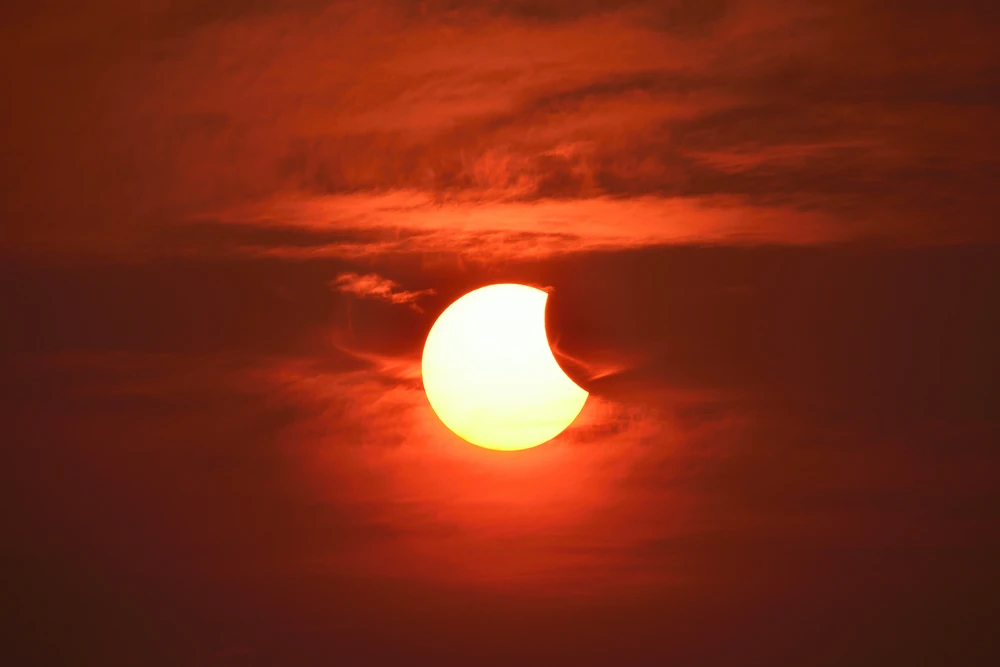
A total solar eclipse is a stunning and extremely rare spectacle. When the Moon passes between the Earth and the Sun, it plunges parts of the planet into darkness and creates a spooky-looking halo in the sky. Next month parts of the world will experience a total solar eclipse – and while the UK isn’t getting the full thing, it’s getting a near-total eclipse. A whopping 90 percent of the Sun will be covered.
Although total solar eclipses happen every 18 months or so, they’re only visible from a specific location once every 366 to 400 years. So, for most of us, it’s a once-in-a-lifetime thing. Partial eclipses, on the other hand, are much more common. They’re when the Moon covers any part of the Sun. A partial solar eclipse is what the UK is getting in August 2026.
August’s solar eclipse will be the most significant eclipse that the UK has seen in almost 30 years. Here’s everything you need to know about viewing it, from the date and time to how to see it.
SKIP TO
🗓️ Date
⏰ Time
🕶️ How to view
🗺️ Best places to see it
RECOMMENDED: The best places to see the once-in-a-lifetime solar eclipse in Europe.
It’ll occur on Wednesday August 12 2026.
Unfortunately, Brits at home won’t witness the full solar eclipse. What we will be able to see is a deep partial eclipse in which around 90 percent of the Sun will be covered by the Moon. That’s the most coverage seen from the UK and Ireland since the 1999 solar eclipse.
The further southwest you are, the more coverage of the Sun there’ll be. Viewers in Cornwall will see roughly 95 percent and spectators in Pembrokeshire will see around 94 percent.
It’ll depend on what part of the UK you’re in. People in Edinburgh and Glasgow will be among the first to witness the partial eclipse and those down in Truro will be the last. Here’s when the eclipse maximum (when most of the Sun is covered) will happen in each region, according to the Royal Museums Greenwich:
Make sure not to look directly at the eclipse – find a pair of special glasses or make yourself a pinhole projector which will allow you to see the eclipse by projecting the Sun’s light, and the chunk of it being blocked, onto another surface.
If you want to see the full eclipse, you’ll have to be in either Greenland, the western tip of Iceland or the north of Spain.
Total solar eclipses are super rare – they tend to only occur once every 400 years at any given location. Partial solar eclipses are more common, typically occurring at an average of twice per year.
Not for a long, long time. The British Isles won’t witness a full solar eclipse until September 23 in the year 2090.
Did you see that two meteor showers will peak on the same night this week?
Stay in the loop: sign up to our free Time Out Travel newsletter for all the latest travel news and best stuff happening across the world.
Discover Time Out original video