[category]
[title]
Cape Town’s dam levels are 75% full - well below last year’s mark as a very strong El Niño raises the prospect of a hotter, drier summer.


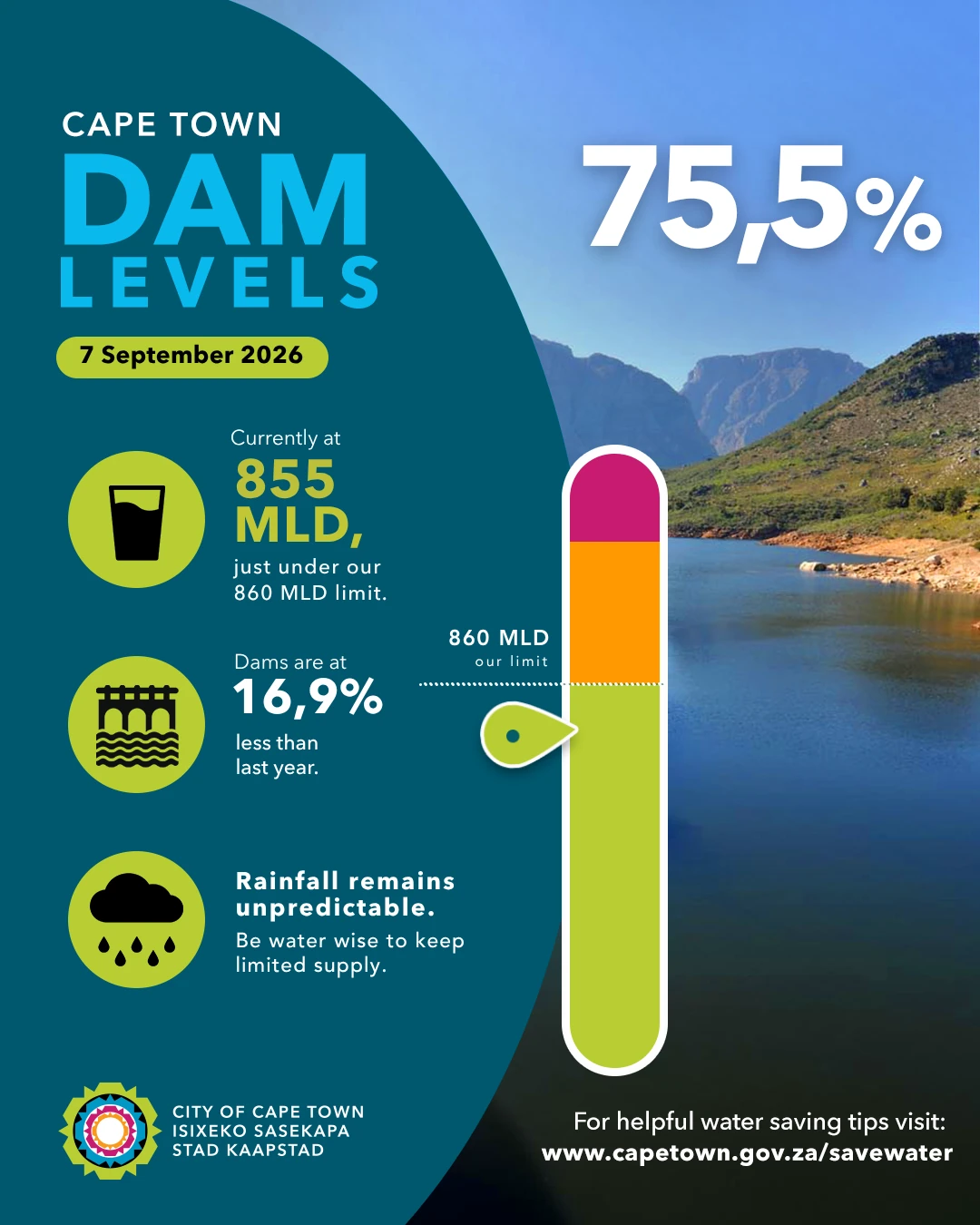
Cape Town’s dam levels are 75% full and well below last year’s mark, as a very strong El Niño raises the prospect of a hotter, drier summer.
Recent thunder, lightning and welcome showers may have brought some drama to Cape Town’s skies, but they have not removed the need to conserve water.
The City of Cape Town is considering introducing water restrictions as a precautionary measure, with combined dam levels at 75% - and while this does not put Cape Town's latest Water Outlook under an immediate threat to the municipal water supply - officials say the possibility of restrictions has increased, particularly if demand continues to grow and rainfall is lower than expected.
Cape Town used 855 million litres of water a day during the latest reporting period – five million litres below the City’s winter target of 860 million litres a day.
READ: The (thirsty) story behind the Table Mountain dams
The lightning and thunder recently experienced across Cape Town were not produced by the cold-front system that usually delivers the south-western Cape’s winter rain.
Climatologist and weatherman Pete shared an explanation with Time O, but said the activity was initially caused by an inland low-pressure trough extending from the north towards the southwest as a frontal system approached from the west.
Rising air within this system produced rapid updraughts and the build-up of powerful electrical charges – a process more commonly associated with Highveld thunderstorms.
"While the rainfall has been a bit disappointing (around 12mm in Bergvliet) over the weekend, the lightning has been exciting. A cut-off low hangs around until Tuesday, when a front moves in, unopposed by any sign of an HP cell. How much rain is anyone's guess, but there should be some significant falls again on Wednesday morning. On Thursday, Spring makes an appearance, but it stays mild for now," explains the climatologist.
“A few scattered thunderstorm cells have also risen over the western interior, stretching over the Peninsula, greater Cape Town and the Boland.”
But a few days of rain do not necessarily translate into a major improvement in Cape Town’s stored water supply. What matters is how much rain falls over the mountain catchments feeding the region’s six major dams, as well as how much water the city uses in the months ahead.
The renewed water-saving drive comes as a powerful El Niño develops across the tropical Pacific.
The World Meteorological Organisation says El Niño is firmly established and is expected to intensify further, with an almost 100% probability that it will persist through February 2027.
Forecasts indicate that it could reach “very strong” intensity before peaking towards the end of 2026.
NOAA’s latest outlook goes further, putting the probability of a very strong El Niño above 90%. It also gives the event a 75% chance of reaching a historic strength exceeding previous El Niño events in records dating back to 1950. NOAA Climate Prediction Centre.
El Niño is generally associated with hotter and drier summer conditions across much of South Africa. The Western Cape is predominantly a winter-rainfall region, however, and the relationship between El Niño and Cape Town’s rainfall is more complicated.
The South African Weather Service cautions that an El Niño forecast is not, by itself, a rainfall forecast.
Other oceanic and atmospheric systems also influence regional rainfall, and even an exceptionally strong El Niño does not guarantee a particular outcome for Cape Town.
What it does create is another layer of uncertainty as the city heads into the hotter months, when water consumption typically rises sharply.
For Cape Town, the practical message is straightforward: rainfall is becoming more difficult to rely on, hotter conditions can increase demand and evaporation, and water planning must account for a wider range of extremes.
Cape Town’s current dam supply needs to last through summer’s expected rise in consumption and carry the city into the next winter rainfall season.
Dam levels dropped by approximately 40 percentage points during the previous summer as temperatures and demand increased.
The national Department of Water and Sanitation usually assesses the Western Cape Water Supply System through its Annual Operating Analysis in November. Dam levels typically need to be at least 80% to avoid nationally imposed restrictions.
Cape Town’s own Water Restrictions Committee can nevertheless introduce municipal restrictions based on its assessment of dam levels, consumption, rainfall forecasts and projected summer demand.
“The City is taking a responsible and measured approach to managing Cape Town’s water resources,” said Mayoral Committee Member for Water and Sanitation Zahid Badroodien.
“While the current Water Outlook does not indicate an immediate risk to supply, we are closely monitoring dam levels, rainfall patterns and water demand to ensure we remain well prepared for a range of possible scenarios.”
Around 70% of Cape Town’s high-volume water consumption takes place in homes, meaning residents also have an important part to play.
“Cape Town is a water-scarce city, and using water wisely should remain part of our everyday habits,” said Badroodien.
Report water issues
Burst municipal pipes can be reported to the contact numbers and email below and residents should provide the exact location and insist on receiving a reference number.
Sign up to Time Out Cape Town's free newsletter for expert recommendations on new things to do, see, eat and drink in the Mother City. You can also follow Time Out Cape Town on Facebook, Instagram and TikTok!
TIME OUT CAPE TOWN RECOMMENDS:
📍 The best things to do in Cape Town
🏨 The best hotels in Cape Town
🍽 The best restaurants in Cape Town
🛏️ Where to stay in Cape Town
📢 Latest news from Cape Town
Discover Time Out original video