[category]
[title]
The second day of Coala Festival was a living showcase of Brazil’s musical avant-garde. Among names like Zé Ibarra, Ana Frango Elétrico and Marina Sena, the crowd witnessed the consolidation of a generation with "fire in their bellies" to rewrite the history of Brazilian popular music.

One of the official t-shirts sold at Coala Festival read in a very confident font: “música brasileira é foda” [Brazilian music is fucking great]. After the event's second day, on 31 May, with a line-up packed with some of the biggest names of the new generation of Brazilian artists, such as Marina Sena, Ana Frango Elétrico, Zé Ibarra and João Gomes, we are not only forced to agree, but also to believe that it will be in safe hands for many long years to come. The atmosphere at the Hipódromo Manuel Possolo, in Cascais, was visibly made up of more young people in brighter and bolder outfits than the previous day, which had been headlined by more classic names like Caetano Veloso and Bonga. However, the mission remained the same: to celebrate the richness of Portuguese-language music, even if it is in constant mutation.
After a first day dominated by male artists – besides the Brazilian and Angolan legends, Portuguese rapper Slow J and Caetano’s son, Zeca Veloso, also performed – few concerts could be more contrasting than Marina Sena's, whether due to her exotic outfits or a musical language closer to styles like pop and funk.
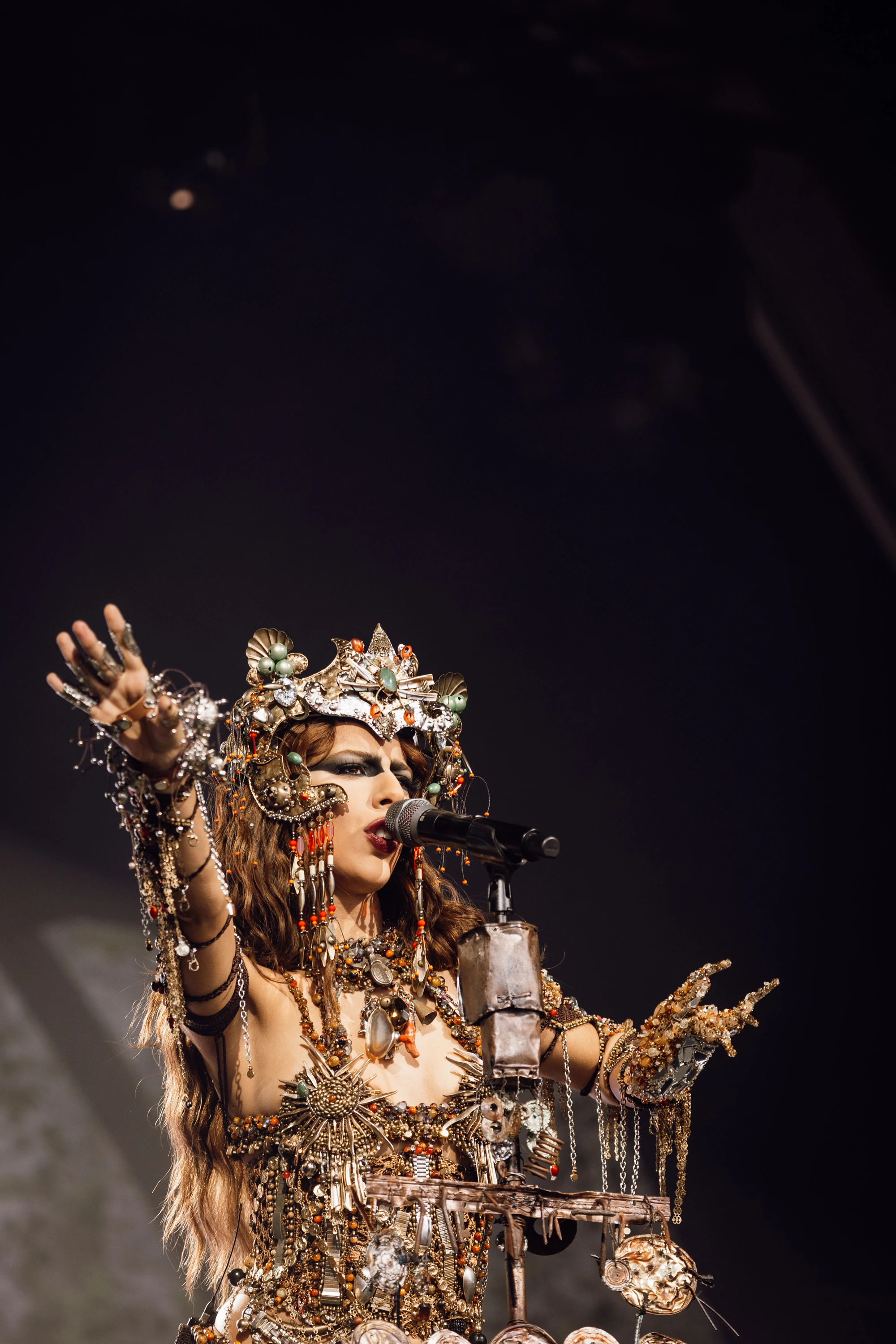
Received and treated like a true Brazilian star – right before the concert we were backstage (for reasons that will be explained later in this text) and witnessed a delightful moment, with Sena heading to the stage while, in a rush, a hair stylist sprayed hairspray onto her hair –, the voice behind "Coisas Naturais" showed how pop doesn't have to be just a whirlwind of stereotypes and catchy tunes, delivering an untameable performance marked by boldness and sensuality. Wearing makeup that reminded us of the movie Black Swan, but also of another Brazilian legend, Ney Matogrosso (who shone at last year’s edition of Coala), Marina dominated the stage and made her hips a true musical instrument, making the temperature rise (even more) during songs like “Numa Ilha” or “Doçura”.
The concert wasn't just made of this intensity, with the artist, mid-song, asking for professional assistance to help someone in the crowd, but rarely did the pace slow down. Sitting down singing seductively in "Lua Cheia", or lying on a pedestal smiling like a madwoman in "Dano Sarrada", Marina hypnotised Cascais. “Eu gosto quando você me olha” [I like it when you look at me], she sang at one point, and we reckon she could only be pleased to know she had every single audience member in the palm of her hand. In "Pra Ficar Comigo", featuring a guitar solo that would make Carlos Santana blush, the crowd surrendered and lost its mind.
The climax came with “Carnaval”, which turned the venue into a true tribal Carnival. An overwhelming percussion – once again reminding us of the music of the Mexican Santana, but this time, through the rhythm section, from the “Soul Sacrifice” era –, joined forces with funk and a "samba from hell". With a man dressed up with horns and the artist smearing herself in paint, Marina Sena left everything on stage with a feral performance. “Quero ver Portugal brasileiro nessa porra!” [I want to see a Brazilian Portugal in this fucking place!], she shouted at one point, evoking an energy so intense it would make fellow countryman Sepultura proud. To close the night, we heard the verses “Vou fazer um carnaval / Na sua vida tão sem sal” [I'm going to bring a carnival / To your life so lacking in salt], in “Desmistificar”, and we can only thank Marina for bringing so many interesting flavours to our night full of great concerts.
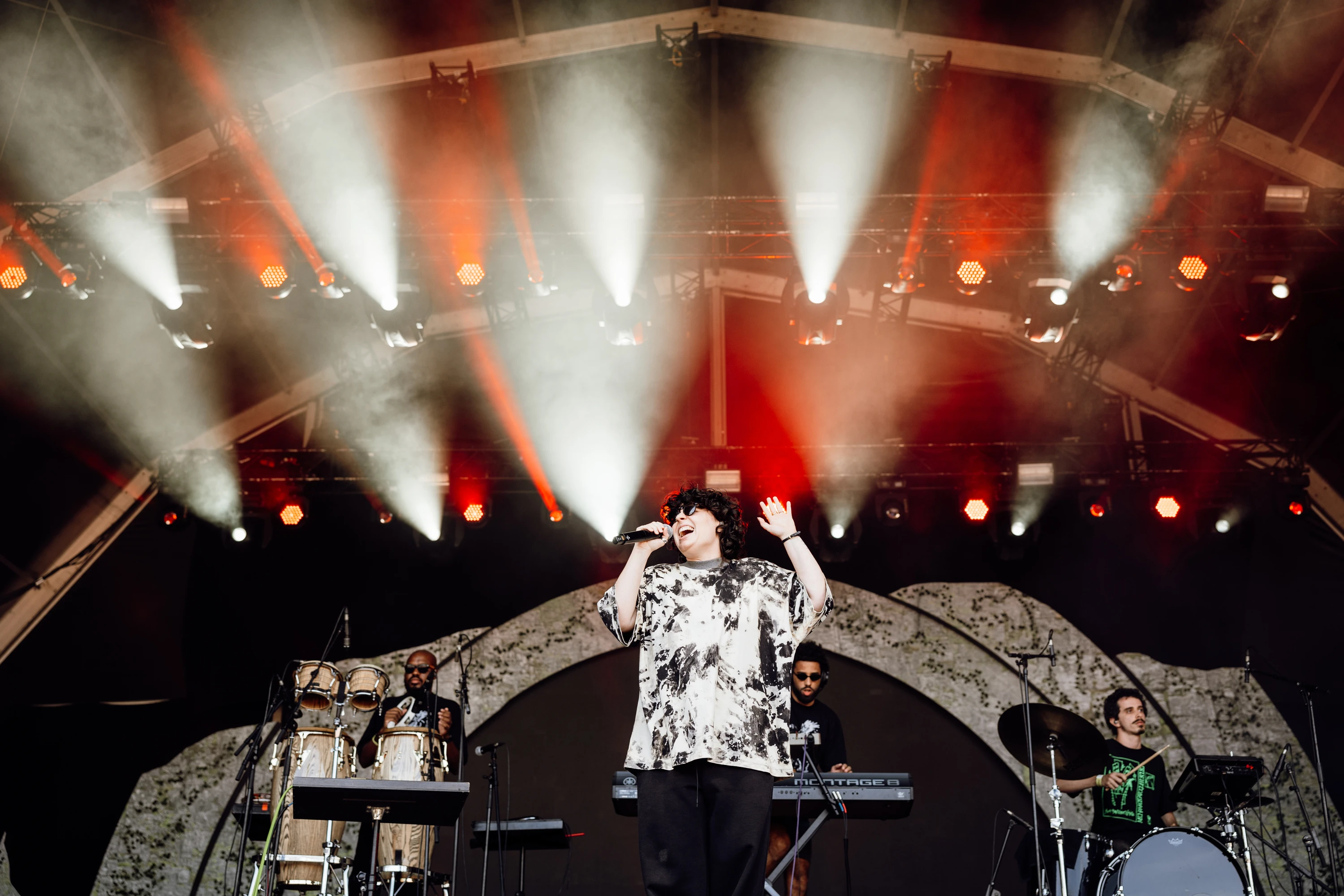
If there is anyone responsible for contributing to the fresh and untameable sound of Brazil’s independent music scene, that person is Ana Frango Elétrico, who blends references like jazz, blues, psychedelic rock, disco and traditional funk into their music, but has also left their mark as a producer and songwriter for other projects, such as Sophia Chablau e Uma Enorme Perda de Tempo, Bala Desejo, Rubel and Dora Morelenbaum. Under a radiant sun, which matched their good mood perfectly, the artist was welcomed by a sea of fans waving in the air and a euphoric crowd that knew the lyrics by heart and was ready to dance until the artist dropped the mic.
On the Coala stage, Ana was very busy. They broke the barriers of genre, identity and language itself in tracks like "Boy of Stranger Things", got everyone dancing with "Tem Certeza?", where they fused traditional funk with disco, but also made people fall in love with "Insista em Mim", one of the best romantic compositions of recent years. “Eu amo sua voz / Seu quadril e sua boca em mim / Seus pais, seus irmãos / Tudo que faz você feliz” [I love your voice / Your hips and your mouth on me / Your parents, your siblings / Everything that makes you happy] – it’s hard to resist.
Backstage, Time Out spoke with the creator of Me Chama de Gato Que Eu Sou Sua about their vision of this new generation of Brazilian artists. “I see many artists achieving great success and that is something that gives me a lot of hope. All the music coming out of Brazil is excellent,” Ana says. But it’s not all a bed of roses: Ana called for a larger platform for their compatriots to succeed and display their art. “I dream of and wish for more space so we can escape social media and show how versatile we are and how we can make different sounds. We have fire in our bellies to succeed and I am inspired by many Brazilian artists, both those who came before me and my contemporaries."
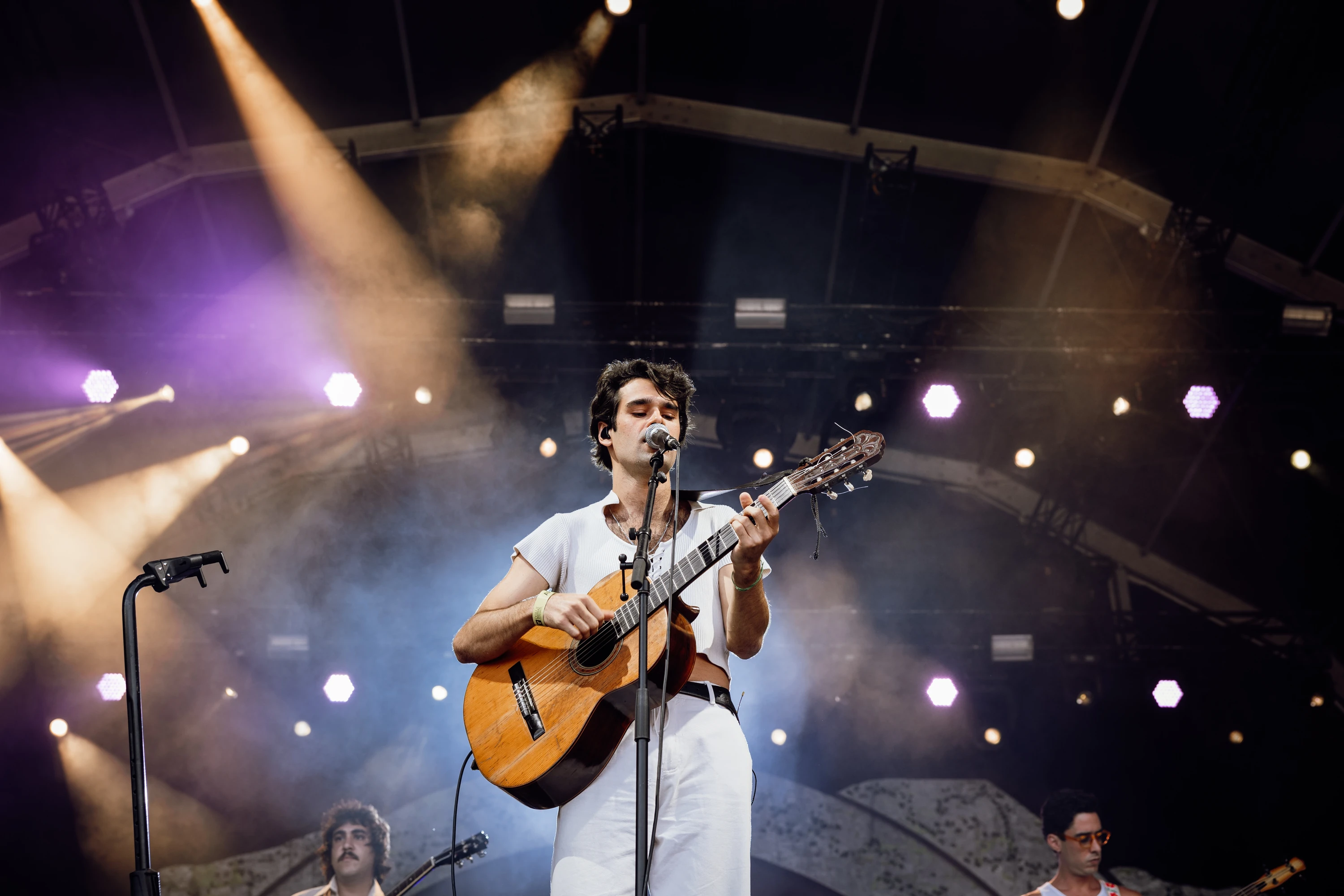
One of the keys to this new generation is sharing. While Ana participates and leaves their print on different projects, others sing songs by their peers, as is the case of Zé Ibarra, the Brazilian singer-songwriter who opened proceedings on Coala's second day. Tipped as one of the great names for the future of Brazilian music, Ibarra balances masterfully between acoustic moments and more electric explosions, with guitars that nod to the psychedelia of Tropicália while directly dialoguing with more contemporary artists like Boogarins.
With a magnetic stance and charm, he hypnotised the crowd, making everyone fall in love equally. The artist took advantage of the complicity with the audience to open up about the album he released in 2025: “Afim was an album that drove me crazy and made me very self-critical”. We can only conclude that stepping onto the stage and receiving so much love must help dispel those doubts. In addition to his repertoire, the singer-songwriter also offered his interpretations of the songs "Hello" and "Segredo" by Sofia Chablau, showing that the new Brazilian scene thrives on deep and collective sharing.
Also featuring performances by João Gomes, a new master of styles like forró and piseiro, and Lulu Santos, representing the older generations at the festival, Coala said goodbye with a series of great concerts and the ambition to keep filling the Hipódromo Manuel Possolo with people who certainly do not lack the desire to celebrate Lusophone music.
Discover Time Out original video