[category]
[title]
You can view—for the first time ever—treasures from the recently uncovered Lost Golden City.


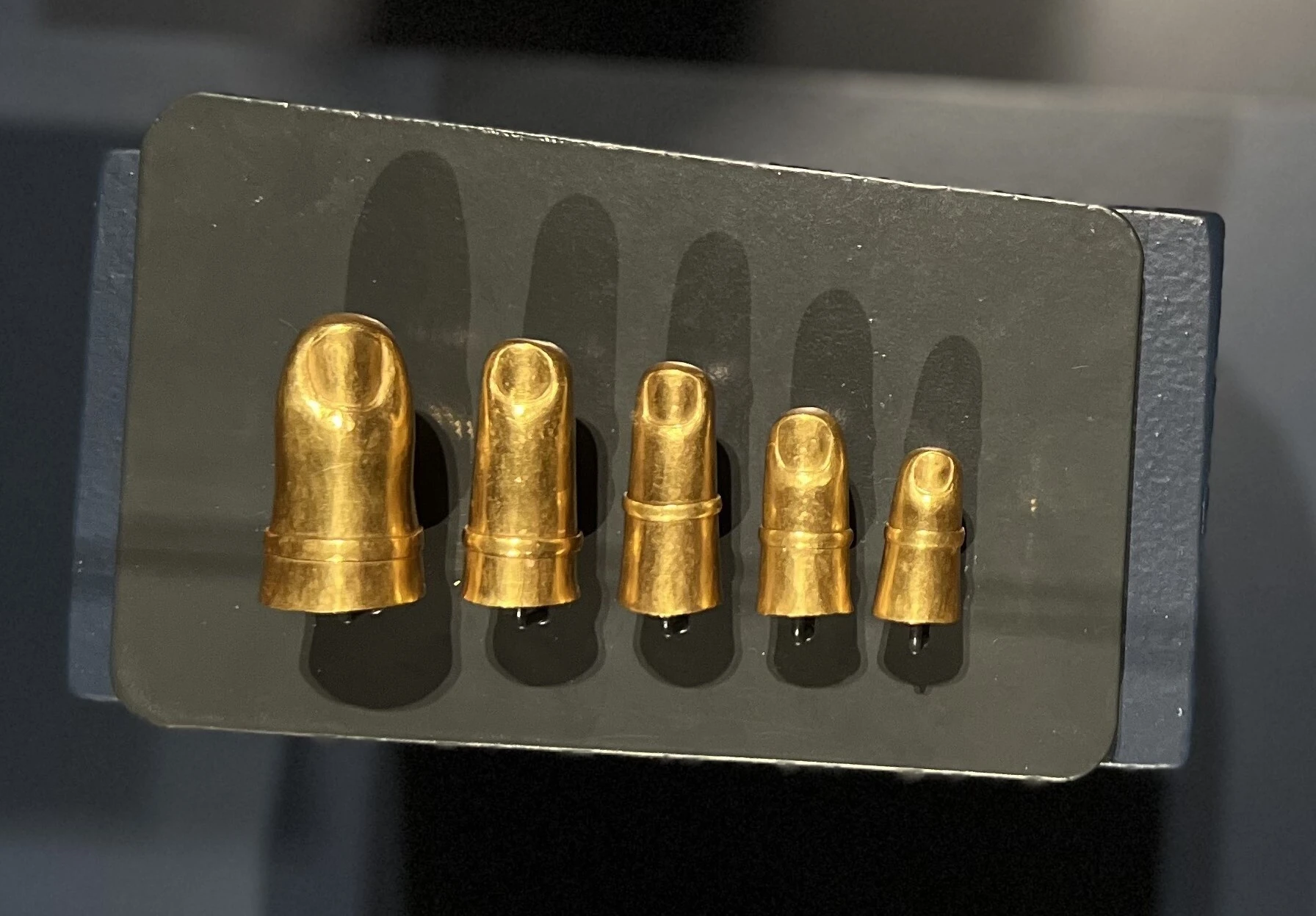
You can’t argue with the many museum-goers who are drawn to institutions’ Egyptian collections. After all, they’re filled with interesting artifacts: golden sheaths that fit around pharaohs’ fingers and toes, lifelike death masks with eyes rimmed in blue lapis lazuli, statues depicting cow-headed goddesses and jackal-headed gods, and objects a dead pharaoh would need for the afterlife, like food, perfumes, games and little statues that would reanimate to serve him.
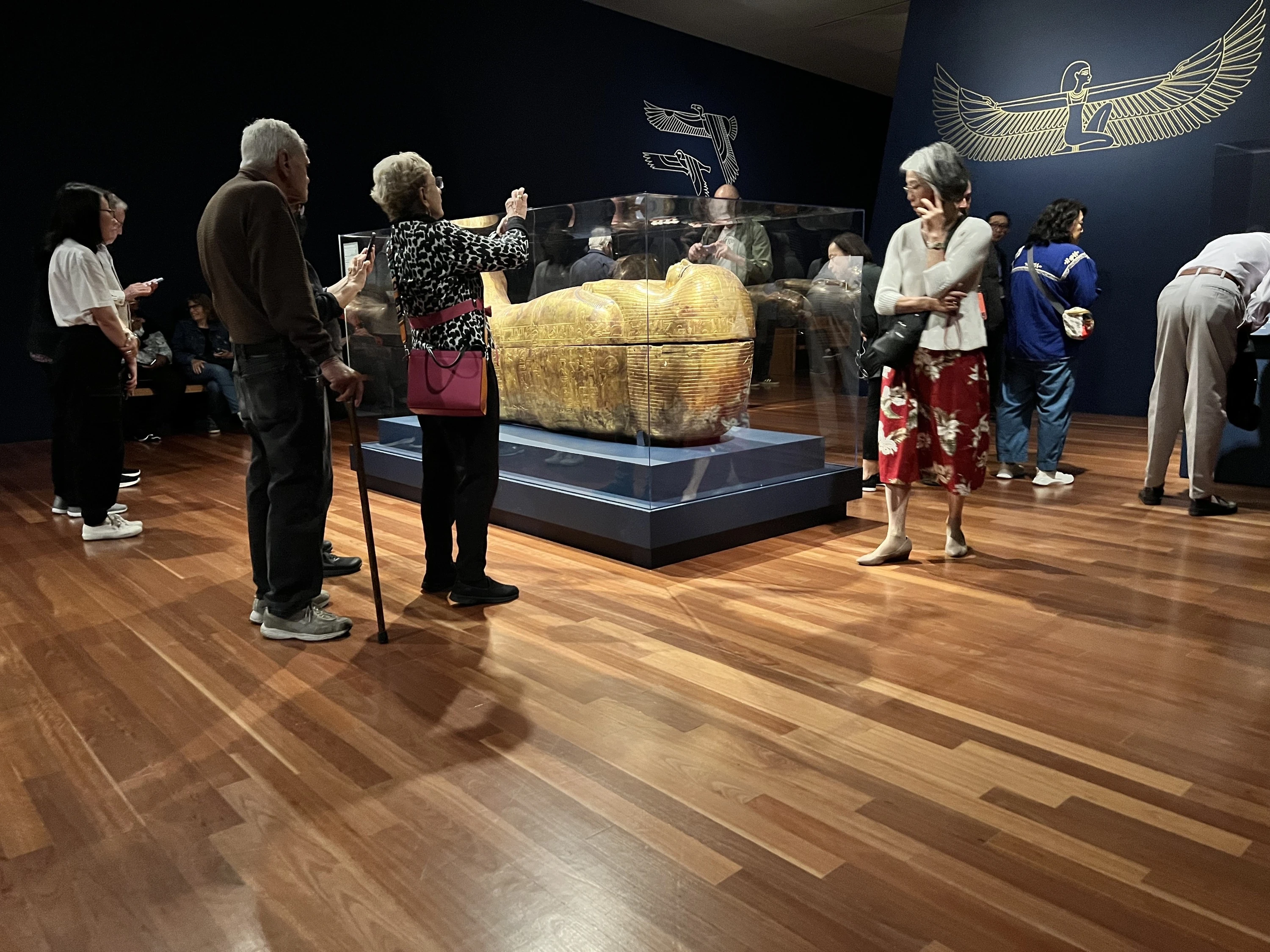
If that’s piqued your interest, then you’ll certainly want to head to San Francisco’s de Young Museum for the recently launched “Treasures of the Pharaohs,” an exhibition bringing some incredible never-before-seen-in-North America objects to the U.S., including a room full of artifacts from the Lost Golden City.
That’s the recently discovered city in Luxor, Egypt, which was home to artisans roughly 1,300 years BCE during the dynasties of Amenhotep III and his son, who rebranded himself as Akhenaten—and later became Tutankhamen’s dad! Because of Akhenaten’s religious conversion, the Lost Golden City (also called the City of the Dazzling Aten) was suddenly abandoned, leaving it largely intact with earthen structures and walkways. Its discovery in 2020 by Dr. Zahi Hawass and team is considered one of the most significant ancient Egyptian finds since Tutankhamen’s tomb in 1922.
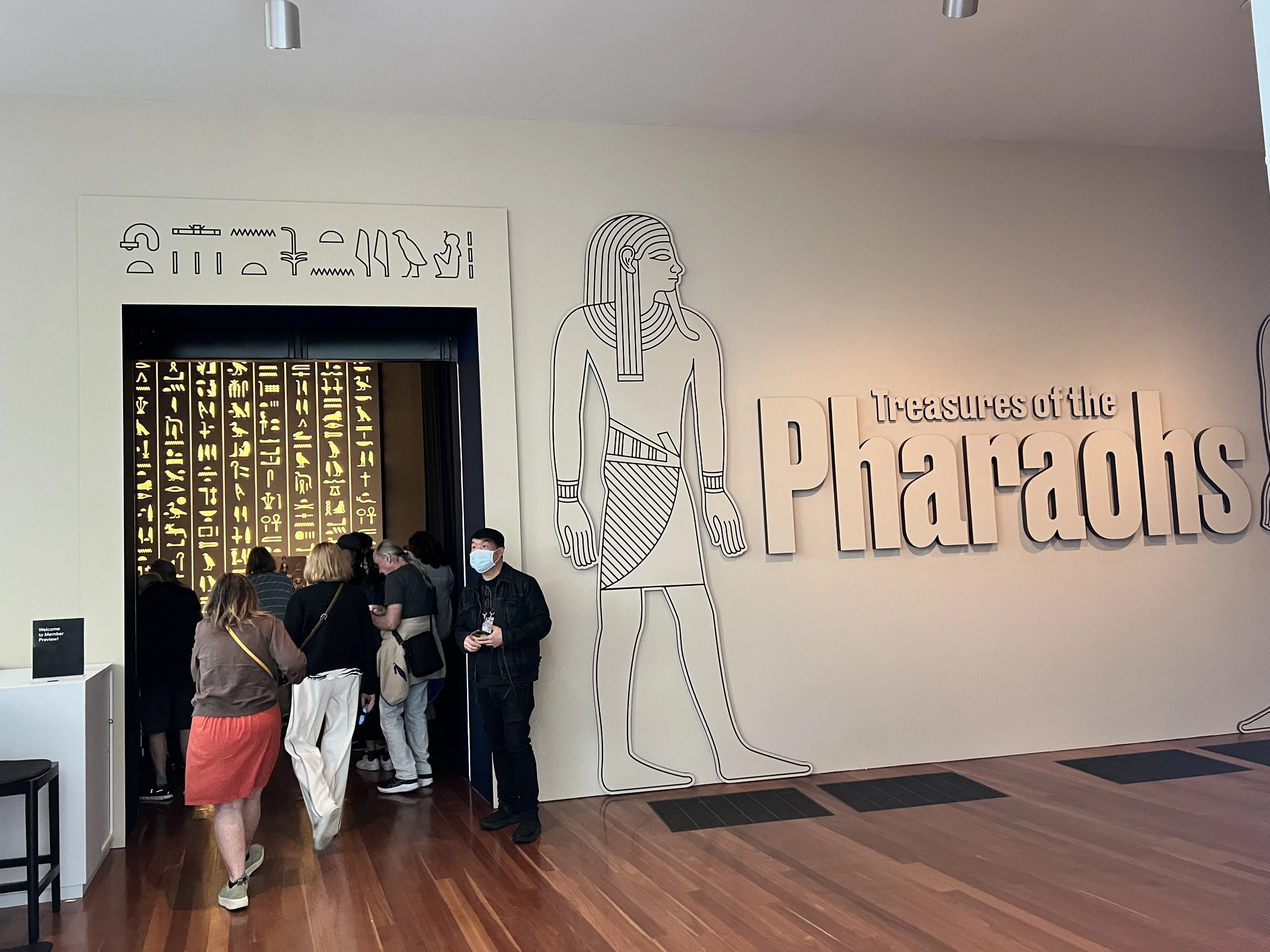
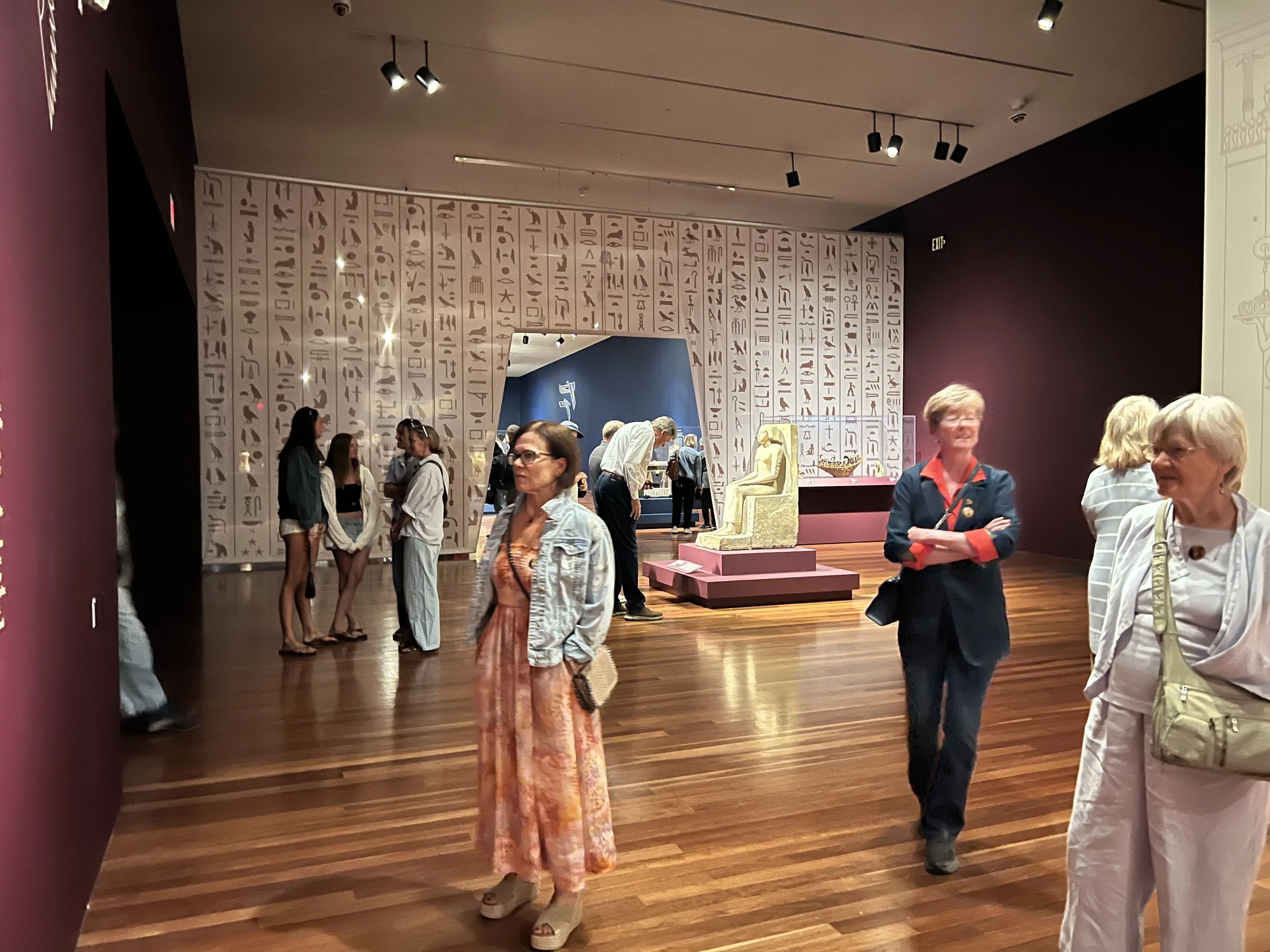
In the exhibition, the Lost Golden City artifacts get their own room, with items like a blue ceramic ring, a potter’s wheel, pottery casting molds and a few examples of objects from those molds, like a wedjat eye and a berry. You’ll also find a handful of other chambers to walk through. The objects are all beautifully displayed, often in glass cases that permit you to walk around it and see side and back views. Throughout the rooms you’ll find fantastic wall illustrations; I saw one young girl completely awestruck, frozen in front of one colossal figure. In fact, if you are bringing kids and think they might be bored, tell them to try to find the illustration of the walking snake, a humorous and also chilling vision.
It was extraordinary to see large-scale artifacts there, like the heavy, cumbersome coffin of Thuya from Dynasty 18, which always makes me wonder how they are placed in position. Undoubtedly, freight elevators whisked Thuya’s coffin upstairs, bypassing the staircase which is decorated so beautifully with a detail of that very coffin, showing her somewhat downcast face. It makes me shiver to think about the artisans of ancient times and how they were able to ease the coffin into place without the technology we have today.
This touring exhibition will only be seen in the U.S. in two places: the De Young until January 31, 2027 and the Kimbell Art Museum in Fort Worth, Texas, where it will go after the San Francisco show closes. Previously, it was in Rome’s Scuderie del Quirinale last year. The De Young’s curator for this exhibition is Renée Dreyfus, who’s also curator of “The Etruscans” exhibit on display at San Francisco’s Legion of Honor museum. The original Egyptian curator who assembled the artifacts is Dr. Tarek el-Awady, former director of the Egyptian Museum in Cairo.
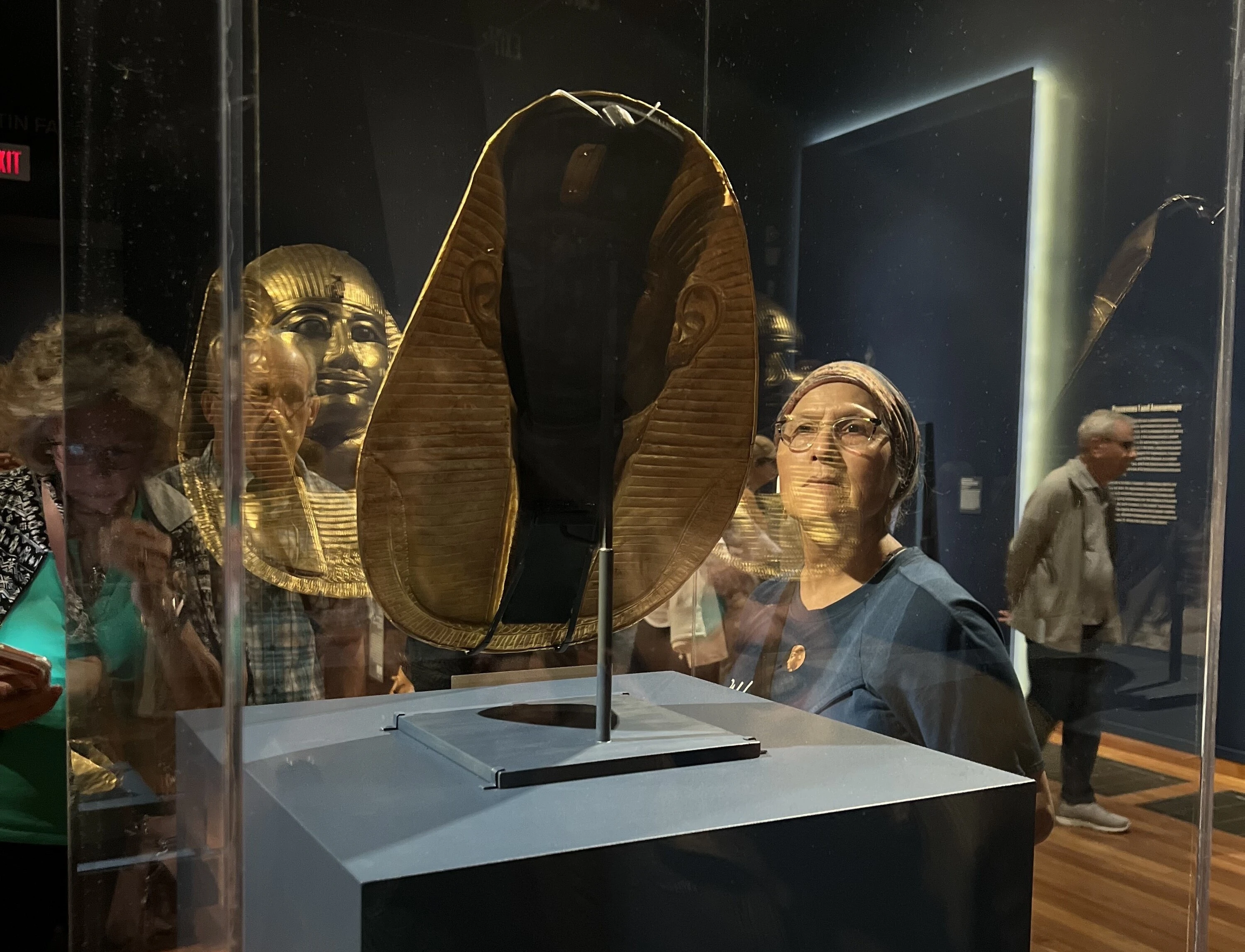
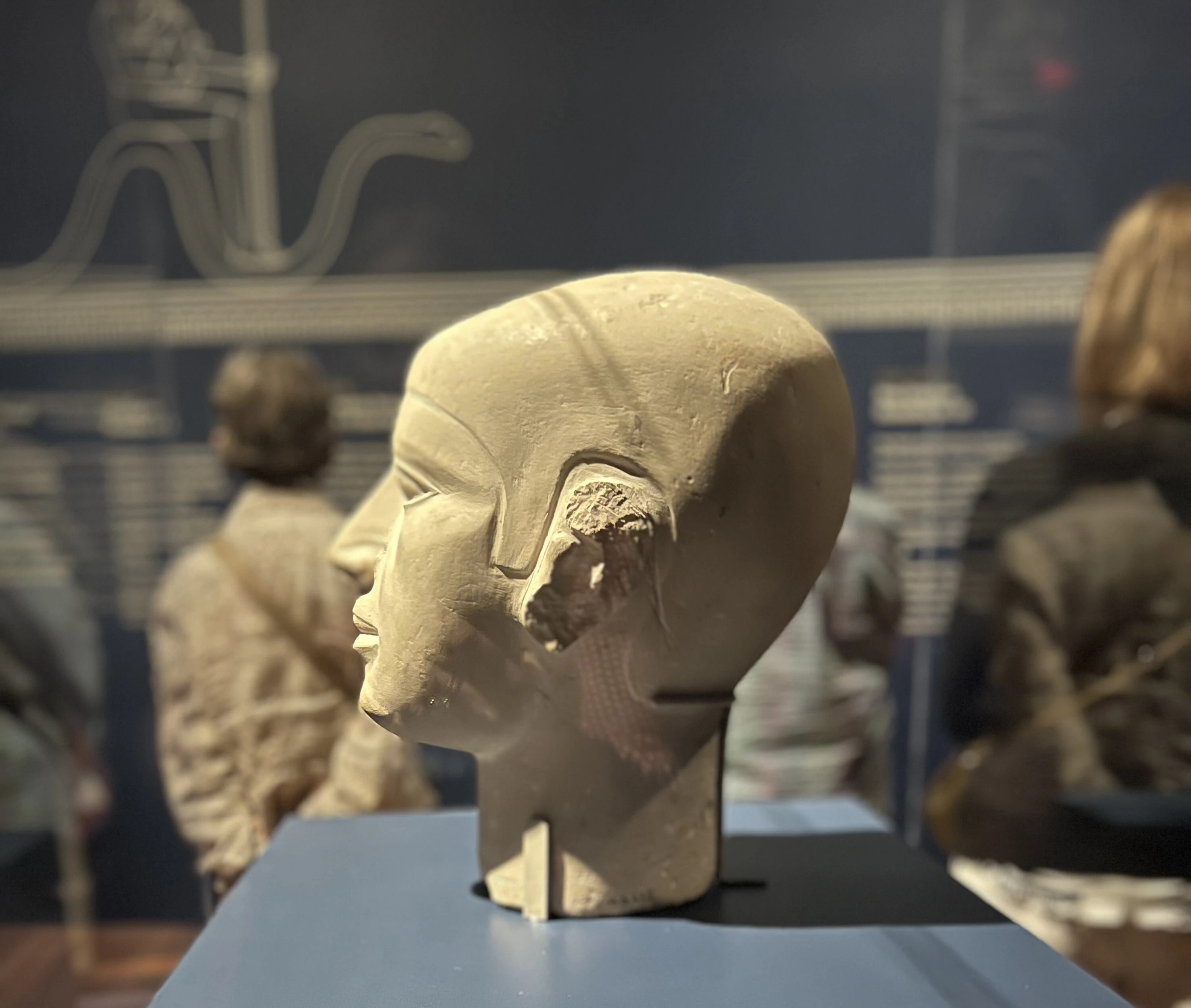
These objects, sometimes stark, sometimes busy with hieroglyphics and detailing, invite close study and maybe even reverie. I loved watching one woman stare intensely at the golden funerary mask of Amenemope; it’s one of my favorite photos from the exhibition! Imagining that people fashioned and held these objects 3,000 years ago boggles the mind. We’re celebrating America at 250… comparing 250 years to 3,000 makes us realize our country is only mere minutes old.
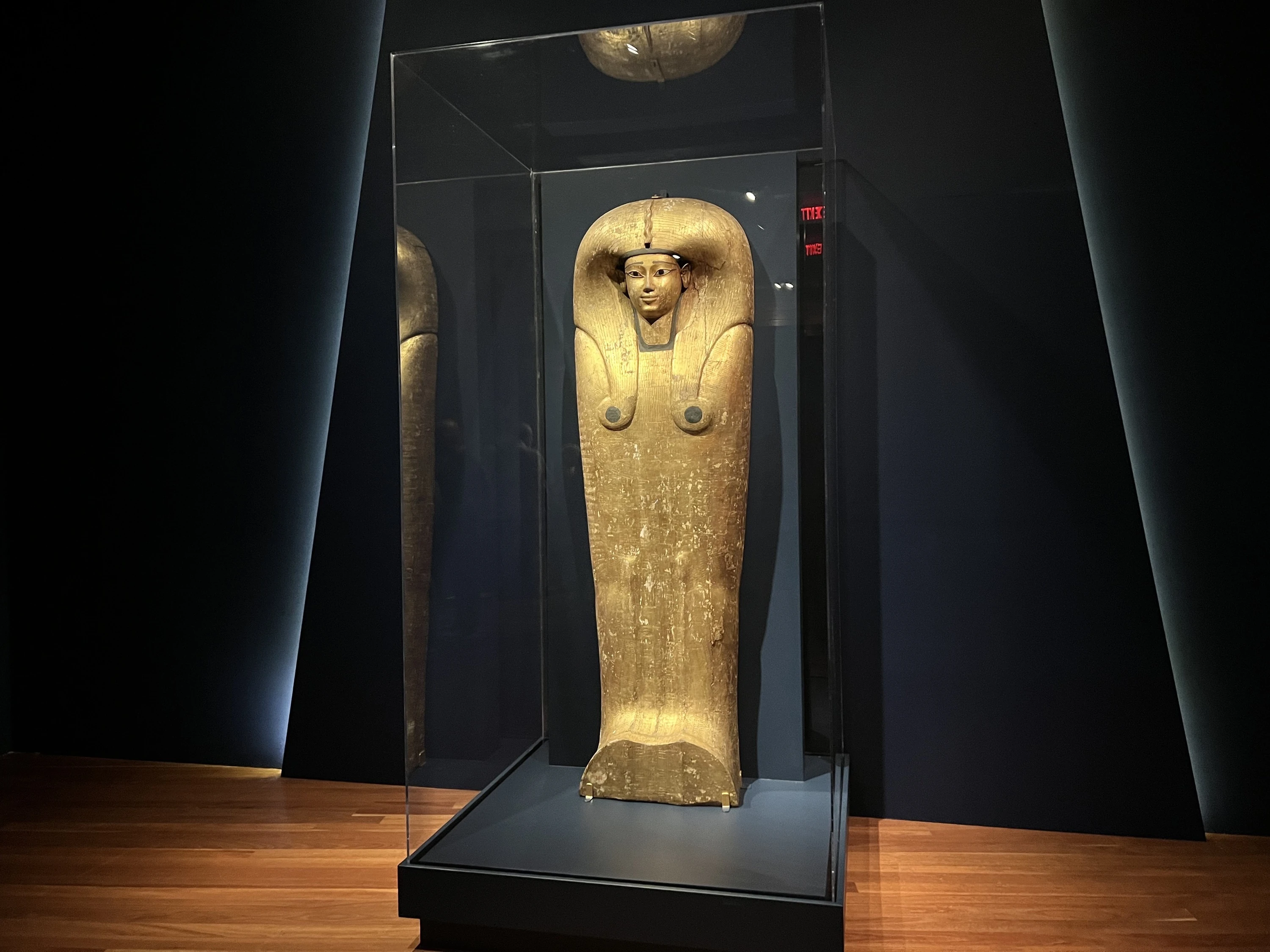
A few highlights for me were a military necklace made out of stylized flies and the standing coffin lid of Queen Ahhotep II. This shows her in a massive Hathor-style wig, with two braids ending with decorative blue disks. Her whole body is covered in feathers from the goddess Nut, who nightly bends her body over the earth to become the night sky. Nut (pronounced “newt”) swallows the sun each evening and then gives birth to it in the morning. Some of the objects seem simple, especially given the artistic oddity of the habit of giving people seen in profile a full eye as if seen from the front. Other objects stun you with their precision, like seeing the flexed calf muscle in a standing figure. The artifacts humanize the ancients, with a baby rattle, bracelets, an armchair, a vase for holding flowers. Although their death practices were very different from ours, their lives were filled with many of the same household items.
The exhibit is separately ticketed on top of de Young admission with timed entry, at $40 for adults, $37 for seniors, $31 for students and $25 for youths ages 6 to 17. Admission includes entry to the rest of the museum’s contemporary art collection and the exhibition “The Gathering,” of paintings on sacred cloth by Nigerian artist Nengi Omuku. You enter through a portal that tantalizingly shows a wall of hieroglyphics inside, lit from behind.
Decades ago, back in June of 1979, the de Young hosted the famous traveling exhibition of King Tutankhamen’s treasures. Although amazing institutions like the Metropolitan Museum of Art, the National Gallery of Art in Washington, D.C., Chicago’s Field Museum, or even another west coast locale, Los Angeles County Museum of Art, showed that Tut exhibit before the de Young did, we’re pretty chuffed that San Francisco is one of only two cities chosen for this exhibition!
The 130 objects here are on loan from the Egyptian museums in Cairo and Luxor. The exhibition launch at the de Young earlier in August included visits with dignitaries like the current Minister of Tourism and Antiques, Sherif Fathy, and Hawass himself doing a book signing of his exhibition book Treasures of the Pharaohs. This hardcover catalog weighs five pounds (I put it on the scale!) and costs $70, a great coffee table book to fuel your further dive into ancient Egypt. “Mysterious and rich in knowledge, ancient Egypt remains an intriguing culture with roots lost in the mists of time,” writes Hawass in the introduction.
Discover Time Out original video