[category]
[title]
From leading a human rights organisation to painting murals that span continents. Jacqueline de Montaigne welcomed Time Out into her Cascais studio to discuss how painting became her ultimate balance, the botanical legacy of her grandfather, and the process of turning mental health into monochromatic art.
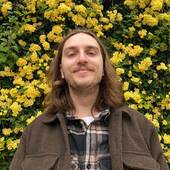

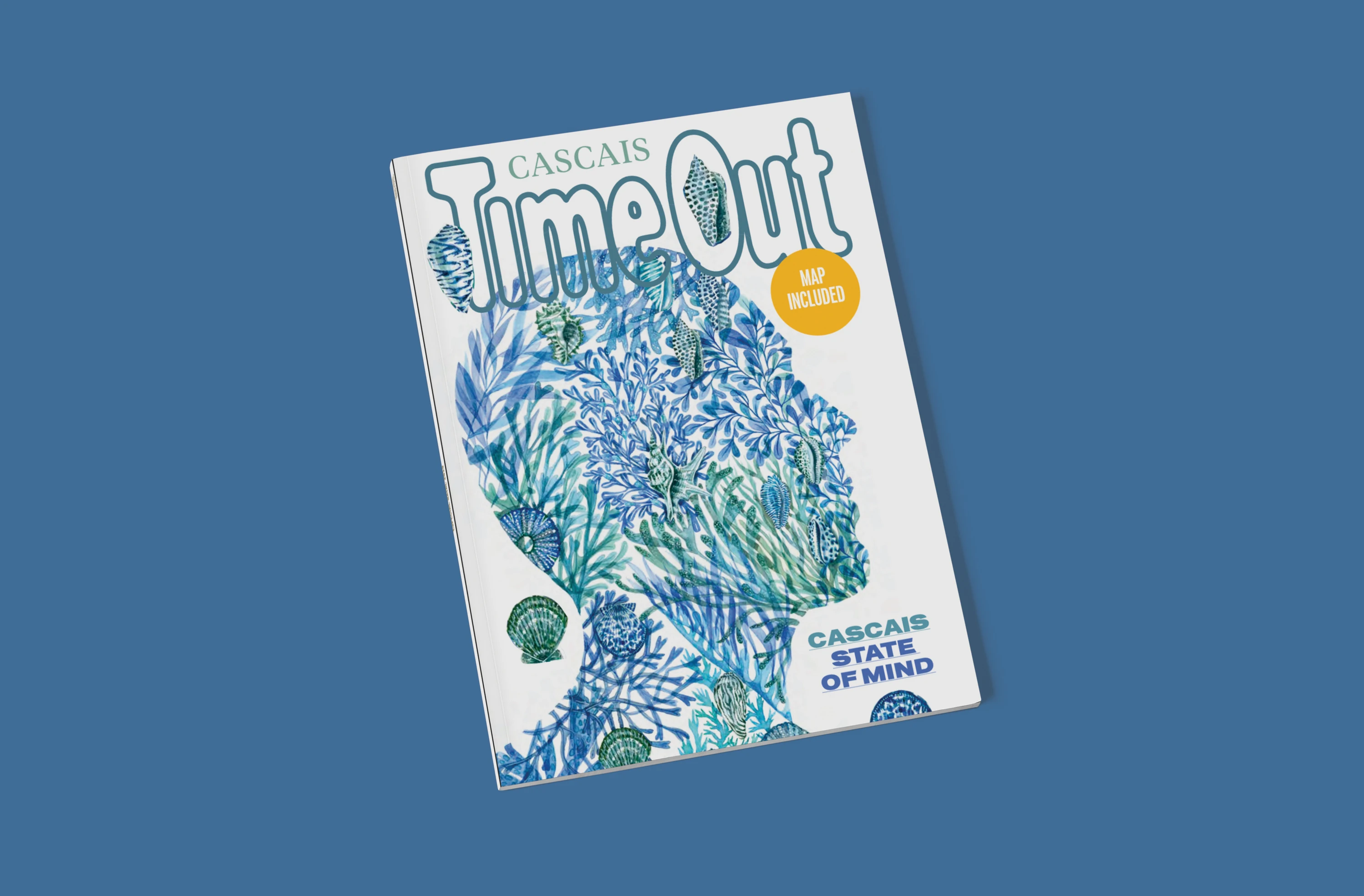
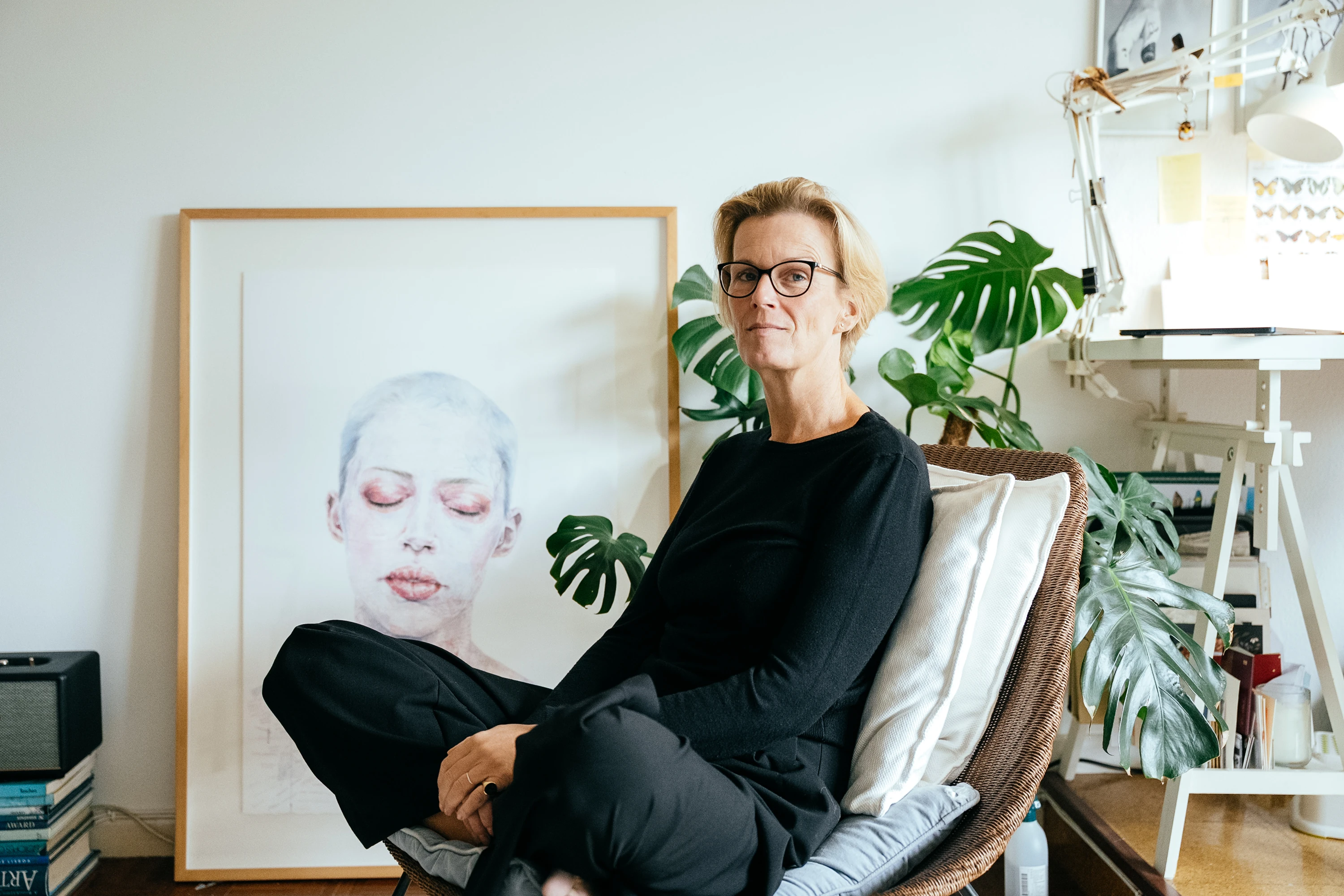
She lives between continents, but Cascais is still the place she calls home. Jacqueline de Montaigne, a trained psychotherapist, former director of a human rights organisation and artist by vocation, found in painting a way to bring together everything that defines her: a deep interest in people, a connection to nature and a highly personal relationship with mental health. With a career spanning both intimate canvases and large-scale murals, she is the artist behind the maritime-inspired cover illustration of the latest issue of Time Out Cascais.
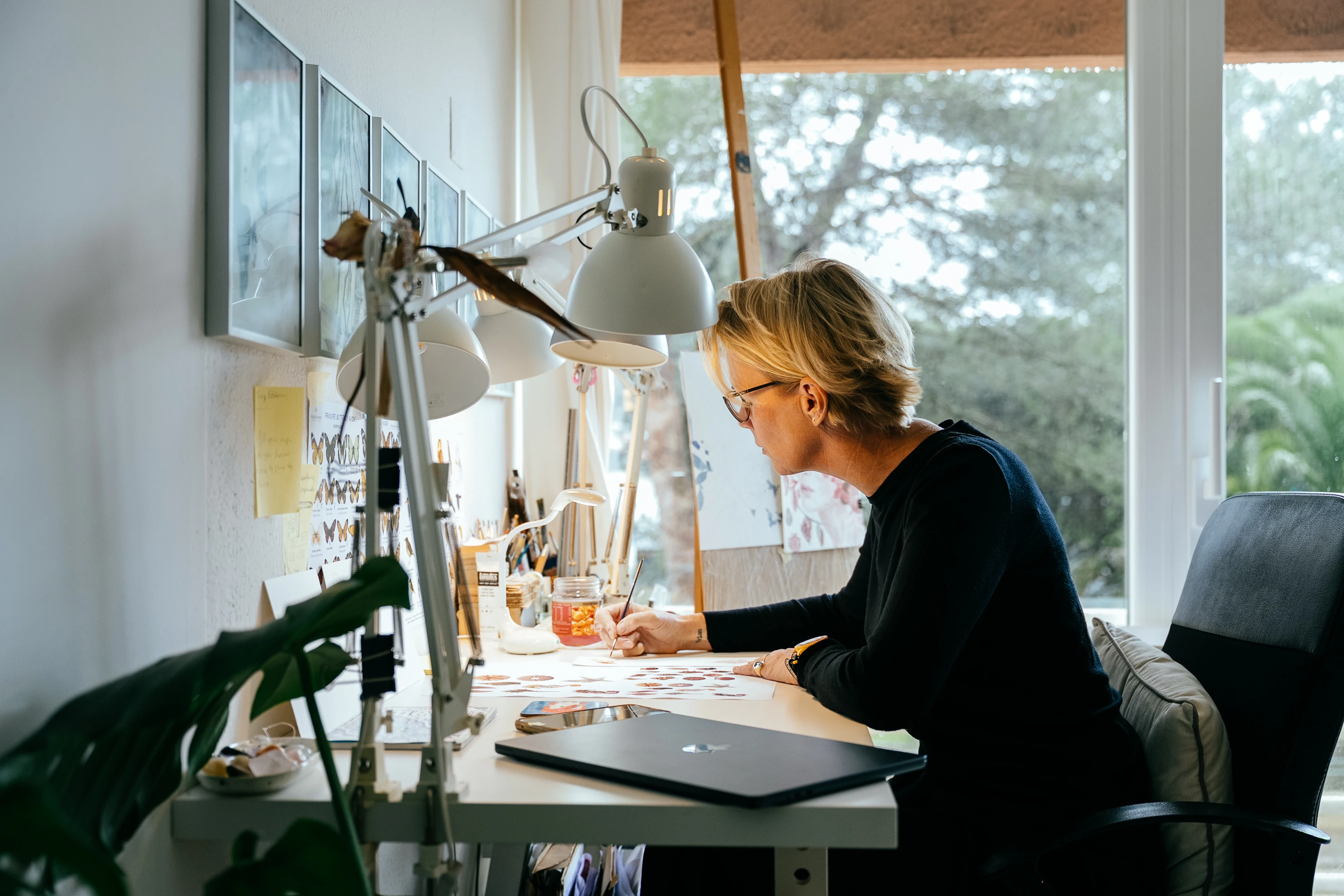
At her home and studio in Cascais, she spoke to us about the unlikely path that led her from science to mural painting, her fascination with portraiture, the legacy of her grandfather, a botanical artist, and the way art became her most important tool for maintaining balance.
One thing that caught my attention in your work is the paintings you do on walls and huge canvases. How does an artist become interested in working on this scale?
It was never my intention to paint murals. In fact, the first one that really caught my eye was in Cascais, a piece by Mário Belém. I was very confused by the way he painted, and how the police didn’t catch him (laughs). I had no idea what this thing called urban art was. Later, a friend told me who he was – we even went to the same school, although he’s older – and that’s how it began.
When did the first invitation to work on this scale appear?
At the time I was the director of a human rights organisation and we were going to build support centres in the south of Portugal for women and refugees. I wanted to use walls as a form of education about child nutrition or to promote breastfeeding. I had already seen this in poorer countries, where people don’t speak the language or have the literature to understand, but an image can speak a thousand words. So I contacted a curator and asked how much it would cost to do this kind of project. In the end it didn’t go ahead, but years later that same person contacted me and said, “I know you paint” – although at that time I had stopped because I had gone back to university, where I was studying health sciences and psychotherapy – “would you like to paint a mural?” I didn’t know what to say, or where to begin. I hadn’t picked up a brush for seven years. I ended up doing a very small mural at LX Factory [Alcântara, Lisbon] and got the bug. Interaction with the public is my favourite part. That mural took a week to paint; now it would take an afternoon.
Going back to the beginning, where did this interest in art come from?
It wasn’t something that suddenly appeared – it had been there organically since I was young. I believe everyone has an interest in art, all children like art classes at school, but I was obsessed. If I didn’t have a brush, I’d look for a stick and draw on the ground or make drawings with water on the pavement. It was always present.
When you were studying science, did you ever think your life would end up being dedicated to art?
When I was younger I painted, exhibited and sold my work, but I still hadn’t found my kind of painting. I could do an old-style oil painting, work with charcoal or paint a building… I could paint anything, but I didn’t have a style. The value of an artist really comes from their identity, and that was something I lacked. I didn’t want to box myself into anything, because I would feel tired and frustrated. However, I was always interested in portraits because I’m fascinated by people. When I was 12 I did some modelling jobs, but I was very shy at castings. So I used to hide behind a small sketchbook drawing people. It was my way of disconnecting and hiding, but also of watching what was around me, especially the beauty of angular figures. I wanted to capture them somehow.
But your portraits don’t represent only the human figure. There are other elements.
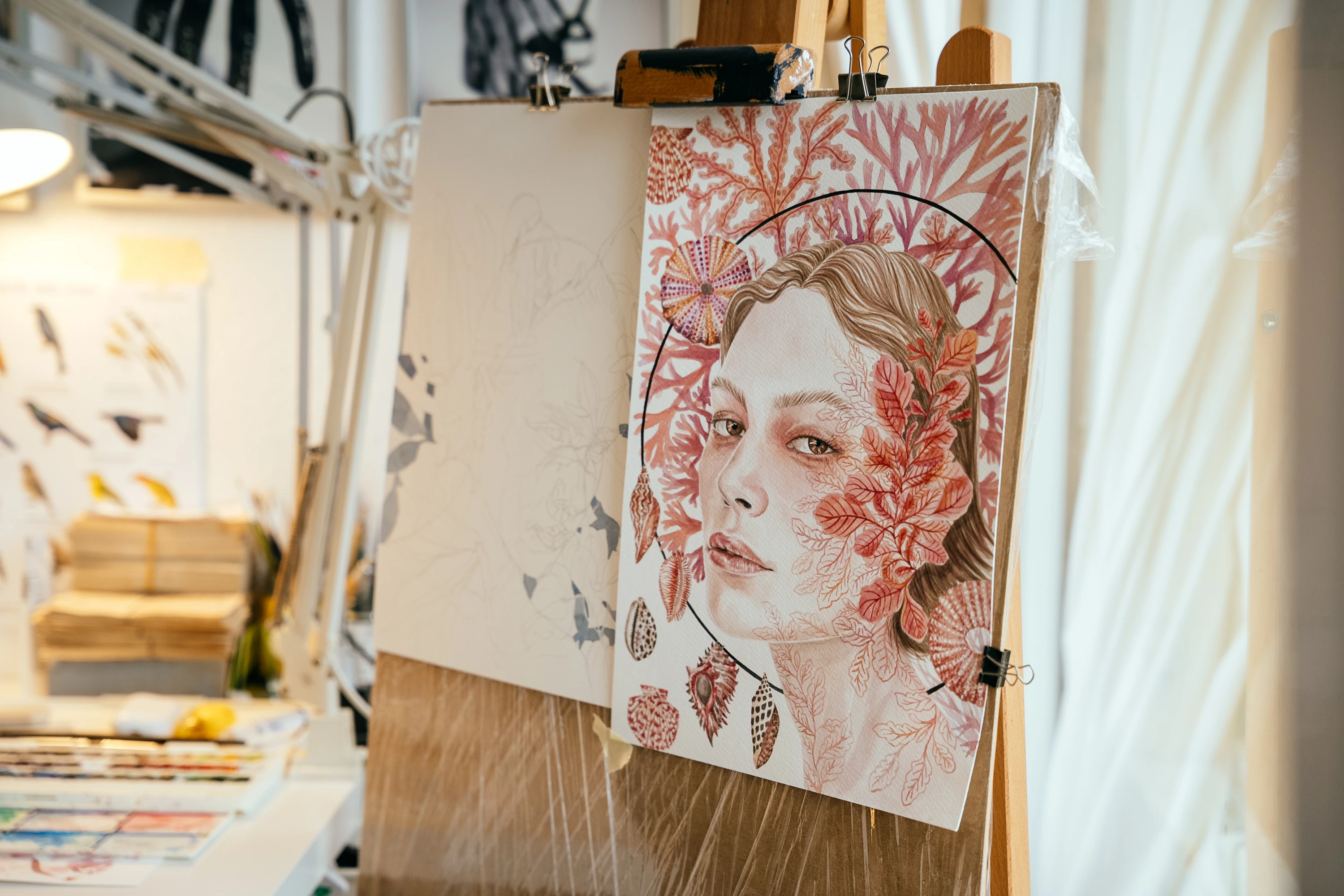
My grandfather was a botanical painter. I used to sit next to him in the studio and that’s how flowers began to appear in my work. As you can see, this desire to make art was always inside me, but I simply didn’t have the chance to pursue it. I was also a single mother and couldn’t just follow this ambition – someone had to put food on the table. It was a decision I made and didn’t have the luxury of making earlier. Even before moving forward I had to do thousands of silly jobs – like writing letters for restaurants or illustrations for magazines – to see whether there would be any demand for my work.
When you’re choosing models for your portraits, what elements do you look for?
I love a good bone structure and angular figures. I spend my life stopping people in the street to photograph them. I have an image bank with thousands of portraits that I never know when I’m going to use. This preference comes from the time when I worked as a model, but also from my family. We’re all tall, thin and angular. I love drawing my eldest son, who is truly androgynous and two metres tall.
You were talking about how plants began to appear in your work, but what do they represent?
One of the first times I painted flowers was for my grandmother’s birthday – although they turned out very badly. When I was 37, I asked her for my grandfather’s old books. They still had the dried flowers I had put inside them. Her favourite flower was the freesia, and when she fell ill I decided to include it in one of my works. Whenever I painted flowers I felt a connection with her. But anyone can paint flowers. I wanted mine to have meaning. So I researched and realised there was a system of codes, very popular in Victorian times, that could add something to my work. For example, in the case of freesias, they are flowers you would give to a friend. The more flowers you add, the more complex the message becomes. I thought it was a good way of adding layers to my art. All the flowers in my work have meaning.
There is also a mental health component in your art. How is it represented?
I think it works the other way round. I was diagnosed with clinical depression when I was 10. It’s something that runs in my family and it’s very frustrating because there is no clear cause and there isn’t much you can do to deal with it – you have to learn to live with it. One of the reasons I studied psychotherapy was to understand myself; I never intended to work in the field. Art has always been my therapy. Not the finished painting, but the process. I always try to convey a message, but it’s the other way round: the act of painting helps me maintain a certain balance. People often say that my work helps them relax, and that’s exactly how I feel. That’s one of the reasons why there is little diversity of colour in my paintings, because that would be too stimulating. Keeping this monochromatic aspect and the elements of nature evokes calm. More than having a direct and literal message, I want my art to make people talk naturally about their problems, as is happening between us today.
Since we’re talking about your art, could you tell us a little about the illustration you did for Time Out Cascais magazine?
A few years ago, I painted a large mural at Hotel Baía, in Cascais, where I told the story of the family. Through this project, I ended up meeting the President of the Parish Council, who explained to me that the origin of the town’s name is related to the sound that shells make when they are on the sand of the beach. This story was a great inspiration. The artwork is monochromatic; all the shells represented are native to Cascais. I try, in my art, to create a single ecosystem, where the person is part of nature and nature becomes part of the person. Only in the last 100 years have people started living in urban spaces, in these concrete jungles. This is not natural to us. I try to represent this return to our origins.
Which flowers did you use in this portrait?
They’re all seaweed, because we’re in a fishing town by the sea.
And besides representing the sea, is there another meaning linked to your system of codes?
It’s not that deep (laughs). The same applies to the circles that appear in my works. The truth is that I’m neurotic and that helps me to “organise” all the elements I want to draw. I had never explored these maritime themes before; however, this year I have five murals to paint – and they’re all by the sea.
Was it a difficult theme to explore?
I had already painted shells on the back of the bay. I prepared myself well and did thorough research; that gives me confidence and reassurance.
How does Cascais inspire your work?
My family has been here for hundreds of years. It’s my home. I’ve lived in places like the Philippines, Thailand, Saudi Arabia and Scotland, but this is where my grandparents lived. When I’m here, I still go to the market and people still recognise me because of my grandmother, or say they remember my grandfather. I remember going to Parque Marechal Carmona to play with the monkeys that used to live there. The town today has nothing to do with those days, and since my grandparents died I’ve lost such a strong connection, but it’s still home. Places like Guincho – when it’s not violently cold – are truly inspiring. Coming back here always puts me in a calmer state of mind.
What are your plans for the near future?
I’ll continue painting murals, but I’m being more selective. I have five murals planned in five countries. I’ll also have my first exhibition at Museu da Água in October, which will be about my two years on Príncipe Island and about the circular system of social work, artistic interventions, my mental health and the impact it has on our lives. I’ll also be curating my first urban art festival in Africa, also on Príncipe Island. It’s a pilot programme, but I’ll explain and teach, in the hope that they can continue afterwards. I’m very excited, but I feel it will be similar to when I’m building a mural. Halfway through the process I think, “Why did I get myself into this?” Then I finish, and it’s a huge victory.
Time Out Cascais is a free magazine, available at the Cascais Tourist Information Centre, on the Bay.
Discover Time Out original video