

[category]
[title]
Little Ripper Skateboarding offers after-school programs in Chicago Public Schools, teaching children life skills through the sport of skateboarding and actively raising funds for local community causes.


Ask any so-called expert what children need these days and you’ll get the usual answers: less screen time, more structure, consistent bedtime—and, inevitably, therapy. But according to Enrico Hufana, there’s something else kids need: the feeling of dropping into a quarter-pipe with nothing but a wooden board and the wings of their own confidence beneath them.
Hufana is the founder of Little Ripper Skateboarding, a fast-growing skate school that began as a few lessons in a city park and has since evolved into a community hub—offering group and private classes, year-round programming and serving as an official Chicago Public Schools after-school provider. It’s not just a place to learn how to shred; it’s a space where kids build confidence, make friends and discover what they’re capable of. This year, they further expanded their reach, deepening their engagement with the community through grassroots activism and new after-school programming initiatives.
It’s a vision that mirrors the organization’s mission: to bring skateboarding to kids of all ages, genders, racial and socioeconomic backgrounds—uplifting them through camaraderie, sportsmanship and community. In a city where access often depends on zip code or income, Little Ripper offers a space where everyone starts from the same place: one foot on the board, one push forward and a community ready to help them cruising.
Hufana’s love for skating began the way many great love stories do: young, determined and blissfully unconcerned with personal safety. He learned alongside friends at Roscoe Village’s Lane Tech College Prep and bought gear from a classmate who cycled through used boards at breakneck speed, selling decks for $30—a small miracle in a sport known for its hefty price tag. But adulthood eventually intervened. A physically demanding job pulled him away from skating, and a decade passed without the familiar rhythm of wheels against concrete.
That changed the moment Hufana learned he was going to be a father. Suddenly he had nine months to return to skateboarding—not as a midlife scramble, but as a vow to the child on the way. And he kept it.
Eight years later, that paternal pledge had turned into a daily routine, culminating when the world slowed down during the pandemic. “People were baking sourdough bread and I was out skating every day with my son,” he recalls of those early months in 2020.
Even before lockdowns, Hufana knew he wanted to teach his son to skate, but the shutdown offered something parents rarely get: unlimited warm-weather daylight with nowhere else they were expected to be. Skateboarding felt safe—an open-air activity where distance came naturally and movement helped counter the heaviness of the global moment. Hufana’s plan was simple: hit as many skate parks as possible, often daily, with Grant Skate Park quickly becoming their home base.
One afternoon, while skating with his son and nephews, a mother approached Hufana and asked whether he would teach her child, assuming he was an instructor. He declined at first out of caution, but she checked in every few weeks, and eventually he reconsidered. At the time, he was still learning how to teach his own son, who hadn’t taken to the sport immediately. Hufana believed that once the basics clicked, his son could truly decide whether skateboarding was for him. And when those fundamentals finally landed for his son, something else landed, too: genuine joy.
That breakthrough was the turning point. Hufana agreed to teach the mother’s child, and his first formal lesson resonated not just with that student, but with other kids who were watching, too. The mother filmed part of the session and posted it in a Facebook group populated by South Loop moms, and soon more parents reached out. By the end of the summer, Hufana was teaching around 20 children.
When winter arrived, parents begged the question: How do we keep this going in the cold? That concern pushed Little Ripper into its first physical home—a vacant storefront Hufana temporarily secured through his former real estate career. The space was bare-bones: four walls, a leaking roof and no heat. But it was enough. He began building small ramps and obstacles, each one tested and approved by his son Rue, whom he proudly calls the “boss” and the “secret CEO” of Little Ripper. Kids stayed warm dropping into tiny ramps and cruising over improvised features while parents lined the walls in coats and hats, phones ready to capture every hesitant ollie and triumphant first drop-in.
“Parents tell me their children have become more confident,” Hufana says. “They learn here that things take time and usually come with a lot of failed attempts—and they take that mindset into everything else. It’s amazing what skateboarding can do for a kid.”
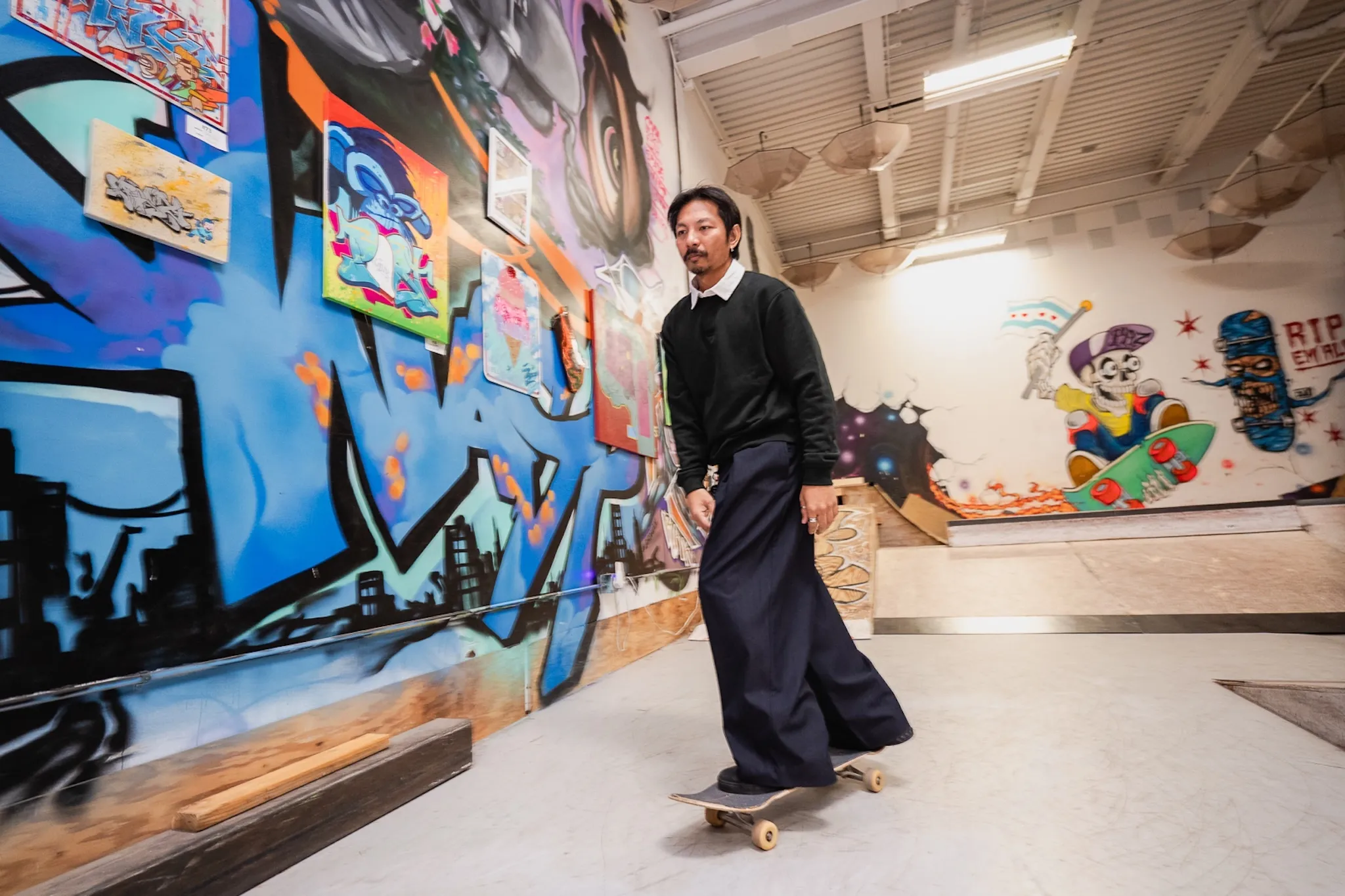
Since that first DIY storefront, Little Ripper has grown into its current home at 4319 North Knox Avenue. Not long after they settled in, Hufana invited a local graffiti crew to tag the interior; word spread, and now artists regularly reach out asking to add their own work. The walls have become a living collage of murals, tags and spray-painted skulls—an ever-evolving record of the community taking shape inside the space.
The programming has expanded alongside the artwork. Little Ripper now offers private lessons for children, after-school programs and adult classes, creating a rare environment where parents, seasoned skaters and absolute beginners learn side by side. In a city where after-school options can be uneven and families often scramble for safe, meaningful spaces, Little Ripper offers something distinct: structured chaos with intention. Here, falling isn’t failure—it’s part of the lesson plan.
“We see kids from all backgrounds, and what we’re offering shows that none of that matters. They leave the lesson feeling better about what they did—and better about themselves.”
This distinctive approach has allowed Little Ripper to integrate into the formal education system, becoming an official Chicago Public Schools after-school provider at schools like St. Therese Chinese Catholic School and St. John Berchmans, which sits right across from Logan Square Skate Park. Roughly 3,000 students have passed through Little Ripper’s programs so far—some actively enrolled, others returning from earlier seasons and many just starting out. Hundreds more take private lessons each week, and school-based sessions continue to grow as word travels across the city.
“I think it’s the chance to really socialize,” Hufana says. “Skateboarding naturally offers that, and we’re creating a space where kids and adults can practice it. Especially now, when so much is digital, it becomes a mental practice—learning inner confidence through falling, trying, failing and doing it again.”
Beyond traditional lessons, Little Ripper hosts “skate jams,” drop-in sessions for kids when school is out, giving them a safe place to move, experiment and just be around one another. There are adult skate jams, too—including one specifically for women, moms and femmes—a welcome counterbalance to skate culture’s formerly macho posturing.
“We see kids from all backgrounds, and what we’re offering shows that none of that matters,” Hufana says. “They leave the lesson feeling better about what they did—and better about themselves.”
In early 2025, when ICE launched Operation Midway Blitz and other immigration enforcement sweeps across Chicago, Hufana watched neighborhoods he’d grown up in absorb a familiar mix of fear and uncertainty. Like many, he stepped into grassroots organizing—helping parents understand their rights, connect with resources and redirect their anxiety into something actionable.
That work soon took on a visual identity: bright cobalt shirts reading “ICE BREAKER,” illustrated with skaters smashing a block of ice beneath their boards. The Little Ripper community rallied behind the effort, raising thousands of dollars for the business’s solidarity fund—money Hufana intentionally funneled not toward large national organizations, but toward local efforts often overlooked. The fund has helped support legal defense for families, aided Swap-o-Rama vendors abducted in October and backed the Illinois Coalition for Immigrant and Refugee Rights.
“I just want to help people—I didn’t know that was the thing that would bring me joy, but now I do,” he says. “And if it’s not ICE next time, it’ll be something else. Another community that needs support.”
Little Ripper is continuing its expansion across Chicago, and Hufana has a particular focus on Passages Charter School in Uptown, which serves predominantly immigrant families. The school faces limited funding and few after-school options—a gap he hopes to help close not only with skate lessons, but with the consistency, mentorship and community support systems many families say they struggle to find elsewhere.
“You don’t have to come from a wealthy background to skate,” Hufana says. “I started with used gear. Kids today with limited access still have talent—you just have to help them reach it.”
That idea—that access is a community responsibility—drives many of Little Ripper’s newest partnerships. The organization recently teamed up with Logan Square Skate, a nonprofit committed to rejuvenating the aging, weather-sheltered skate park beneath I-94. Despite years of disrepair, the park remains a rare resource: a year-round, covered gathering space for skaters and neighborhood kids who need somewhere safe to land after school. To support the revitalization, Hufana is circulating a petition, and a town hall is scheduled for December 11 at St. John Berchmans—the first school to partner with Little Ripper. From there, he hopes to activate the space even further with expanded programming and deeper community-driven efforts.
For Hufana, Little Ripper’s mission has evolved far beyond teaching tricks. It’s about creating inclusive spaces where young people can spend time after school, feel seen and discover parts of themselves in the company of others.
“I grew up when skateboarding was seen as a white kids’ activity, and in the city there wasn’t much access for us,” Hufana says. “From the beginning my mentality has been: don’t deny anybody; consider everybody. If this is what I can do alone, imagine what we can do together.”
In the end, skateboarding isn’t just flipping and grinding—it’s the quiet miracle of wheels meeting pavement and something inside a kid clicking into place. It’s the first wobbly kickturn landed, a parent realizing their child’s sense of wonder is still intact, a community building momentum where none was guaranteed. The sport itself is a demanding teacher, giving nothing you don’t earn and everything you didn’t know you needed: confidence, breath, balance, the resilience to fall and try again. For Hufana and Little Ripper, that’s the gift they offer Chicago—one small push at a time, toward joy, possibility and a future where community resources are built from the ground up, together.
Discover Time Out original video