[category]
[title]

Review

In Peter Shaffer’s Amadeus, genius is not just a blessing: It’s a declaration of war. Composer Antonio Salieri sees himself as one of its principal casualties. Once the darling of the 18th-century Viennese court, he watches in mounting horror as “the creature”—his term for the rising musical prodigy Wolfgang Amadeus Mozart—launches an artistic takeover that endangers not just Salieri’s career but his very conception of himself. The scaffolding of his principles collapses beneath his suspicion that God has chosen someone else above him, and his devotion rots into destruction.
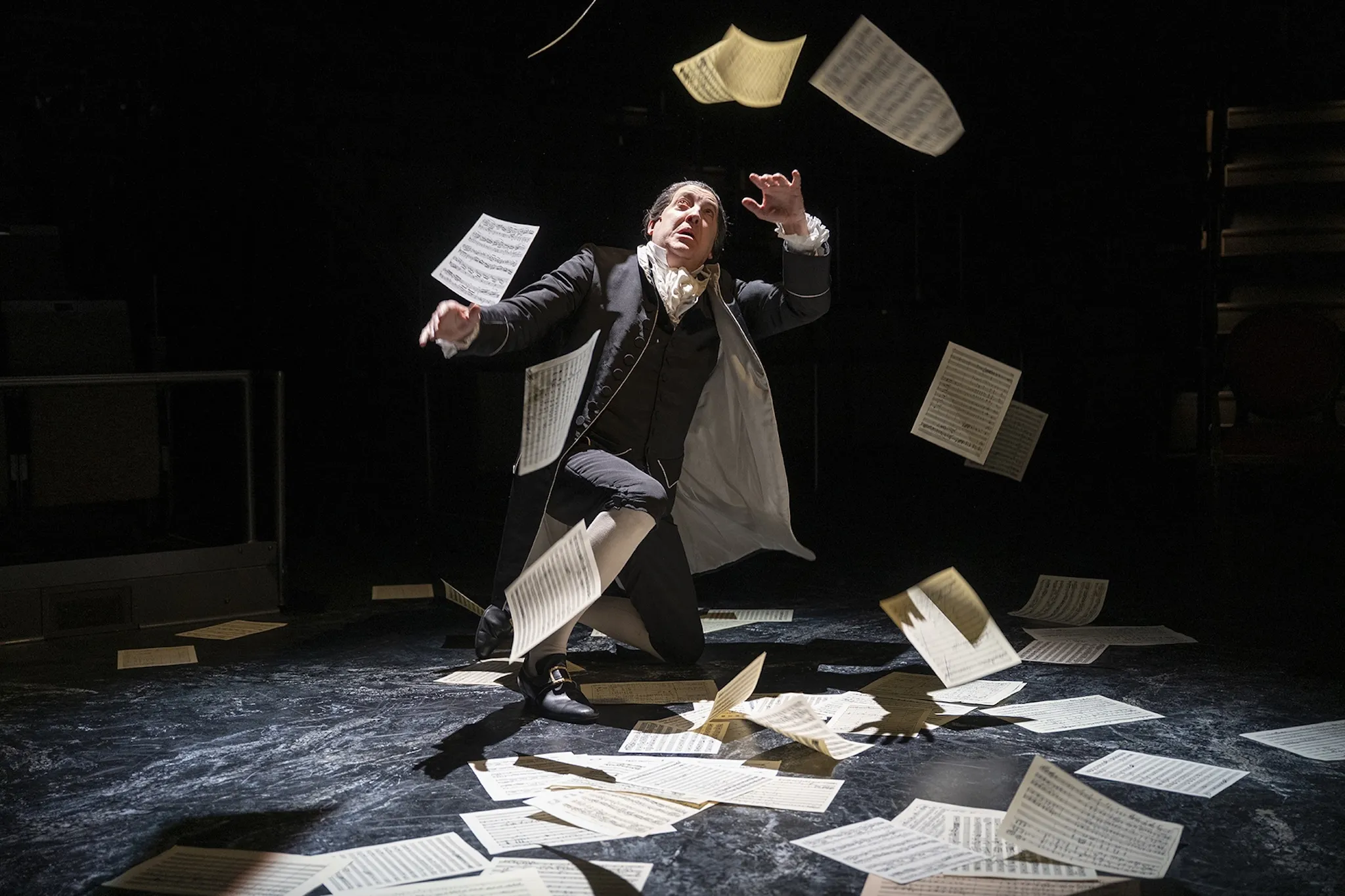
Amadeus | Photograph: Courtesy Michael Brosilow
Salieri never leaves the stage. Recounting his venomous rivalry from the safety of his deathbed, he is both Amadeus’s antagonist and its narrator, and his voice is the lens that refracts the entire story. Once he had offered his life in monastic devotion to music and to God; now he confesses how swiftly he turned away from both when Mozart revealed what true genius sounds like. In a lesser actor’s hands the role might wear thin, but Ian Barford, seasoned in Steppenwolf cynics since 2017’s Linda Vista, is magnetic. Salieri insists on being the omniscient puppeteer behind Mozart’s downfall, yet the audience can’t quite believe him. His envy is so vast it becomes its own orbiting body, circling a sun named Mozart.
That sun is played by David Darrow, whose Mozart radiates an irresistible, maddening charm. Darrow leans into the character’s impish, sophomoric humor; his magenta hair and gilded coats telegraph a man intoxicated by his own whims. He speaks in lightning-fast allegro, in words that hurtle like a freight train while staying startlingly precise. But it’s in the fleeting moments when Darrow, himself a composer, sits at the keyboard that he fully captures Mozart’s transcendence. Suddenly, we understand the awe, and the terror, he inspires in Salieri. “My tongue is stupid, but my heart isn’t,” Mozart declares. It’s the only truth clear enough to cleave through the chaos around him.
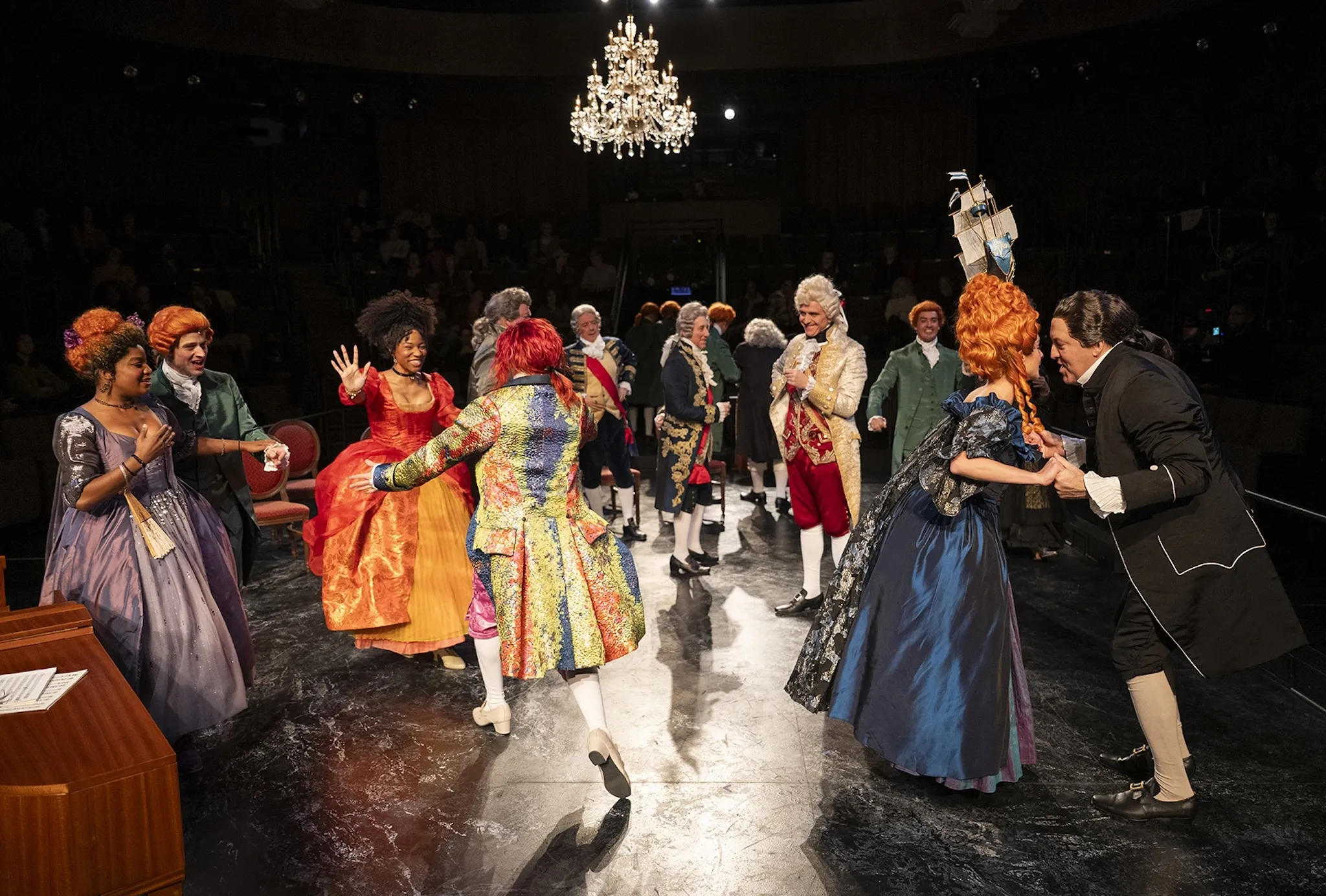
Amadeus | Photograph: Courtesy Michael Brosilow
Robert Falls, making his Steppenwolf debut after recently retiring as artistic director of the Goodman, directs with a bold, almost operatic confidence. His revival of Shaffer’s 1979 drama is the most audacious use yet of the Ensemble Theatre, the 400-seat venue that Steppenwolf unveiled in 2021. It’s a theater-in-the-round space with nowhere to hide and no room for proscenium illusions; actors slip through multiple entrances that act as arterial passages in a vast imperial chamber. Above it all looms a stained-glass Christ, watching (or judging) as Salieri unravels. Todd Rosenthal’s chandelier-studded set holds back just enough, allowing Amanda Gladu’s sumptuous costumes to speak volumes.
What Amadeus captures keenly is the lengths to which we go to avoid confronting our own mediocrity. Salieri will blame God, fate, Mozart—anyone but himself. Yet the production is at its most electric when these two men share the stage, exchanging words like punches in a championship boxing match; the audience holds its breath at each emotional strike. Above all, Shaffer offers a haunting portrait of two artists with irreconcilable visions of art, love and faith, but drawn again and again to the same creator: the keyboard.
Amadeus. Steppenwolf Theatre. By Peter Shaffer. Directed by Robert Falls. With Ian Barford, David Darrow, Jaye Ladymore, Robert Breuler. Running time: 2hrs 45mins. One intermission.
Follow Shannon Shreibak on Instagram: @ShannonShreibak
Follow Time Out Theater on Twitter: @TimeOutTheater
Keep up with the latest news and reviews on our Time Out Theater Facebook page
Discover Time Out original video