[category]
[title]
The ‘One Human Show’ turned the Roppongi venue into a sermon, séance and soft hallucination

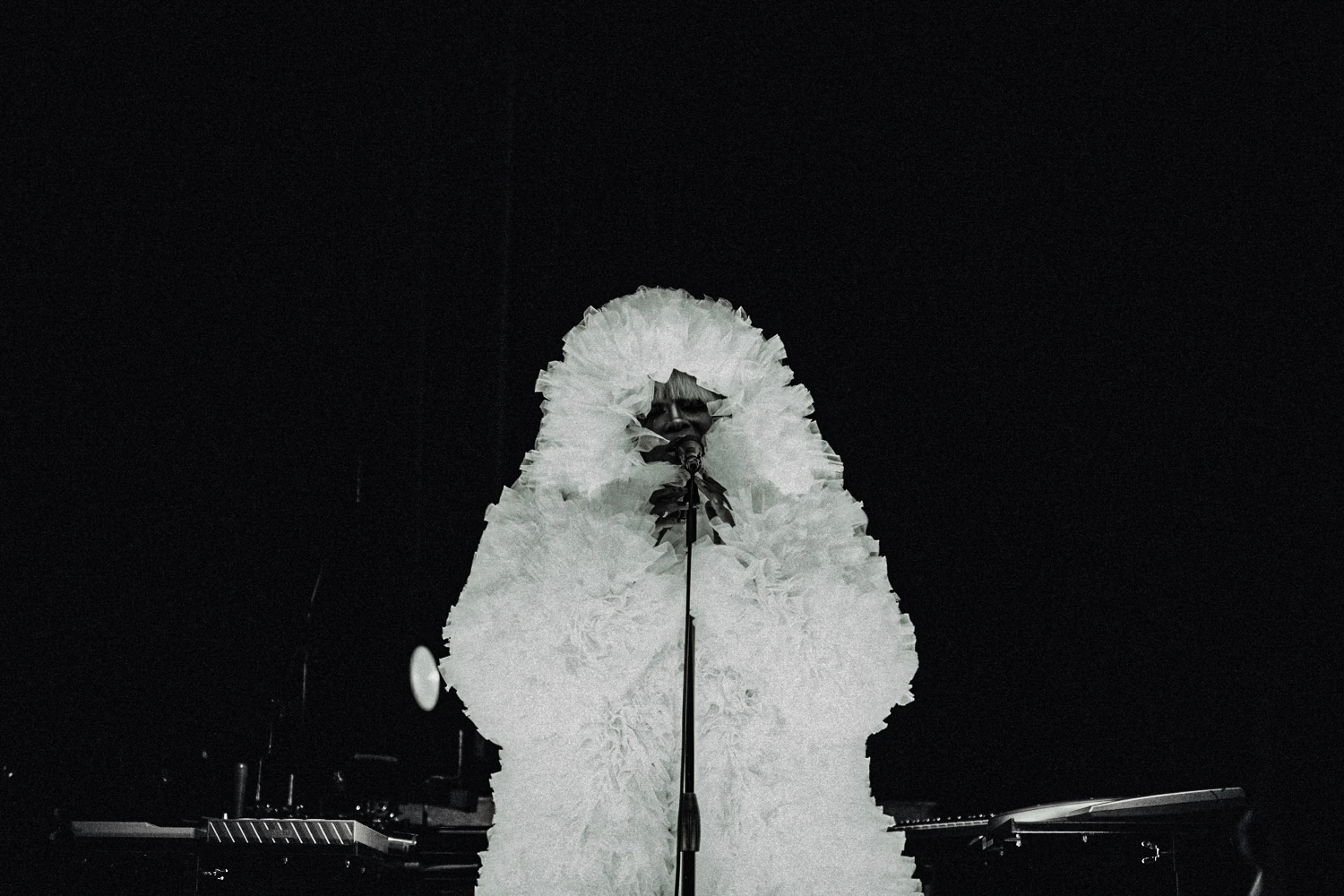
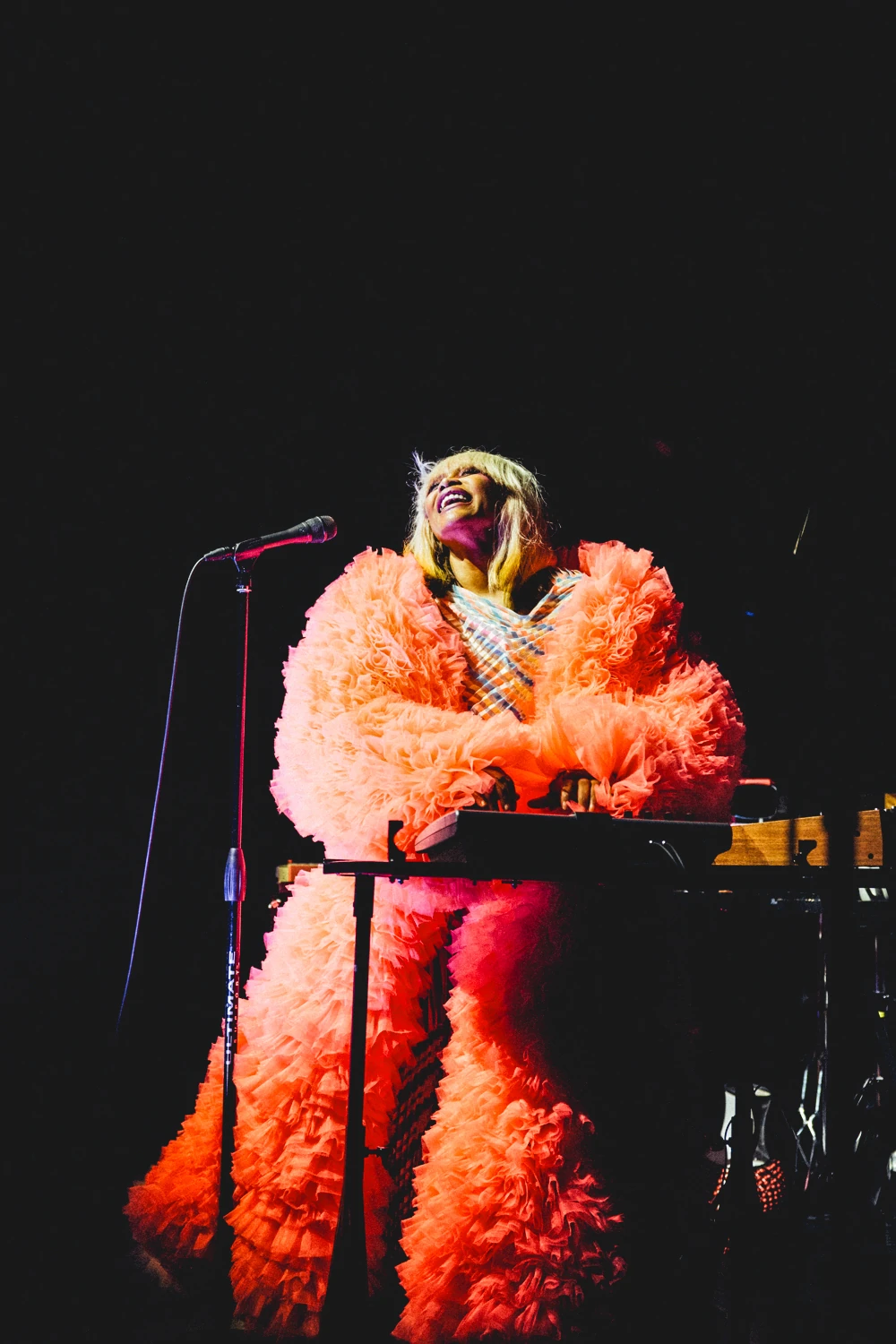
Tokyo, humid dusk, Billboard Live glowing like a chapel someone built inside a shopping mall. Erykah Badu walks out in what looks like a rose bush mid religious awakening, a Tomo Koizumi jacket blooming red and pink over a puffy-white afro centric hood. The room stops clapping and starts holding its breath instead.
‘Costumes are part of the improvisation, just like the music,’ she'd say later. Nothing about this show was pre decided. That's the whole premise of IMEHO, her new project with longtime collaborator RC Williams: Improvisation, no script, just voice, piano, and percussion – a Tokyo exclusive that had bongos rattling under the room like a second heartbeat. Japan is its world debut, the first breath of something that migrates to Europe in October.
Calling it a concert undersells it. This was church. Orange and blue light washed the stage like stained glass caught at golden hour, and Williams' chords rolled out with the same weight as a Hammond organ mid sermon. Badu commanded the crowd, pulling everyone into a call and response nobody could resist. You don't watch an Erykah Badu show. You get preached to, gently, and you thank her for it.
Every note got held onto like it might not come back around. Then ‘On & On’ hit and the room forgot itself entirely, up out of their seats, harmonising with Williams like it was choir practice and Sunday best.
Badu never broke focus. Present tense only, gracious every time she said so, no two nights ever meant to be the same. That's the whole philosophy sitting inside the name. IMEHO isn't a tour, it's an alter ego – a way of building the work together in real time and letting it dissolve the second the lights come up. Tokyo got the first version of it. Nobody gets that version again.
After the show, still carrying the frequency of the room, we had the opportunity to sit with her.
Peace and love, Time Out. My name is Erykah Badu, also known as Badula Oblongata, also known as She Ill, also known as Fat Belly Bella, also known as Low Down Loretta Brown, also known as IMEHO.
You just introduced IMEHO tonight. What did she arrive to say that Loretta, Badula and the rest hadn't already?
IMEHO is just another one of my aliases. It's basically explaining who I am. ‘I'm me, ho’ is what I'm trying to say. I'm me, bitch, I'm me, ho. I'm me. I guess it was important to express that at this point, because people have so many opinions about who you are. I thought I'd leave them with that.
You and RC Williams have worked together for so long that the improvisation almost looks rehearsed. What do you value most in that kind of musical relationship?
It’s beautiful working with a piano player or keyboardist who knows me so well, and I know him so well. We pretty much finish each other’s musical sentences. We’ve been performing together for so long that it makes it look like it has been rehearsed. But actually, we have not.
I wanted not only the audience to feel the energy between us, but I wanted RC to get an opportunity to be very, very free with his playing. He’s a jazz pianist, so it gave him an opportunity to create on the spot and be spontaneous with me.
No two shows on this run are the same since it's improvised. Between your two sets tonight, were there separate narratives running through them?
I live in the moment. I've been touring eight months out of the year for thirty years, I only make records when I feel I've lived enough to say something. But I'm a performance artist first. When the audience and I become one living, breathing organism, I genuinely don't know what's going to happen. I do keep a setlist, I call that the guard rails, so the band isn't totally lost when we go to hyperspace. RC Williams got to explore just as much as I did tonight, and we added a percussionist from Tokyo named Khan, someone we'd never played with before. We were making it up as we went, and the audience was a huge part of steering that.
You’ve also expanded your practice into sound meditations and more immersive experiences. After nearly 30 years since Baduizm, what still feels new to you?
I’ve been a recording artist for 30 years. Next year it will be 30 years for Baduizm in 2027. I’ve been singing since I was a very little kid. I’ve been acting forever.
In any kind of art, I love creating. I believe my best work is still in me. There’s so much more that I have to share with the world, and I can’t wait to do that. I feel the freest doing that in Tokyo.
You've been known to weave unexpected references into your shows live – Japanese court music during Sound Temple, for instance. Was there anything embedded tonight people might not have caught?
It becomes a blur after enough shows, because I'm really living in the moment, even down to what I'm wearing. Sometimes it's a happy accident, sometimes it's a terrible mistake, but it doesn't matter, because it all becomes part of that moment. And that moment can never be duplicated, repeated or imposed.
Your style is as legendary as your music at this point. Tell us about the jacket tonight and how you work with local designers.
When I started out in 1997, I only wore Black designers, because I wanted to highlight us, give us a platform. It wasn't until about five years in that I met creatives who happened to be artistic directors at some of the big houses, Tom Ford was one of the first, then Riccardo Tisci.
That's when I understood they were sculptors too, just working in fabric instead of clay. Fast forward to Tokyo, 2026, and I'm doing IMEHO, a one woman show that's all improvisation, just me, a keyboardist, and now a percussionist. I wanted the garments to have that same impromptu feeling, so I went to visit Mode School of Design and Art and Fashion, met some incredible young designers there, hair, makeup, garments, all of it.
Right now I'm in Viviano, someone I fell in love with back in the States before I knew he was from Tokyo. I've also worn Tomo Koizumi, Keori, and a sumo wrestler dress from a student named Mikito that I have never seen anything like. I'm proud to be an activist for up and coming artists. I feel kindred to them. I feel like my best work is still inside me, and clothing is one way to say that out loud.
Your fans know you're a deeply spiritual person, and Japan has as many shrines and fortune tellers as it does convenience stores. Have you gone looking for any of that since you've been here?
To me, everything is spiritual about Japan, Tokyo specifically for me.
I like the gardens here. I like the greenery. I like the trees, the sun, the breeze. I like the birds, specifically those black ones, the ravens. They’re so old and so smart and so fun to communicate with.
I love the plants. I love the pine trees. They’re very old and they all look like bonsais. I love the sculpture of it all.
I love walking around the city. I love the random things I may run into, like wishing trees, where there’s a tree with different colored pieces of paper hanging off the tree and we get to make a wish, or wish something great for someone else.
I like how soft the grass is on my bare feet. I like how clean the city is. I like how much people respect their land, their home.
So many things. I love the old structures. There are not many left in the city, but the ones that are there are uniquely beautiful still, as if it was yesterday when they were built.
I like the gold and the copper on the roofs. I call it the jewellery of the buildings.
I like the fashion, or the style, not fashion, the style. I like the tradition of the kimono.
So many beautiful things. And I like looking at the people. I like looking at the older people and how they’re very upright. And I love looking at the youth and how they’re so happy and resilient.
It’s a brilliant place, and I feel like I’m a part of it every time I’m here. And I love that I’m welcomed.
More from Time Out Tokyo
17 artists to look out for at Fuji Rock 2026
FamilyMart’s Nigo-directed flagship store is now open in Tokyo
Onitsuka Tiger has opened its largest global flagship store in Shinjuku
Kyoto’s Ki No Bi has launched a bar pop-up at JW Marriott Hotel Tokyo
10 art exhibitions to see in Tokyo this summer
Want to be the first to know what’s cool in Tokyo? Sign up to our newsletter for the latest updates from Tokyo and Japan.
Discover Time Out original video