[category]
[title]
Don’t miss out on what’s shaping up to be one of the best line-ups in years

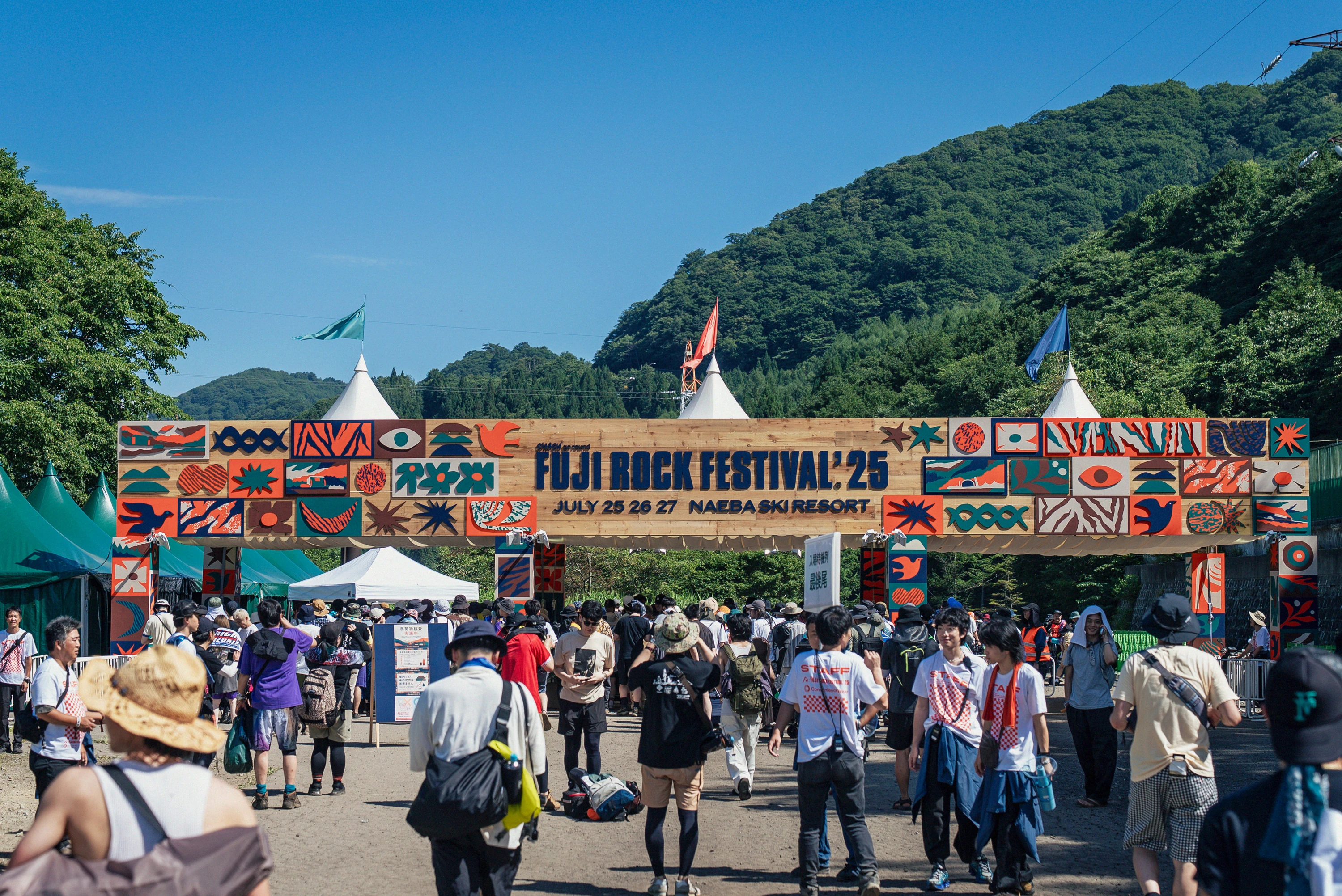
Every summer, for three days, a ski resort two hours outside Tokyo turns into the closest thing Japan has to a religious pilgrimage for music people. Fuji Rock started in 1997 as a chaotic, storm battered one-off near Mt Fuji, moved to Naeba Ski Resort in Niigata two years later, and has been building myth ever since.
The slopes that carry skiers all winter turn into a sprawling network of stages tucked into forest and riverbank, connected by wooden walkways that somehow never feel as far apart as they actually are. People camp for days, soak in the onsen between sets, and wander into secret woodland shows that nobody announces until the day of. It rains constantly and nobody seems to mind. Twenty-nine years in, it's still the festival every other Japanese festival is quietly trying to be.
This year's edition runs July 24 to 26, and the anticipation's been building since the first line-up drop back in February. Three-day tickets sold out well ahead of the festival, single day passes are going fast, and the line-up itself is doing something Fuji Rock does better than almost anyone: mixing generational headliners with the kind of deep cuts that reward people willing to wander off the main stages. There's a real sense this year that the bill skews younger and stranger than usual without losing the legacy acts that make the festival feel like an institution. If you're only making it to Naeba once this decade, this might be the year to do it.
Naturally, the top of the poster is already doing plenty of work. The xx headline Friday, completing a slow climb through Fuji Rock that began at the Red Marquee in 2010, continued at the White Stage in 2013 and reached the Green Stage in 2017. This time, they return as the main event. Their music has always made silence feel as important as sound, which should land beautifully once the sky goes black over Naeba and several thousand people collectively decide not to speak over ‘Intro’.
Khruangbin take over the Green Stage on Saturday, seven years after playing the much smaller Field of Heaven. Their records can sound like music drifting from the best room at a house party, but live, those warm guitar lines and unhurried grooves become something bigger and far more physical.
Massive Attack close the festival on Sunday, returning for the first time since their 2010 headline appearance and wrapping up the whole festival the way only a band that basically invented trip hop can, all cinematic low end and visuals that tend to leave people a little shaken. Few groups are better suited to ending three days in the mountains than one capable of making a field full of people feel like they have wandered into a beautiful, slightly terrifying transmission from the future. Three very different definitions of ‘headliner’, which feels very on brand for a festival that's never been interested in booking the obvious version of itself.
Sunday, 3pm, Green Stage
Most festivals ease people gently into Sunday afternoon. Fuji Rock is handing the Green Stage to Kneecap and allowing Belfast’s most politically combustible rap group to deal with the rest. The trio move between Irish and English with the speed of an argument getting out of hand, turning satire, identity and genuine anger into music made for jumping on someone’s shoulders. They arrive with a new album, Fenian, but their reputation has largely been built on what happens in the room.
Friday, 5pm, Green Stage
Turnstile have spent the last few years making hardcore feel huge without watering it down, and this year they arrive with two Grammys to back it up. Their sets run on trust as much as volume, with pits that open and close like everyone rehearsed it beforehand. At 5pm, with daylight still hanging over Naeba, this could feel less like a concert and more like a sudden change in weather.
Saturday, 8.30pm, Field of Heaven
You might know Badbadnotgood from their famous Adult Swim run. They may have come up turning hip-hop songs into jazz instrumentals, but years of touring, production and collaboration have made them far harder to categorise. Songs stretch, tighten and mutate depending on what the band finds interesting in the moment. Field of Heaven, surrounded by trees and famous for some of the best sound at the festival, is almost suspiciously perfect for them. Get there before dark, find somewhere comfortable and let the set slowly rearrange your brain.
Sunday, 10.10pm, White Stage
If you’ve got a screen time of over 4 hours a day, then chances are you’ve heard Mitski’s music – but she’s so much more than trending audio. Her recent live shows have become highly controlled pieces of physical theatre, where a turn of the wrist or a few steps across the stage can make familiar lyrics feel newly disturbing. On Sunday she closes the White Stage with a 90-minute set. The timetable has cruelly placed her opening half hour against the end of Massive Attack, so decisions will need to be made and friendships may be tested.
Saturday, 7.50pm, White Stage
XG appeared, announced themselves as a global group and started performing as though the rest had already been agreed upon. Now touring their first full album, The Core, the seven-member group arrive with the kind of camera-aware precision, styling and choreography usually contained inside an arena production. Seeing that machinery dropped onto the White Stage, surrounded by trees, mud and people in plastic ponchos, should be one of the weekend’s stranger visual collisions. This will be a full-scale pop moment just with a little mountain air.
Friday, 5.40pm, Field of Heaven
Don't let the name throw you – this is one of the most consistently interesting rock bands in Japan, built on hypnotic, motorik grooves that owe as much to krautrock as anything domestic. Ogre You Asshole build songs out of looping basslines and small, repeating guitar figures that feel static until you notice the whole track has quietly shifted under you. Live, those arrangements tend to get heavier and stranger than the studio versions, leaning further into the band's instincts. Early evening at Field of Heaven is exactly the right setting for it.
Friday night into Saturday, 3.30am, Red Marquee
At 3.30am, terms like ‘Friday’ and ‘responsible decision-making’ have largely stopped meaning anything. That is when Wata Igarashi takes control of the Red Marquee. His techno is psychedelic – built from sounds that circle and keep climbing long after another producer would have reached for an obvious drop. The reward comes from staying inside it long enough for your sense of time to disappear. This is the set for people who came to Fuji Rock prepared to see the sunrise, or who simply lost the path back to their tent.
Friday, 11.10am, Red Marquee
Whoever's inside the Red Marquee before lunch on Friday gets to spend the rest of the festival being smug about it. TV Tairiku Ondo formed in Sapporo in 2023, went viral off a track called ‘Ore ni Shinjitsu wo Oshiete Kure!!’, and graduated straight from last year's Rookie A Go Go newcomer stage onto the main programme. The sound is post punk nerves with a chorus bolted on, played by four people who still look a little surprised to be here. This is what a Fuji Rock discovery is supposed to feel like.
Saturday, 10pm, White Stage
Norwegian artist Aurora and the Chemical Brothers’ began making music together and clearly, the last thing they thought of was the name. Their debut album Come Closer landed in April, and Fuji Rock is only their second time ever playing it live. Aurora brings the voice and otherworldly stage presence; Rowlands brings decades of knowledge about how to make an enormous crowd move at once. Their White Stage set comes directly after XG and opposite the end of Khruangbin, creating another deeply unfriendly clash. Still, nobody quite knows what this looks like yet, which makes it one of the most interesting bets on the whole timetable.
Saturday, 12.40pm, Red Marquee
Calling Quadeca a former YouTube rapper is technically true in the same way that calling a butterfly a former caterpillar is technically true. His music has moved far beyond its beginnings, slipping between hip-hop, folk, ambient noise and full narrative world-building. Albums such as I Didn’t Mean to Haunt You revealed an artist far more interested in creating atmosphere than chasing the cleanest possible single. His Fuji Rock slot is early, but the Red Marquee should give all that strange, densely layered production somewhere to properly echo.
Sunday, 2pm, Red Marquee
The Lemon Twigs make music as though the last 50 years of recording technology were a minor clerical error. Brothers Brian and Michael D’Addario pull from glam, power pop, Broadway-sized harmonies and the kind of chord changes that used to require several people smoking inside a very expensive studio. It would all risk becoming costume play if the songs were not so irritatingly well written. Their live shows are theatrical, technically ridiculous and completely sincere. A strong Sunday afternoon choice for anyone whose body is tired but whose inner show-off remains alive.
Sunday, 11.30am and 11pm, Red Marquee
US, the Finnish garage-rock band with the nearly unsearchable name, have become Fuji Rock’s recurring summer situationship. Their first Japanese performance took place at the festival in 2024, when attendees voted them the artist they were happiest to have discovered. They returned in 2025 and are now back for a third consecutive year, this time playing the Red Marquee twice in one day. There is nothing especially complicated about their appeal. They play fast, sweaty rock’n’roll like four friends who have been told they are about to lose the rehearsal room.
Saturday, 7pm, Green Stage
Fujii Kaze is obviously not an underground recommendation, but leaving him out would be dishonest. He arrives after releasing the English-language album Prema, making his Coachella debut and expanding into the kind of international career Japanese labels have been trying to engineer for decades. The difference is that Kaze rarely feels engineered. He can move from technically pristine piano playing to loose, almost conversational singing without breaking the spell. His sunset Green Stage slot feels less like support for Khruangbin and more like the festival quietly scheduling a second Saturday headliner.
Sunday, 6.10pm, White Stage
Former Black Midi frontman Geordie Greep makes music that sounds like a Las Vegas bandleader having a nervous breakdown in several time signatures at once. His solo album The New Sound pulls in lounge music, progressive rock, jazz, Brazilian instrumentation and narrators who should probably not be left alone with anyone. On record, it is dense and faintly ridiculous. Live, with a full band attempting to keep up with him, it becomes something closer to controlled public collapse. One of the least predictable hours on the entire timetable.
Sunday, 10.20am, Red Marquee
Aooo have been described as a supergroup, but thankfully do not carry themselves like four established musicians doing a side quest. Vocalist Riko Ishino, guitarist Surii, bassist Hikaru Yamamoto and drummer Tsumiki each arrive with their own careers and audiences, yet the band sounds unusually natural together. Their songs are tightly constructed without becoming too polished, balancing internet-era pop instincts with the energy of an actual rock band in a room. The only real obstacle is making it to the Red Marquee by 10.20am on Sunday.
Sunday, 1.45am, Red Marquee
Seeing Ichiro Yamaguchi without the full force of Sakanaction behind him is a rare proposition. His solo sets strip away the arena-sized production and put the focus back on the strange, meticulous mind at the centre of the band: the voice, the electronics and the tiny shifts in mood that usually sit beneath Sakanaction’s bigger machinery.
Sunday, 3am, Red Marquee
By 3am on Monday morning, Fuji Rock has separated the people who attended a festival from the people who have fully surrendered to it. Takkyu Ishino takes over the Red Marquee for that final stretch, bringing more than three decades of Japanese techno history with him. As one half of Denki Groove and a fixture of Japan’s club culture, he knows exactly how to keep a room moving after everyone’s legs should have stopped working hours ago. This is not a polite closing set. It is the last dance before Naeba turns back into a ski resort.
More from Time Out Tokyo
Onitsuka Tiger has opened its largest global flagship store in Shinjuku
FamilyMart’s Nigo-directed flagship store is now open in Tokyo
Enoshima island is hosting a free projection mapping event this summer
Ultraman finally has a real home in Harajuku with the opening of Ultra Mart
Hakone is hosting a week-long fireworks festival this summer
Want to be the first to know what’s cool in Tokyo? Sign up to our newsletter for the latest updates from Tokyo and Japan.
Discover Time Out original video