

[title]
Last September, the National Gallery launched an international competition to find a designer to conceptualise its new wing. A total of 65 firms threw their hat into the ring, and the museum whittled the submissions down to six finalists including New York-based Selldorf Architects, the designers behind the 2025 refurbishment of the gallery’s Sainsbury Wing.
Now, the National Gallery has announced a winner and spoiler: Selldorf was snubbed for the job. Instead, the museum selected Japanese architect Kengo Kuma – who famously designed the Tokyo Olympic stadium – and his eponymous firm to take on the project.
Plans for a new wing form part of the gallery’s wider Project Domani, the biggest transformation of the National Gallery in its 200 years of history, which is expected to cost a whopping £750 million.
The hefty sum will go towards expanding its collection to include art from the 20th and 21st centuries. Turns out, this move has the potential to cause some serious beef in the art scene. The gallery has traditionally only collected paintings made before 1900 because of an agreement with Tate, which itself has stuck to only collecting modern art. According to the Guardian, industry insiders have warned in the past that breaking the agreement could create ‘bad blood’ and risks the two organisations being ‘at each other’s throats’.
Despite looming challenges, plans for the new wing are extensive and include some pretty exciting features.
What can we expect from the National Gallery extension?
The new wing, the name of which is yet to be revealed, is due to open in the early 2030s and will be built on the site of St Vincent House. The property, which the museum has owned for almost 30 years and currently houses a hotel and office complex, will be demolished as a result.
In its place, we can expect the new Kuma-designed building, which will sit just to the north of the Sainsbury Wing, to be clad in light-coloured stone.
John Booth, the National Gallery’s chair of trustees and jury chair, said the new building’s exterior would ‘help to unite two of London’s most important outdoor spaces – Leicester and Trafalgar Squares – by creating an enticing new public realm between them’.
A roof garden is also included in the plans, which will offer stunning views of Leicester Square and the north London skyline.
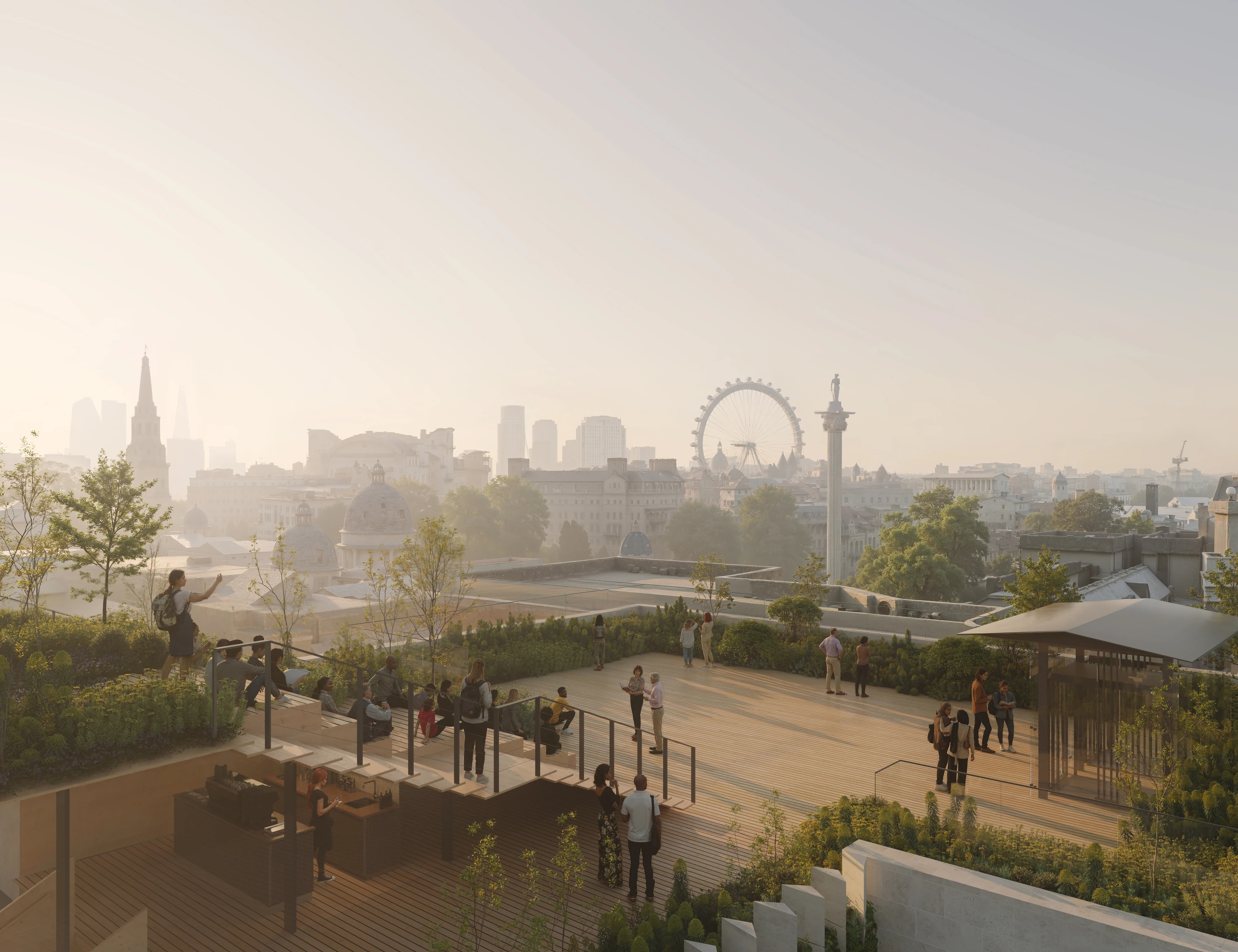
As for what’s inside, additional space created by the new wing will enable the National Gallery to mount much larger exhibitions or divide the space into smaller shows. Vaults and arches have been incorporated into the design plans for the main floor, which will be dedicated to public facilities and temporary exhibition galleries. Plus street-level access means that shows could even open for longer hours than the permanent collection.
Designs for the upper floor have a more geometric feel. The space is expected to be hung with paintings from the late 19th century up to the present, with bridge links to the Sainsbury Wing and the Wilkins building.
Kengo Kuma’s designs for the extension were praised for their ‘supremely beautiful handling of light and of materials’ by National Gallery director Sir Gabriele Finaldi.
The Tokyo-based firm, which has experience creating art spaces having previously designed V&A Dundee, will work with UK-based design companies Building Design Partnership (BDP) and MICA on the project, which is expected to take at least four years to come to fruition.
Did you see that the Bayeux Tapestry is coming to London this year, and it will be free to visit for millions of Londoners?
Get the latest and greatest from the Big Smoke – from news and reviews to events and trends. Just follow our Time Out London WhatsApp channel.
Stay in the loop: sign up for our free Time Out London newsletter for the best of the city, straight to your inbox.