

[title]
In a city where “starting a book club” often turns into “let’s never actually read the book,” one New York-born concept is trying something radically simple: reading it together. Out loud. In real time.
Page Break, a literary retreat series founded in 2024, has been quietly building a following by rethinking what a book club can be. Instead of assigning a novel and hoping everyone finishes it between work, dinner reservations and doomscrolling, Page Break condenses the entire experience into a single weekend getaway. Fifteen or so strangers head upstate, sit in a circle and read a novel aloud together, a few pages at a time.
It sounds a little like a middle school English class, but founder Mikey Friedman cautions that it’s not. “Page Break is a weekend reading retreat and literary community powered by the magic of reading aloud,” Friedman told Time Out. (Research suggests that reading aloud can help improve memory and comprehension.)

At a typical retreat, the group works through roughly 70% of a book together in sessions led by Friedman, rotating readers every couple of pages and pausing for discussion along the way. The rest is read independently, with time carved out for meals, wine, yoga and other activities. The structure is deliberate—and born out of a frustration that will feel familiar to anyone who’s ever ghosted a book club.
Friedman, who spent a decade working in advertising, first had the idea after realizing he loved the idea of a book club but not the logistics. The time commitment, the pressure to keep up and the awkwardness of trying to discuss something everyone experienced separately made it all feel like homework.
The workaround came almost immediately: What if you did the whole thing in a weekend? What if you started and finished the book together? And then, crucially: What if you read it aloud?

That last part is the “secret sauce,” as Friedman, 34, put it. It slows everything down, turns reading into something communal and a little vulnerable. Participants can always opt out and just listen, Friedman said, but most don’t. “There’s something about everyone doing that same act of vulnerability,” he explained. “It makes you feel like you can trust the group.”
That dynamic is part of what’s helped turn Page Break from a scrappy experiment into a sold-out series. Retreats now regularly draw dozens of applicants for a handful of spots, with attendees skewing toward a mix of creatives, curious readers and New Yorkers looking for a different kind of social experience.
The books themselves are carefully chosen by Friedman. They’re often contemporary literary fiction, typically by emerging or underrepresented authors and are usually around 250 pages (aka short enough to get through in a weekend). The goal isn’t just to read—it’s to have something worth talking about.

Because everyone is moving through the story at the same pace, conversations tend to stay grounded in the moment in the form of reacting to a line, a character or a twist as it happens. When something funny lands, the room laughs together. When something hits harder, the room feels it together. It’s closer, Friedman suggested, to watching a movie in a packed theater than to quietly reading on your own.
But Page Break isn’t just about books. Each retreat pairs the reading with chef-driven meals inspired by the text, plus wine programming and other low-key activities. The idea is to make the experience feel less like a literary obligation and more like a weekend you actually want to show up for, even if you came for the food and stayed for the book.
It also helps lower the barrier to entry. Not everyone who signs up is a self-identified “reader,” which is intentional. “The reason most people come is to make new friends,” Friedman said, which gets at the project’s bigger appeal.
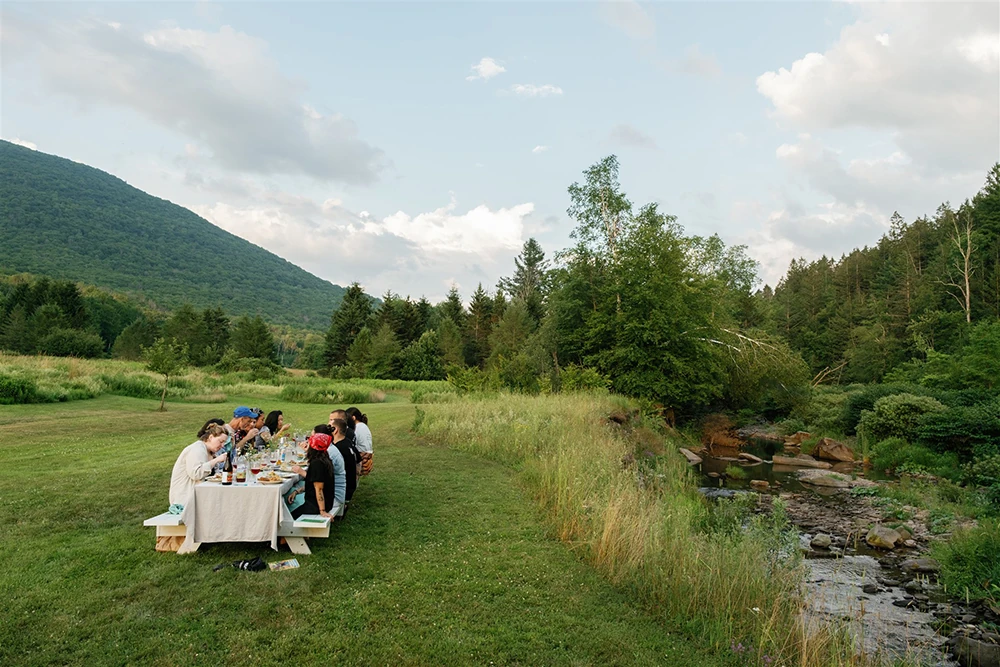
In a city built on constant motion (and, increasingly, a kind of low-level social fatigue), Page Break offers something slower. Phones are put away during reading sessions and there’s no multitasking and no background noise. It’s simply a group of people paying attention to the same thing at the same time. That might be why it’s catching on now.
“I think we’re in an epidemic of loneliness,” Friedman said. “People are dying to be together again but it’s hard to get past small talk.” Reading aloud, it turns out, is one way through that.
For those not ready to commit to a full weekend upstate, Friedman has also started bringing the concept back to the city with a live series called Stage Break, held at Littlefield in Brooklyn. The format keeps the core idea of shared reading and audience participation intact, but compresses it into a single evening.
Still, the retreats are the center of it all. Page Break isn’t about speed or productivity—it’s about reading together, in real time, with all the awkwardness and intimacy that entails.
Or put more simply: it’s a book club that actually happens.