[category]
[title]


Review
The National Portrait Gallery is as much a monument to national identity as it is an art gallery. Walk through its hallowed halls, and you’ll witness royals and politicians rendered in rich oil paints, celebrated actors and great thinkers captured by history’s leading artists, athletes and rock stars peering across the room at one another from gilded frames. It’s an education in our collective understanding of British life, culture and history. But who isn’t here? Who doesn’t get to shape the version of the nation’s identity on display to the thousands of tourists, school groups and art lovers who parade through these grand rooms every day? That question is central to the work of American photographer Catherine Opie, whose exhibition, To Be Seen, is currently installed on the second floor of the gallery.
Securing Opie’s first major UK exhibition feels like a coup for a gallery that has clearly taken pains to shake off its stuffy image in recent years and is lent an air of transgressive cool by the cult photographer. And fortunately, it turns out that putting her oeuvre in direct conversation with the largest collection of portraiture in the world works wonders. Not only does Opie's work serve to challenge visitors’ ideas about who belongs on the walls of this historic institution, but it also brilliantly elucidates the artist’s Baroque and Renaissance references.
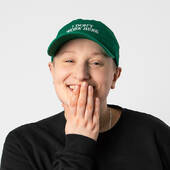
Visitors entering the exhibition are met with the piercing gaze of actor Daniela (now Daniel) Sea, best known for playing Max in The L Word, a role which elevated them to queer icon status as one of the first mainstream portrayals of a trans man on primetime TV. Here, they pose tall and proud, dressed in a colourful doublet against a shocking pink background, an LA gay’s version of a Tudor princeling.
Another room is filled with vivid portraits shot on black backdrops, redolent of Baroque masters. A nude portrait of long-distance swimmer Diana Nyad evokes Caravaggio with its dramatic chiarascuro, light seeming to emanate from the subject’s face, her browned back criss-crossed with gleaming white swimsuit tan lines, while a seated portrait of Opie’s grey-bearded friend Lawrence smoking a cigarette is redolent of van Dyck’s or Rembrandt’s doleful old men.
A nude portrait of long-distance swimmer Diana Nyad evokes Caravaggio with its dramatic chiarascuro
Thought has clearly been given to the architecture and sightlines of the exhibition space, its irregularly sized, brightly painted rooms evoking the endless procession of themed spaces in the main gallery on the other side of the wall. Several of the artist’s most celebrated works are presented in a kind of inner sanctum within the first room of the exhibition, including the 13 close-up portraits of her dyke friends dressed as their masc alter-egos that comprise Opie’s seminal 1991 project ‘Being and Having’, each photograph mounted with an engraved plaque bearing the sitter’s nickname.
The people in these portraits should be afforded the same space and consideration as the elite historical figures portrayed elsewhere on this gallery’s walls, Opie is saying. It might not sound especially radical in this era preoccupied with identity politics, but you need only flick through a recent copy of Dazed or swing by your local queer zine fair to recognise the enduring impact this early work has had on contemporary queer visual culture.
If the exhibition loses its focus towards the final rooms – showcasing Opie’s early noughties projects documenting surfers and high-school football players – these pieces also show that the artist is by no means a one-trick pony. Her portraits of teen athletes are beautiful, all the braggadocio of these young emblems of American masculinity dissipating as soon as they’re in front of the camera, shoulder pads faintly ridiculous on their lanky frames.
Alongside the exhibition, Opie has staged a series of ‘interventions’ around the main galleries, placing select photographs side by side with similar portraits in the permanent collection. Walking around the second floor seeking out these pieces, I found myself looking at a 1997 portrait of drag artist Divinity Fudge at the same time as a group of primary school kids. ‘Why is that man wearing a dress?’ asked one gleeful child, eliciting giggles from his peers and a measured, patient explanation from the class’s harried young teacher.
It would be eye-rollingly obvious, not to mention a bit reductive, to say that that kind of exchange is the whole point of Opie’s work, but it certainly served as a reminder that this sort of representation does have an impact. And that’s something worth celebrating.
Discover Time Out original video