

Last summer I was at an arts festival in Poland and so was Tilda Swinton, performing a show of her own devising called Embodying Pasolini. Performance art rather than theatre, it was definitely interesting, and very much in keeping with a post-fame live career that has seen her eschew conventional stage acting: in the ‘90s she famously slept in a glass box for a week at the Serpentine gallery, a signature piece she revived a couple of decades later in New York.
Which is very cool and very Tilda Swinton but also kind of a shame because Swinton by all accounts tore up the stage in her twenties before settling on film as her medium. You don’t begrudge Derek Jarman for luring her away to the world of arthouse celluloid. But it would be nice if she still did normal plays!
What’s shocking about Man to Man, the wholesale rival of the Swinton-starring 1987 version of German playwright Manfred Karge’s monologue, is that it is a normal play. Maybe not a conventional one. But as the curtain lifts to reveal Swinton leering away at us in whiteface, house coat, Y-fronts and a shock of punky blonde hair – a sort of incongruously elegant hybrid of Johnny Rotten and Rab C Nesbitt – there’s something reassuringly actorly about the sarf London growl she adopts, so far from her own fluting tones. Obviously we’re all here to see Tilda Swinton the icon. But this isn’t one of her arch performance projects, it’s a proper play, in which she loses herself in a proper character. It’s a show that predates her celebrity, the Stephen Unwin-directed project dusted off by a creative team who are considerably older but still very much with us.
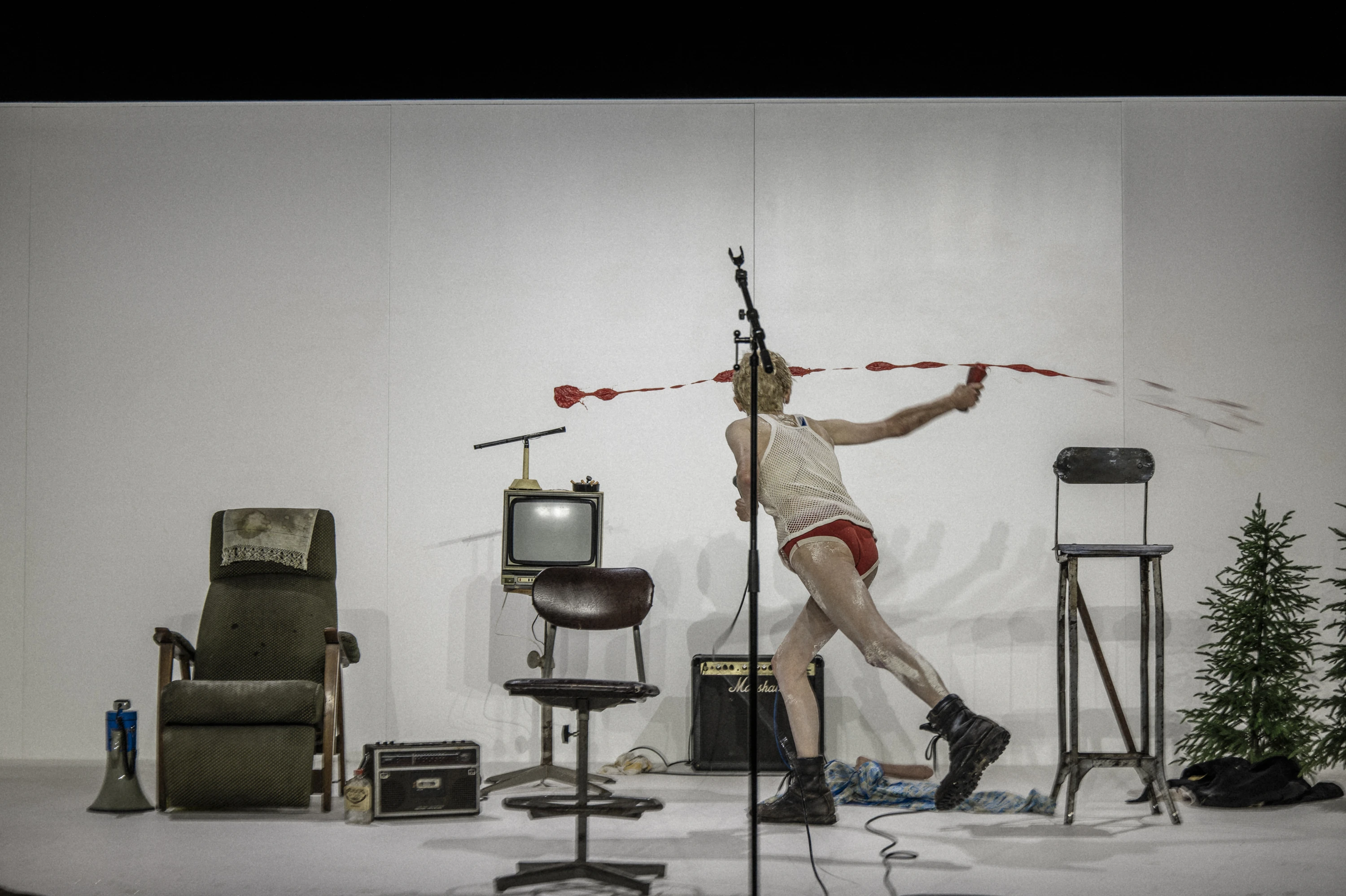
In impressionistic style we’re led through the life of Ella, a German woman who takes on the identity of her dead husband Max so that she might keep earning in the interwar era. Standing on Bunny Christie’s wonderfully evocative set – a stark white room bisected by a red line and strewn with consumerist junk (a black and white hire TV, a dilapidated Smeg fridge, a Marshall amp) – she take us on her journey of feral, almost rat like survival through the 20th century.
I say ‘she’ – do we ever really meet Ella? I’m not so sure: it becomes apparent early on that she has become hopelessly separated from her original identity and has, to a large degree, become Max. Perhaps not the original Max but a new Max, originally crafted as a disguise – so she could take his job as a crane operator – but eventually a mode of living that she’s more comfortable with than her old one. Certainly there’s little sense that the role Swinton is playing is that of a woman, with her slobby male togs, growly, blokey voice and constant beer chugging. Her old identity is referred to in the third person, usually as ‘Snow White’. At one pivotal point she gives away the last legal proof of who she was.
What’s Man to Man about? Working class survival and the lives of ordinary people continuing in spite of great events, for starters. It’s an attempt to parse Germany’s 20th century from a ground level, a story of endurance that – via Anthony Vivis’s translation of Karge’s capriciously poetic prose – plays out in pungent, half-dreamlike episodes (the text has been revised, accounting now for the fall of the Berlin Wall). It also feels more universal than purely German, in part because the chaos Ella/Max lived through feels of a piece with the chaos repeated throughout Europe in the ’30s and ’40s, in part because of the pointed Britishness of Swinton’s mad-geezer-down-the-pub performance.
Is it a trans narrative? I mean yes and no. It certainly speaks of the constructed nature of gender. But I don’t think Karge’s intent is to tell a representative story of the trans experience. Max freely acknowledges that he’s also a woman, it’s just that he’s disassociated from her personality. It’s quite possible you could tell a different version of this story from the point of view of Ella, who arguably we never truly meet.
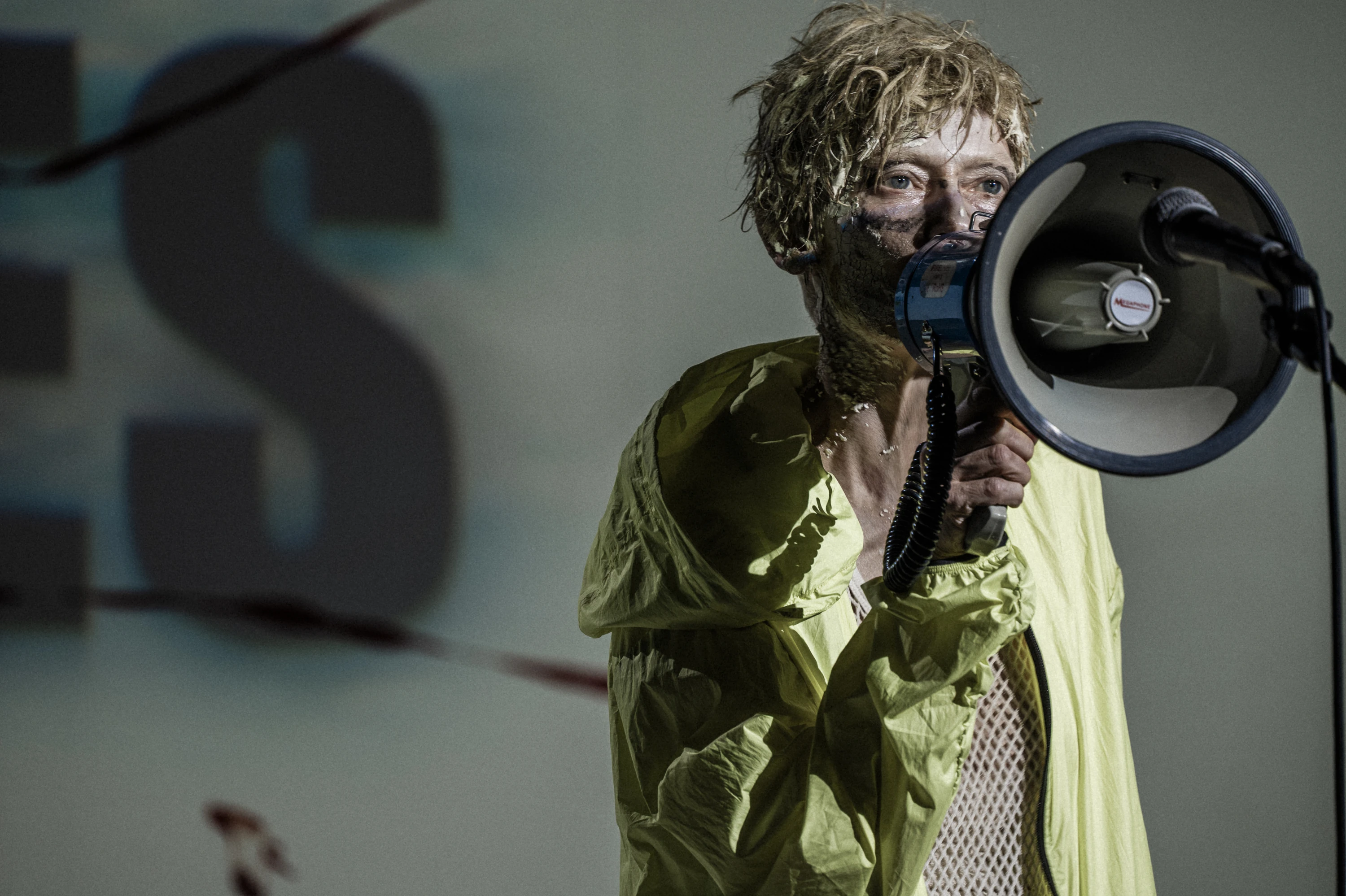
And much as it’s a fine and fascinating play, with a great set and spiky, punky direction from Unwin, it does, of course, all come back to Tilda Swinton. She’s pretty much been the poster girl for otherworldly androgyny for 40 years now, and it’s genuinely astonishing how ageless she looks - you’d never put her at 65. But it feels like that’s not simply because she doesn’t look it, but because she really really is a great and incredibly vigorous actor who can choose to channel the energy and voice and posture of a younger woman. Slash man. Slash woman pretending to be a woman pretending to be a man.
When Gary Oldman called in at the Royal Court earlier this year with his take on Krapp’s Last Tape, I didn’t necessarily think ‘oh we desperately need to see that guy in more stage stuff’ (I mean I wouldn’t say no, he just feels like a screen bloke now). Swinton has so much energy and presence, the sense she probably has a colossal amount to give and could become a theatre artist of real significance again if only she had any interest in doing that. There is, however, absolutely zero question: Tilda Swinton has still got it.
Royal Court Theatre, until October 24.
How to get tickets to see Man to Man.
The show is sold out. However, tickets to see shows on Mondays at the Royal Court do not go on sale until 9am on the day of performance, from the Royal Court website. You can also queue in person at the theatre before a performance to try and snag either a return or one of the legendary 10p standing tickets (which are actually £1 if you don't have a 10p piece).