[title]
Off Broadway review by Adam Feldman
Rating: ★★★ (three stars)
Imagine the surprise that Henry Darger’s landlords must have felt in 1972 when, in clearing out the cramped Chicago rooms where this reclusive menial worker had lived for decades, they discovered what he had left there: reams upon reams of writings—from an 15,000-page fantasy novel to an unfinished autobiography and a ten-year weather diary—as well as hundreds of watercolor illustrations in a bizarre and fascinating style, some as wide as ten feet across, many depicting young girls. Much of Darger’s work remains shocking even today, when he has been posthumously celebrated as an outsider artist for more than half a century. Idiosyncratic and colorful, it is also often disturbing in its violence and nudity: a singular vision of apocalyptic kitsch, rather as though Heironymous Bosch were illustrating 1920s children’s books.
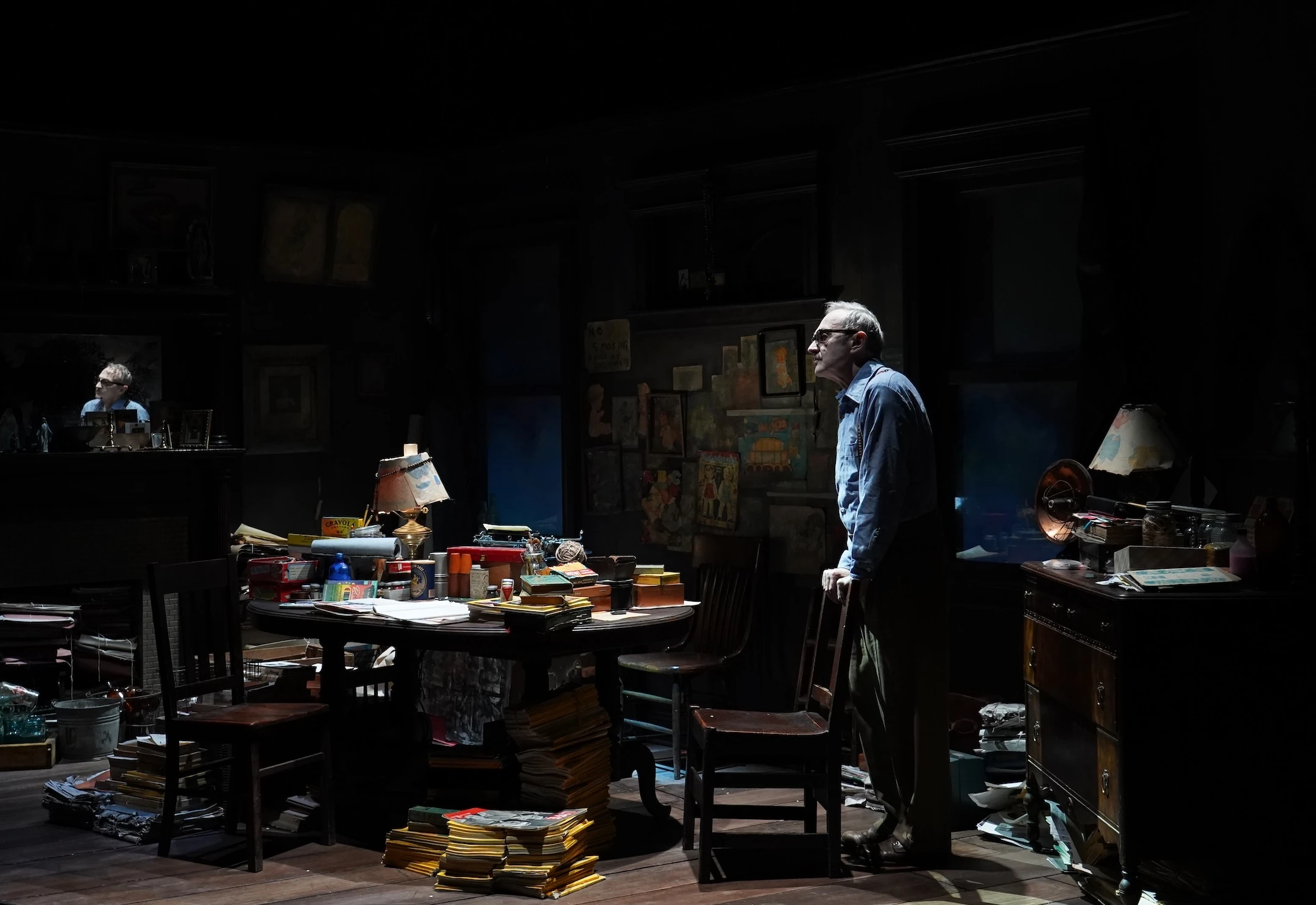
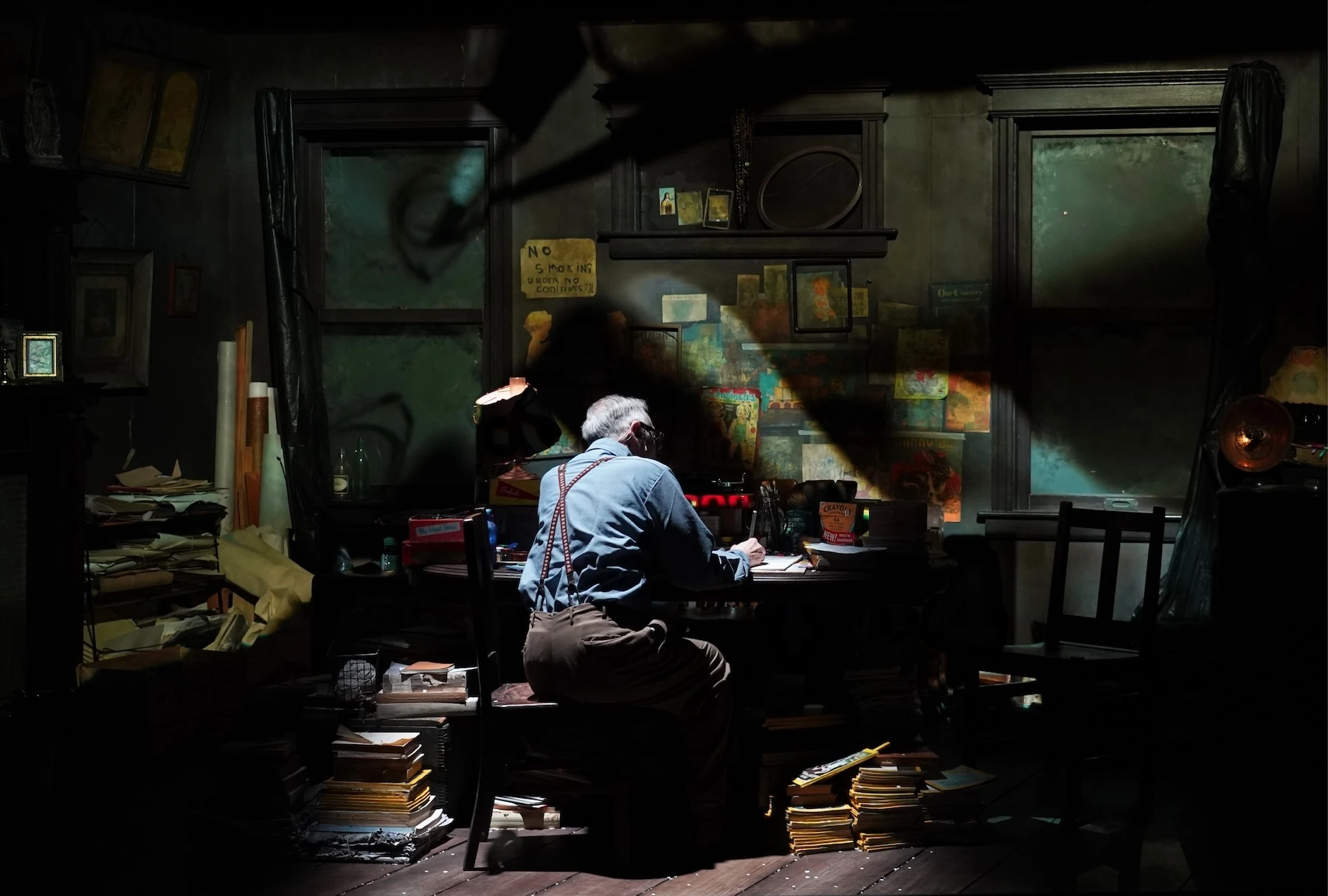
While Darger’s secret life as a graphomaniacal hoarder was characterized by obsessive excess—within the cloisters of his home, at least—the portrait of him on display in Bughouse is exceedingly slim. John Kelly, fastidious and precise, plays the artist in a brief solo show whose text has been culled by Beth Henley (Crimes of the Heart) from Darger’s copious scribblings. We learn a bit about his troubled youth, much of it spent at a home for feeble-minded children. “I was taken several times to be examined by a doctor who on the second time I came said my heart is not in the right place,” he recalls. We see how a newspaper photo of a murdered girl inspired a character in his magnum opus, The Story of the Vivian Girls, in What Is Known as the Realms of the Unreal, of the Glandeco-Angelinian War Storm, Caused by the Child Slave Rebellion, in which the valiant Vivian Girls—”prettier than fairies and as good as saints and though delicate in form as they looked, they were perfectly strong”—battled Christian-hating child slavers. We hear of his own tormented relationship to the Church and the resentment that comes to complicate his devout self-abnegation.
RELATED: Buy Tickets to Bughouse

Kelly’s artistry since the 1980s has often featured queer themes and gender-blending approaches to performance—among his most famous works are countertenor tributes to the songs of Joni Mitchell—and there are certainly elements of unconventional sexuality in Darger’s work. In his drawings of naked girls, most of them have what appear to be male genitals. His only relationship of any depth—though it’s unclear if the bond was ever sexual—seems to have been with a Luxembourgian man named Whilliam. And Henley’s script teases a moment of proto-trans identification from his biography: “One cause mainly of the boy being bad, and a foolish one at that,” he says of himself, “was because he was angry at God for not having created him into a girl which he wanted to be more than anything else.”
Like everything else about Darger, however, this element is touched on only glancingly in Bughouse. Glancing is what this production does best: It’s a visual experience more than a visceral one. Directed by Martha Clarke, who has an excellent eye for beauty, the play is a bit of a tableau vivant. The set, by production designer Neil Patel and set decorator Faye Armon-Troncoso, is a piece of cluttered art in itself, and it is also the canvas for other very fine work: Christopher Akerlind’s lighting, John Narun’s projections, Fred Murphy’s cinematography, Ruth Lingford’s animation. The result is a diverting way to spend an hour at the Vineyard Theatre, and a fair introduction to Darger and his work, but—perhaps out of respect—it seems unwilling to take imaginative or critical liberties. While the play’s heart is in the right place, its portrait of an archetypical outsider doesn’t afford him much internal life.
Bughouse. Vineyard Theatre (Off Broadway). By Beth Henley. Directed by Martha Clarke. With John Kelly. Running time: 55mins. No intermissions.
Follow Adam Feldman on X: @FeldmanAdam
Follow Adam Feldman on Bluesky: @FeldmanAdam
Follow Adam Feldman on Threads: @adfeldman
Watch Adam Feldman's theater podcast on YouTube: Sitting Ovations
Follow Time Out Theater on X: @TimeOutTheater
Keep up with the latest news and reviews on our Time Out Theater Facebook page