

[image]
[title]There’s a decent chance that if you’ve been for a twilight stroll in one of London’s many parks, you might have witnessed (and probably heard) a flurry of vivid green arrows darting towards the trees. It’s a parakeet roost – the daily return of the flock to their nesting place for the night – and despite the bird’s strikingly exotic appearance, they’re actually a common sight in London.
However, their reputation isn’t as sunny as their vibe might imply – in fact, the birds are downright controversial. But, how did they even end up in London, why are there so many of them, and what does their ever-growing presence mean for the city’s environment? As birdwatching soars in popularity among Gen Z, with Google searches surging by 200 percent in February 2026, we’ve called on scientific experts and Londoners for the low-down on all things parakeets.
What the heck even is a parakeet?
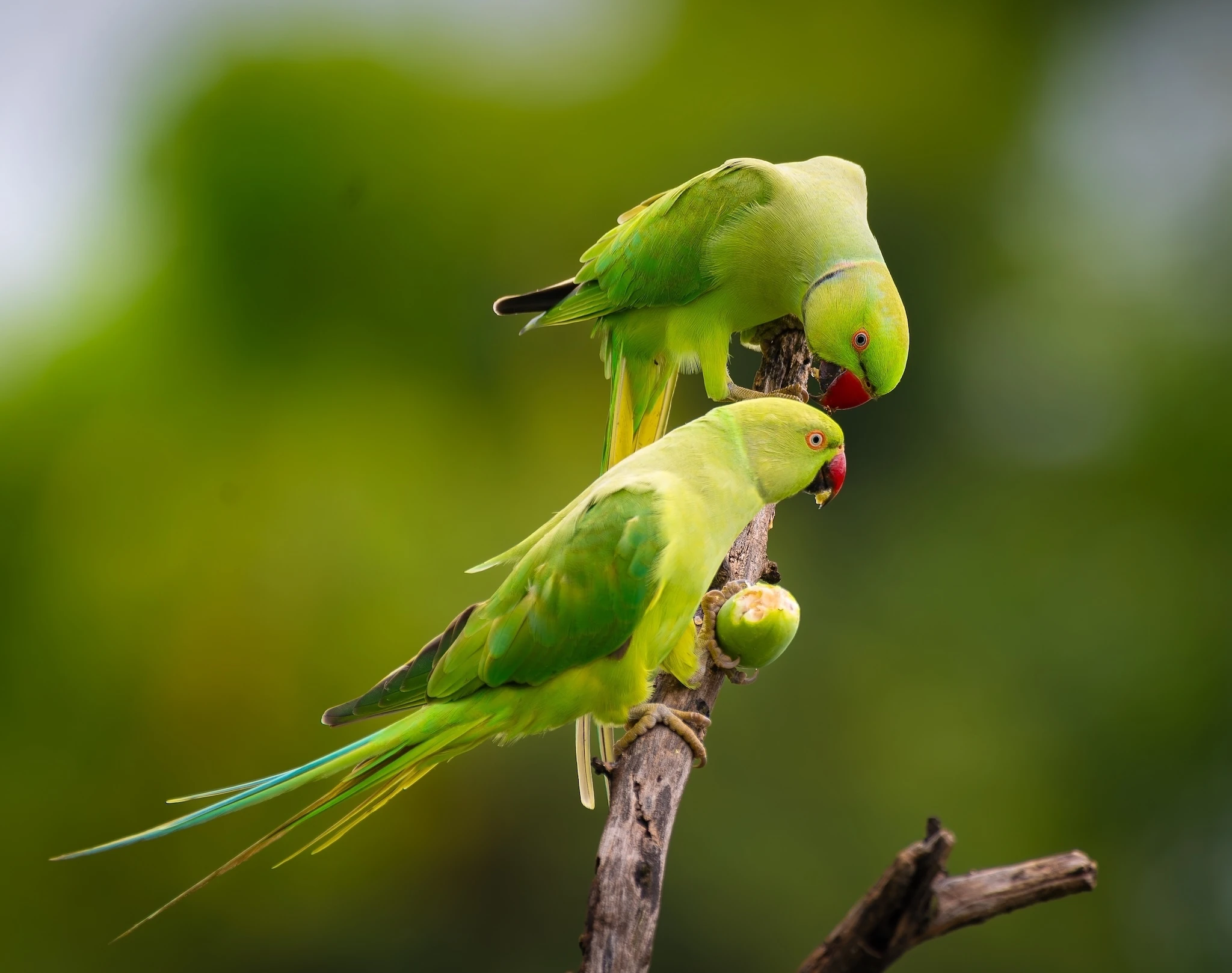
Standing around 40cm tall (from the tops of their heads to the ends of their tails), characterised by a camp combination of Brat-green feathers, fiery orange eyes, pointy red beaks, and, on the males, what looks like pink necklaces, ring-necked parakeets are the only naturalised parrot species in the UK.
It won’t surprise you to learn that they aren’t London ‘natives’ – parakeets originally hail from Asia and sub-Saharan Africa but have populated the capital in such staggering numbers that the ecological community now widely refers to them as an ‘invasive’ species. According to David Attenborough’s latest BBC Documentary Wild London, it’s estimated that there are currently 30,000 ring-necked parakeets living in London.
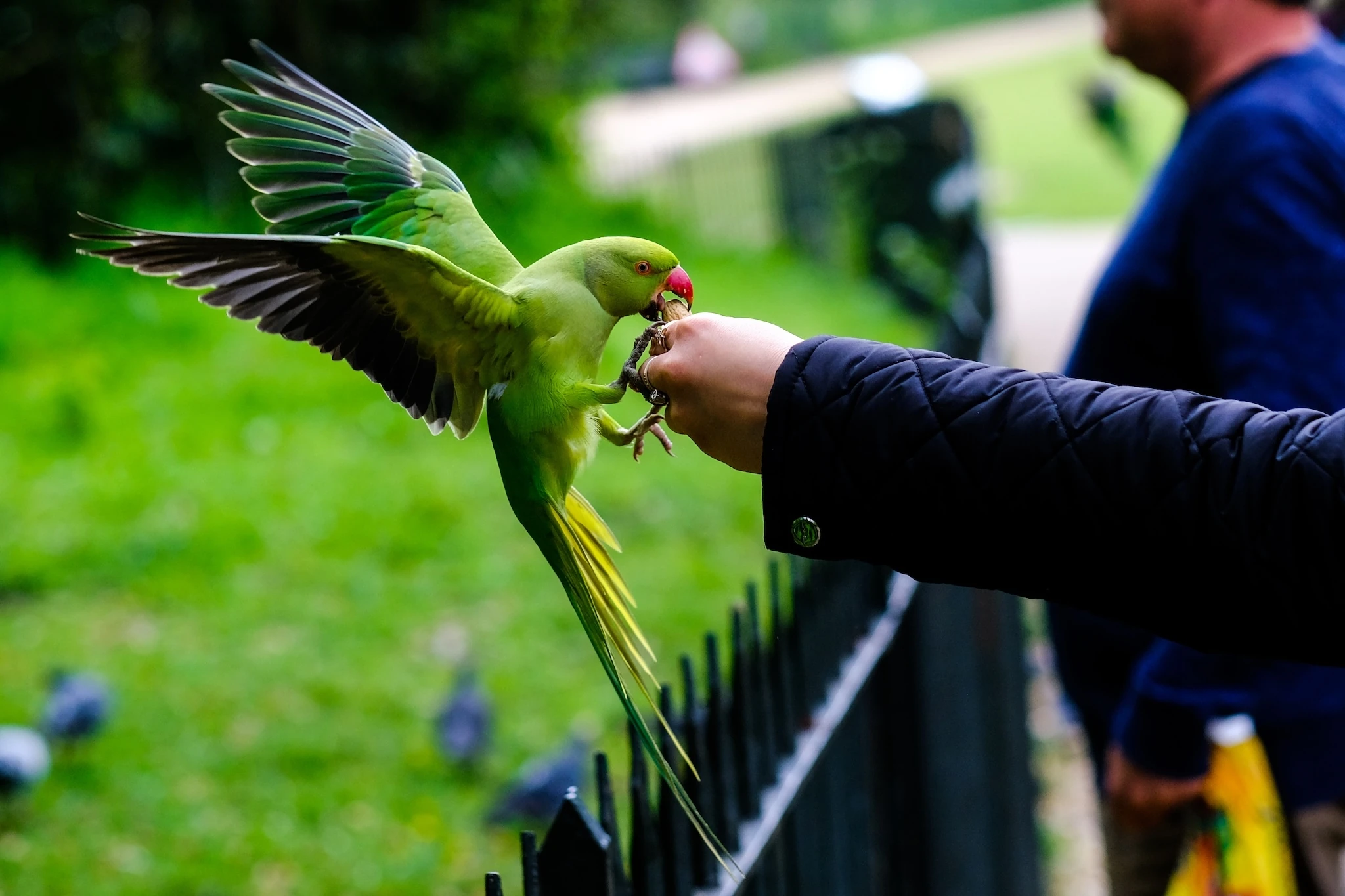
Rumours about the explosion of parakeets in the capital have been circulating for decades, from two escaping the set of The African Queen in 1951 to Jimi Hendrix releasing a pair on Carnaby Street in the late 1960s. According to Professor of Invasion Biology Tim Blackburn, however, ‘We know that’s not true – parakeets were seen in London well before that.’
In a 2019 study which used spatial analysis to determine the birds’ London origins, Blackburn, along with Professor Steve Le Comber and a team of other scientists utilised records and newspaper articles detailing where parakeets have been glimpsed over the years and were able to trace the birds back ‘to the scene of the crime’.
The crime in question? That’d be people who kept parakeets as pets releasing them into the wild. ‘We think the current population started broadly in the London area – specifically west Kent and Croydon,’ says Professor Blackburn, ‘In the 1950s there was a health scare around a disease called psittacosis – or Parrot Fever – and it scared people into opening the cage and setting [their birds] free.’
It’s estimated there are 30,000 ring-necked parakeets in London
Parakeet numbers have grown exponentially over the last seven decades – they were officially granted British Bird status in 1983, but even Attenborough himself described them as ‘running riot’. In fact, as Professor Blackburn explains, London’s birds are the likely source of other UK populations, which are now seen as far north as Aberdeen and in Northern Ireland.
Scientists aren’t entirely sure why London has been such a prosperous setting for them, but it’s likely to do with the fact that the capital is one of the warmest and driest parts of the UK – they do hail from significantly hotter climates, after all.
So, why all the feathered fuss?
Lots of commonplace London species are actually ‘non-native’. From the Plane Trees, which are the most recognisable species that fill our parks, to the feral pigeons which are technically known as rock doves, our local green spaces are full of not-so-local wildlife. However, the parakeets’ presence is, at least according to some experts, surprisingly sinister.
Parakeets have a ‘social nature and bold approach’, according to Attenborough, and it’s likely this boldness which means the birds pose a threat to London’s environment – though the reality of that threat remains contentious.
Kate McVay, Community and Ecology Advisor at Wormwood Scrubs who works for the RSPB, mentioned some concerns she has about the damage parakeets might do. ‘Personally, I’ve noticed they nibble on flower buds, and competing for food resources is probably the most substantial impact,’ she says, ‘but there’s a lot of potential impacts, just not enough data to back any of it yet.’
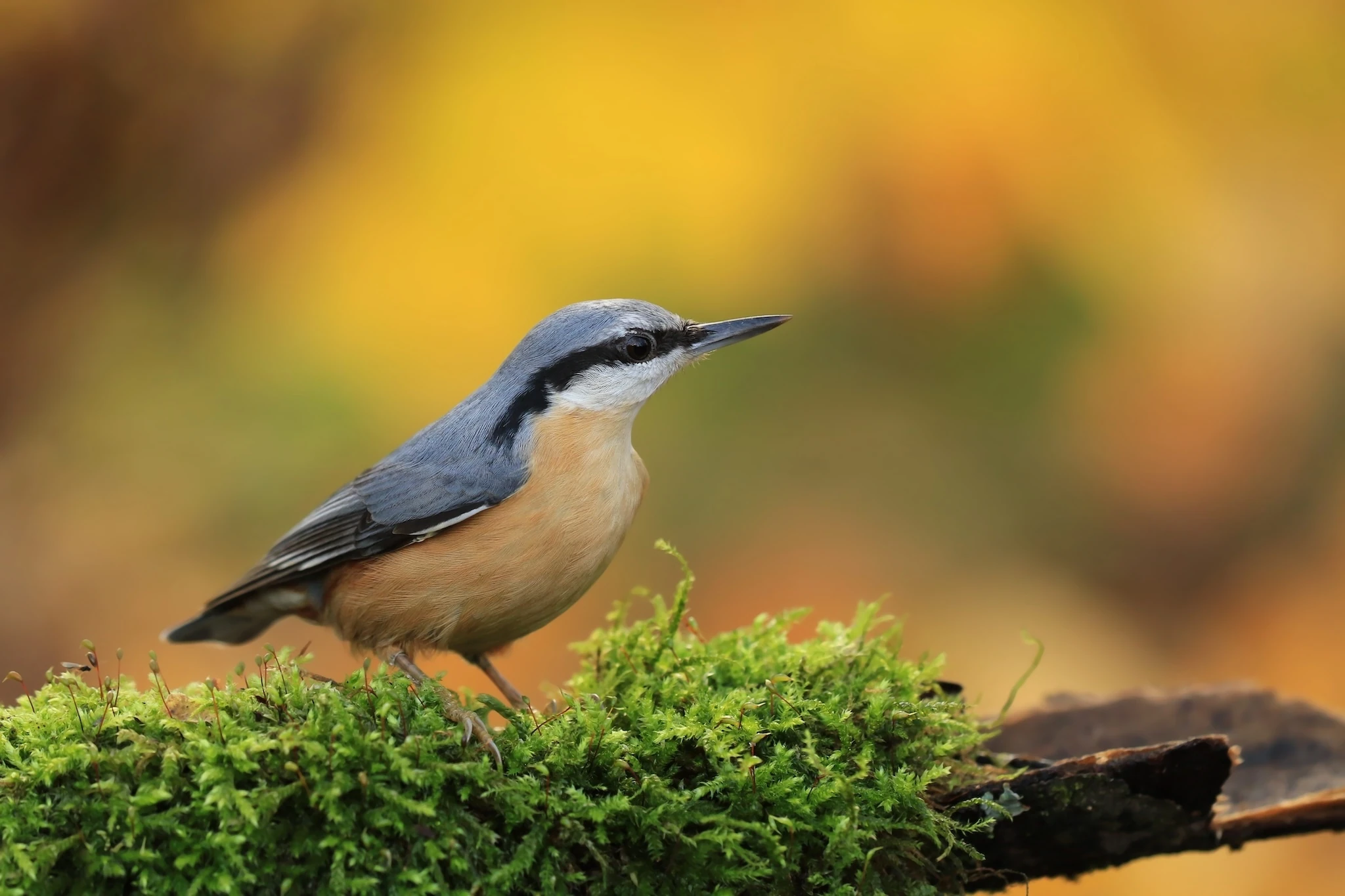
However, there’s evidence to suggest parakeets are already giving other species the boot in mainland Europe. Professor Blackburn explains the Netherlands’ nuthatches population, which is a much smaller bird species (about the size of a Great Tit, but which looks like a mini woodpecker) have declined, and research shows Spain’s bat populations are suffering, too.
Holes in trees are a limited resource
‘What we’re concerned about is that holes in trees are a limited resource,’ says Professor Blackburn, ‘If the parakeets are occupying those holes, then other species can’t do so.’
‘The other big impact is an economic one,’ explains Professor Blackburn, ‘Right now, they’ll pick blossom and fruit off trees, but once they get into agricultural areas in large numbers – I suspect as the climate warms up – they’ll hit the major fruit growing or wine growing areas.’
Word on the para-street
Love them, or loathe them? Well, we asked you. In a poll on Time Out’s Instagram, 373 people responded, with 80 percent of the replies showing the birds some lurve, while just 11 percent of respondents were ‘not a fan’.
However, the same warm sentiment isn’t shared on the online discussion forum Reddit. In a thread on the London page entitled ‘Does anyone else HATE the parakeets?’, dhlynx said the parakeets ‘appear truly magical contrasted with the grey concrete city’, but others expressed less kind impressions of the birds.
‘I was speaking to a wildlife photographer who gets commissioned to capture images of insects. He uses the London parks heavily and told me that the parakeets have chased away all the smaller songbirds. They are aggressive towards any birds that threaten their food source, leaving only crows and pigeons to survive.’ said Next_Drama1717.
I saw some gang up on a squirrel once. Since then, I hate them
‘Award for the most accurate British description goes to ‘They shriek like throttled muppets’’ writes dankydiamonds, while according to Invanabloom, ‘I saw some gang up on a squirrel once. Since then, I hate them.’
Name-calls from other users include: ‘noisy green bastards’, ‘total asshole[s]’, and ‘squawky green terrorists [that] are ruining my life!’. Mixed reviews, eh?
But maybe parakeets aren’t all bad
Long characterised as a hobby for middle-aged blokes donned head-to-toe in khaki, birdwatching (which also covers ‘birding’ and ‘twitching’), has found a new audience thanks to a tidal wave of interest among Gen Z. In the week commencing February 2, 2026, Google searches for ‘birdwatching’ soared by a whopping 200 percent, with ‘London birdwatching’ leaping by 40 percent, specifically. Oh, and TikToks quickly amass thousands of views.
@madeleineeegan A cute afternoon at st James park the birds are so unafraid of people it’s crazy! #london #nature #birdwatching #ornithology #pidgeon ♬ original sound - ᯓ★ alina
Despite the threat parakeets pose to tree-hole availability for other species and to our food-growing areas, their vibrant appearance and loud call make them an ideal ‘entry species’ for birdwatchers. In fact, searches for ‘parakeets London’ leapt by 277 percent in the first two weeks of March compared to February.
‘I find them to be a bit like marmite,’ Professor Blackburn says, ‘But you do encounter a lot of people who love the parakeets. They go to places like Kensington Gardens to feed apples to these fantastic green birds, so it’s obvious that they do get people engaged in nature.’
McVay agrees, saying that ‘anything we can do to get people connected with nature I’m going to take as a win, especially in the day and age we exist in now with such a pressing climate and nature crisis.’
So, what’s the verdict? Well, it seems parakeets occupy an ironic grey area in London’s environment, with their confident character and domineering presence posing a worrying threat not only to other local species but also the livelihoods of British farms.
However, it isn’t too far fetched to think that maybe the parakeets’ arresting, vibrant features are a reminder for lots of us to pay a bit more attention to the state of our natural spaces. And with a looming climate emergency, there are few things more important than that.