

[title]
★★★★
Director Simon Stone – an Australian – seems obsessed with the English upper-middle classes. He works internationally but in this country, at least, his free adaptations of the classics all concern sweary, witty, slightly awful posh people who live in nice Grand Designs-style houses in which they say funny, cutting things until tragedy inevitably raises its head.
It’s easy to be cynical about this: the starts of all his plays are functionally identical, and could easily be swapped with each other without really affecting the main plots.
However, it has to be said that The Oresteia is in many ways the apotheosis of Stone’s style, an expansive adaption of the Greek legend about the fall of the house of Agamemnon that is trashy as hell and yet relentlessly gripping, its three-and-a-half hours whizzing by.
The original story starts with one of the most infamous murders in myth, as Agamemnon sacrifices his own daughter Iphigenia to the gods in order to allow the vengeful Greeks to sail to Troy.
Here, the exact circumstances of the death of Iphigenia-equivalent Isobel are shrouded in mystery until the very end. A non-linear structure maximises shock value in a way that clearly takes a leaf or two from the world of true crime podcasts. After a classic Stone opening scene that introduces us to dad Christopher (David Morriseey), mum Montie (Mary-Louise Park) and kids Augie (Tom Glynn-Carney) and Alice (Rosie Sheehy), we skip forward a decade to discover Christopher is dead and Augie is trying to convince a detective that he killed Montie in revenge.
I think the surest way to send yourself mad here is to see Stone’s Oresteia as explicitly being a version of Ancient Greek playwright Aeschylus’ Oresteia, and by extension Robert Icke’s superlative 2015 adaptation.
In fact it’s stated that Aeschylus is just one source, and while it’s clearly the most important source, but it’s more like a jumping off point. Stone does his own thing and in his prosaic world of rich kids, there’s not much room for the metaphysical themes of the original story. So spoiler alert: Isobel’s death isn’t Christopher’s fault in the way Iphigenia’s was Agamemnon’s. Parker’s Montie is shunted into an overt villain role because there’s not really a ‘reasonable’ justification for her killing Christopher. Glynn-Carney’s Augie’s is driven to bloody revenge by mental health problems. The redemptive final act of Aeschylus is ignored.
A compulsive revenge thriller, expertly paced and structured
And this is fine! Where Icke transposed the events of the play to the modern day regardless of their strangeness, that’s not Stone’s thing. Greek stuff that would make no sense, he changes, and if you can get on board with that you’ll be laughing here.
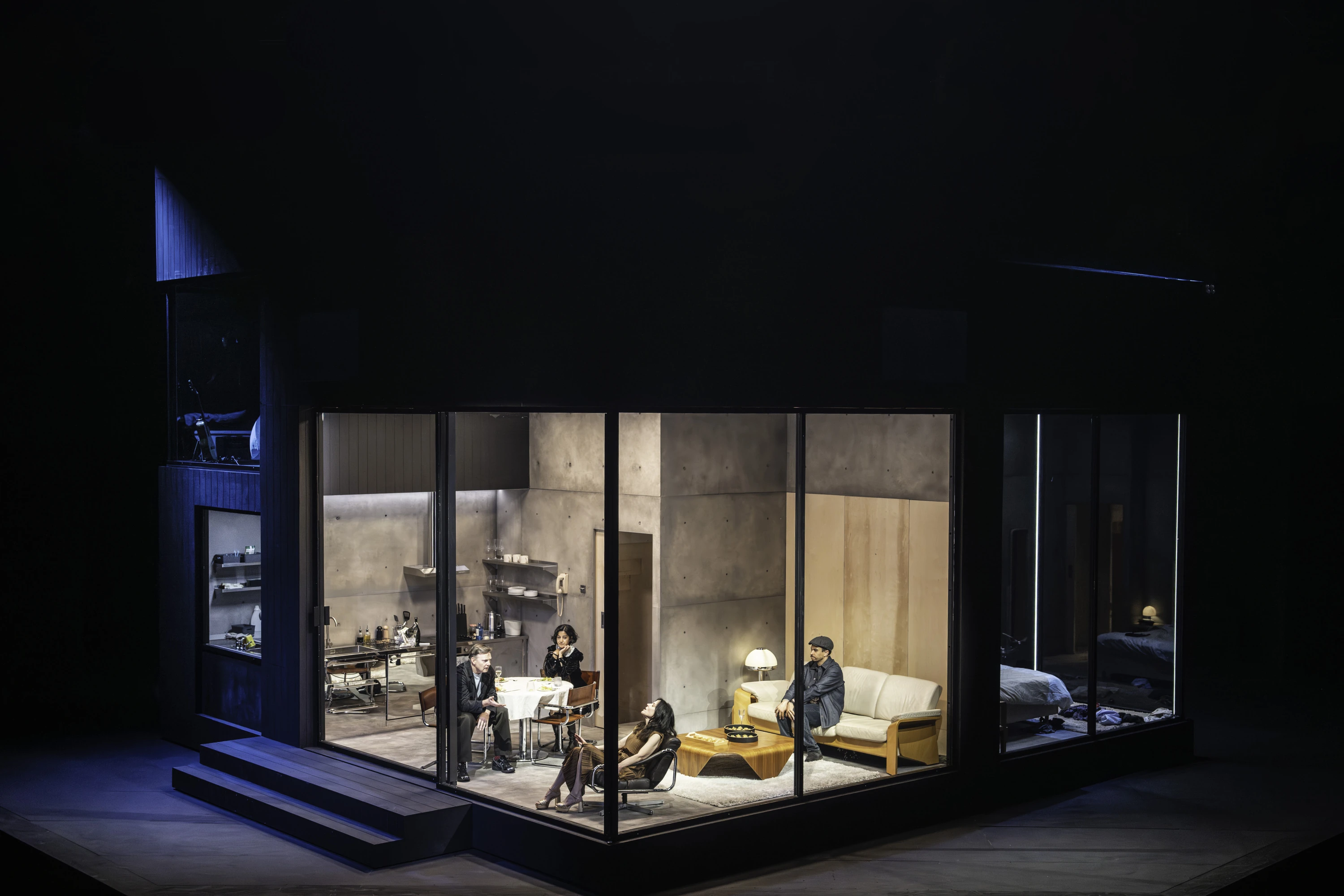
What he offers is a compulsive revenge thriller, expertly paced and structured. The fact that the story is well known is largely irrelevant: think of it as a really entertaining podcast about a murder whose details are already out there, but is told in a gripping enough fashion to largely negate this. The non-linear structure works a treat and Lizzie Clachan’s revolving house set is great for the pacing, with scenes set up in the side of the house we can’t see before it spins around.
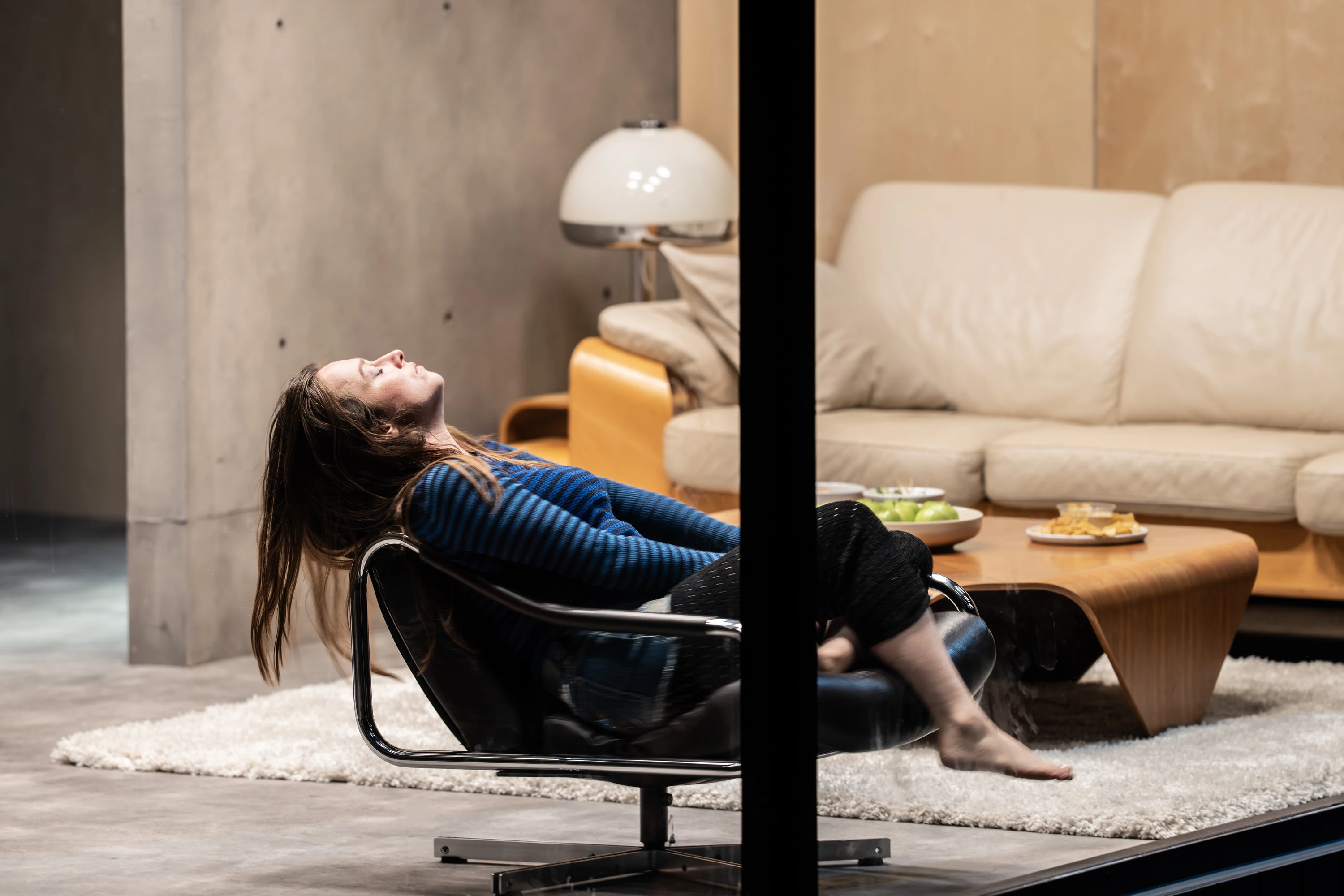
And Stone’s characters are by and large enjoyable. You’ll appreciate Sheehy’s performance a splash more if you’ve seen her in anything else and can appreciate just how far her delightfully awkward posh girl Alice is from anything else the Welsh actor has done. But she’s a delight either way, a vibrant cocktail of privilege and inferiority complex. US star Parker teeters on the cusp of panto villain but she’s tremendously good at it; with a couple of gloriously scenery-chewing monologues. And there are some great second-order characters too, particularly Rakhee Thakrar as Christopher’s parodically wholesome new girlfriend Chandra.
Morrissey arguably gets the short straw. His baleful Christopher often feels beamed in from a different play and you do sometimes wonder if Morrissey is the first working-class English person Stone has met - his usually fluidity of dialogue deserts him. That said, the weird texture afforded by Morrissey’s dour presence does give it a certain something. John Macmillan’s hilariously ineffectual single dad – and later boyfriend to Montie – Jerome isn’t an even slightly plausible killer, but the point is it’s not especially concerned with psychological acuity, but rather entertainment.
Yes, it’s totally Greek myth gone Saltburn. But I had a very good time with The Oresteia until the end when it simply leans too enthusiastically on the idea Augie has lost his mind and degenerates into overwrought silliness.
In the National Theatre’s current production of The Misanthrope there is a passage that seems to be very explicitly mocking Stone and his repetitive sets and bombastic takes on classics. And he’s easy to take the piss out of. But here, at least, he is also incredibly fun.
Bridge Theatre, until Sep 19. Buy tickets here.