

[title]
★★★★
Curiously unmentioned in the publicity around the National Theatre’s most anticipated show of 2026 is that it’s one of those productions where the two leads – that’s Cate Blanchett and Nina Hoss – toss a coin at the start to see who plays which role.
It’s an idea that has some resonance with the themes of duality and identity that permeate Ingmar Bergman’s 1966 cinematic masterpiece Persona, the source text here. It must send its stars deeper into the show’s psychological rabbit hole.
But from the POV of an audience member who will (probably) only ever see it one way around, let’s call it what it is: a flex over how good Blanchett and Hoss are. And they’re really, really good: even if Benedict Andrews’ production doesn’t entirely ‘work’, the sense that it is just bloody amazing having two incredible actors doing an enormous amount of acting – and that we’re actually only seeing half of it – carries the night.
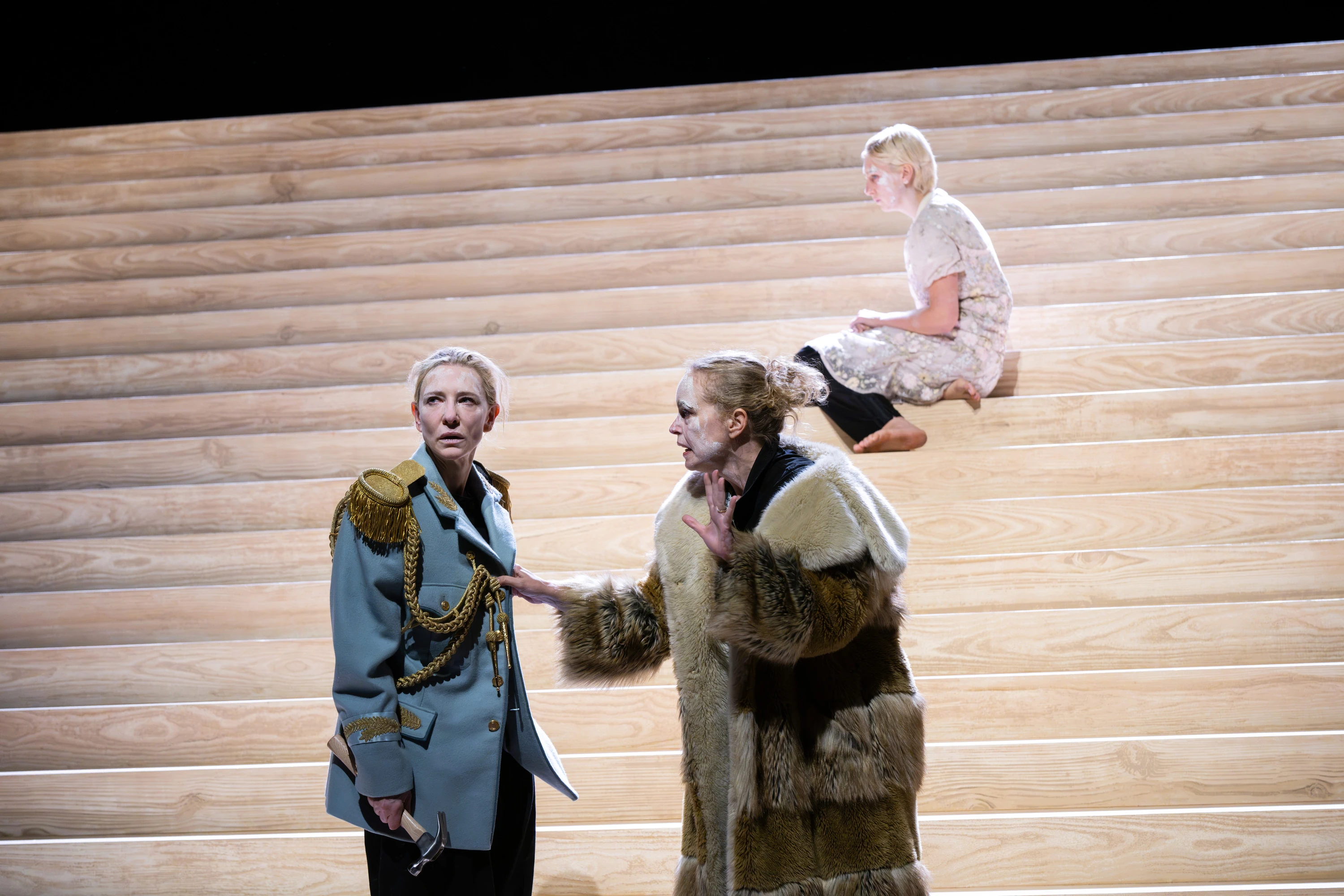
Persona follows Elisabeth, a star of stage and screen who is sent to an isolated country retreat with her nurse Alma in the hope she’ll recover after being mysteriously struck dumb following her performance in a production of Sophocles’s Greek tragedy Electra.
It would be overstating the literalness of Andrews’ adaptation to say that the claustrophobic, clowning-inflected version of Electra that starts the night is intended to be the same one that Elisabeth starred in before her breakdown. It could be. But while there are links between the pieces, you could drive yourself mad looking for continuity: I think it’s easier to view Electra/Persona as a double bill.
Electra sees Andrews take a freer hand, with a short, sweary modern English adaptation in which (on press night) Hoss’s melodramatic Electra rants and rails against Blanchett’s withering Clytemnestra to frequently comic effect. It’s also pretty fucked up: on Magda Willi’s disorienting, ziggurat-like wooden set, each of the two women – wearing crude whiteface makeup – makes the other act out the murder that the other is seeking vengeance for, while Electra’s ‘normal’ sister Chrysothemis (Ella Lily Hyland) occasionally reluctantly joins in. There’s a distinct hint of Genet’s The Maids to the violence and persona swapping.
Speaking of persona… the Bergman adaptation is much more faithful to the original, albeit it’s set in the present day (a mobile phone is a big plot point). There is much more stage trickery in this part, notably the prominent deployment of live film – it’s necessary to show a close up of Elisabeth’s face, because she doesn’t actually speak. On press night this was Hoss’s role and yeah: that’s some face acting. Tears and misery at first, but as she spends time in the company of Blanchett’s prattling, unguarded Alma she becomes warm, fond, eventually condescending. To see all this play silently on her face is quite something.
On press night Blanchett played the straighter of the two roles – she has actual lines – but honestly what a joy to see her in a departure from the irony-heavy, borderline jaded recent stage performances like last year’s The Seagull or previous National Theatre show When We Have Sufficiently Tortured Each Other. She is an extraordinary actor, extraordinary enough to make Alma seem like a heartbreakingly sweet, unguarded human being… right up to the point that stops being the case and her relationship with Elisabeth takes a turn for the darker. Alma realises Elisabeth’s silence is an act and she’s been enjoying leeching off her carer’s babbling chatter. Alma’s personality shifts, and things become muddled and start to overlap between the two (?) women – who is Elizabeth? Who is Alma? Who is feeding off who?
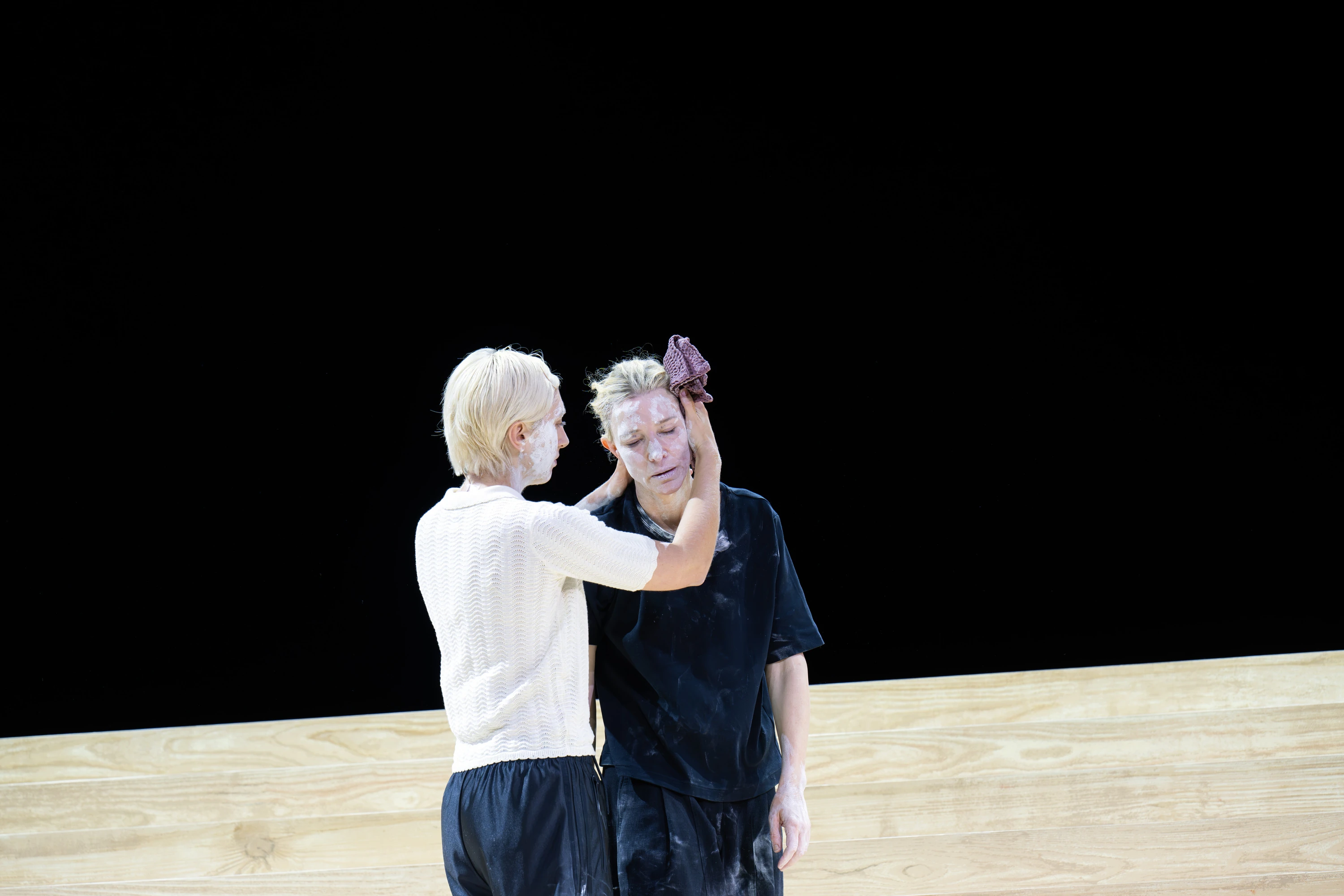
There’s some virtuosic live camera work, but it’s all in aid of the actors: Hoss’s huge, scared eyes, Blanchett’s agelessly beautiful face rendered sinister and skull-like in shadow, and the two women’s movements settling into eerie lockstep. Hildur Guðnadóttir’s original soundtrack is gentle but ominous, recordings of heartbeats and – according to the credits – teeth, with added strings. There is particularly fine lighting, from Jon Clark, that takes us from balmy summer to inky netherworld.
The main problem is that the Electra section ends up feeling somewhat thrown away because it’s so much shorter than the Persona section, and with a lighter tone (closer to Andrews’ usual voice on productions like his recent Hoss-starring Cherry Orchard). And that’s a shame because it’s very good and – despite the millennia-old plot – feels like an original stage work. Persona is really much closer to an act of transposition, of putting Bergman’s story on the stage faithfully. But it’s intense, serious, psychologically demanding source material that drains the night away from the shorter play. Electra is good, Persona is good, Electra/Persona isn’t necessarily one for the ages.
But that’s more of a literary criticism. As live theatre, it all comes back to that massive flex that says ‘look how good Cate Blanchett and Nina Hoss are’. And they are really bloody good, and watching them journey to the deepest recesses of the characters’ blurred souls is all you should want from the stage, really.
Electra/Persona is at the National Theatre, Lyttelton, until Oct 10. Buy tickets here.
The best new London theatre openings to see in 2026.
Seven massive West End shows are about to close.
Get the latest and greatest from the Big Smoke – from news and reviews to events and trends. Just follow our Time Out London WhatsApp channel.
Stay in the loop: sign up for our free Time Out London newsletter for the best of the city, straight to your inbox.