

[title]
★★★
The list of content warnings is long and heady: prolonged nudity, torture, mutilation, murder, sex, incest, violence, forced eating, drug abuse, homophobic and misogynistic language, blood and needles.
So yes, Cleansed starts with a syringe in the hand of the sloping, scruffy Tinker, some kind of malevolent authority figure in a psychiatric hospital-cum-prison-cum torture den, before said syringe is plunged into the eyeball of the willing Graham.
It’s an infamous opening to an infamous play, steeped in the lore of its writer Sarah Kane, whose brutal and bleak dramas in the mid-Nineties redefined theatre and caused no end of controversy. Reviled by critics of the day, she did not live long enough to see her elevation to the echelons of the all time greats, as we came to understand the cries of pain in her work a little better.
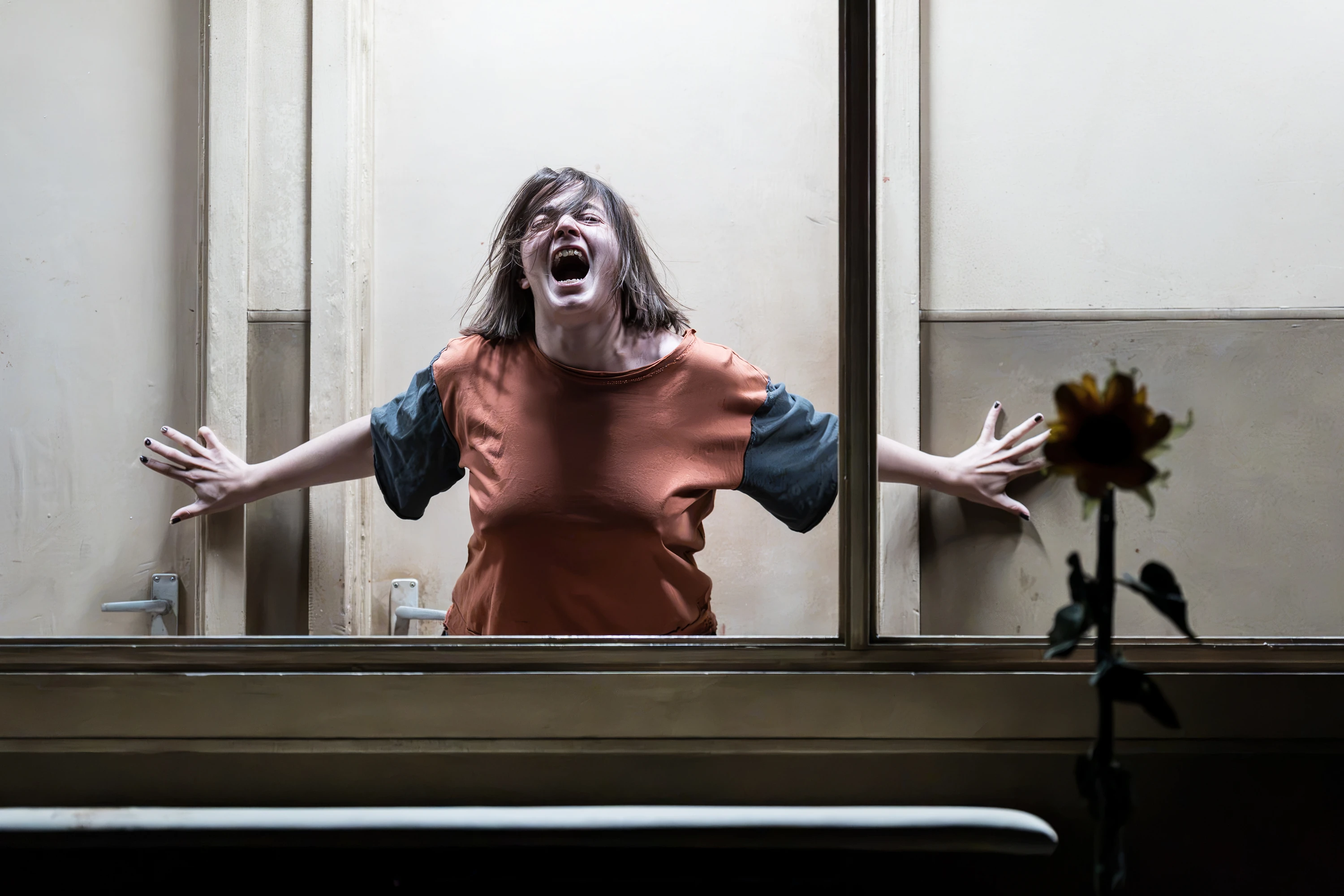
And there is a lot of pain here. Pain is the point, far more than plot. In this institution Graham’s sister Grace seeks romance and then seemingly turns into her dead brother. Gay couple Carl and Rod are tortured. A sweet boy, Robin, falls in love with Grace. All of them are ruled over by Leo Bill’s sad, malevolent Tinker.
You can read these sharp, shocking scenes as metaphor for Kane’s own time in a psychiatric hospital, for the nadirs of human nature that play out in war zones, for the dark dark places the human mind can go when suffering from adverse mental health.
You can see, too, the attraction for a great director: and Rebecca Frecknall is a great director. With a career built on crystalline revivals of classics – Tennessee Williams, Chekhov, Eugene O’Neill – this production shows her usual clarity in every exchange.
But she chooses to tackle the impossible stage directions ('He takes Carl by the arm and cuts off his hands') with a nervous combination of realism and symbolism, sometimes willing to go there, and sometimes hiding the action behind walls. There’s that syringe that looks like it goes into an eyeball, but on the other hand Carl’s hands are not cut off, they are tied and then doused in blood.
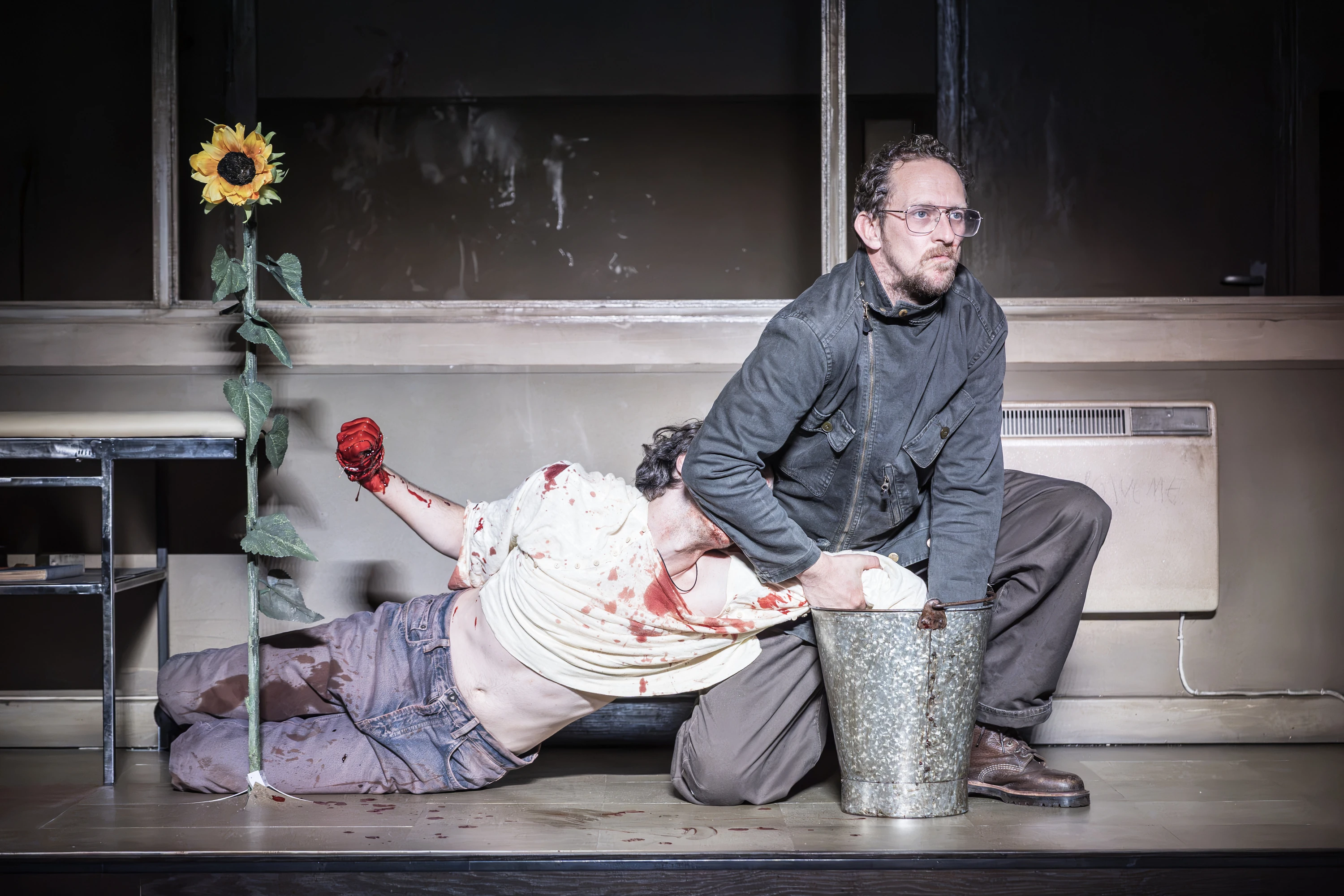
Both approaches have their amazing moments. On the realism side, Robin’s demise is meticulously, sickeningly convincing. On the imagined side, an extraordinarily physical performance from Luke Cinque-White as Carl sees him beaten up by an invisible guard, hurling his body against the floor, smashing his head open on a wall in a bloody mess.
Pain is the point, far more than plot.
These performances are incredible to watch, partly through the actors’ sheer game submission to roles where they have to be naked, maimed, writhing in agony, and occasionally dancing.
Cinque-White again: in one of the few tender moments, he steps onto a field of daffodils that appears from under the stage and does what the play calls ‘a dance of love’ for Rod. The gentleness of it, his smile, the sudden lightness, while he wears blood-stained clothes and has black stumps for hands is pretty heartbreaking. Stuart Thompson – an actor who impresses more and more in each role he takes on – somehow manages in his kittenish innocence to bring humour even in the play’s late, bloody and denuded stages.
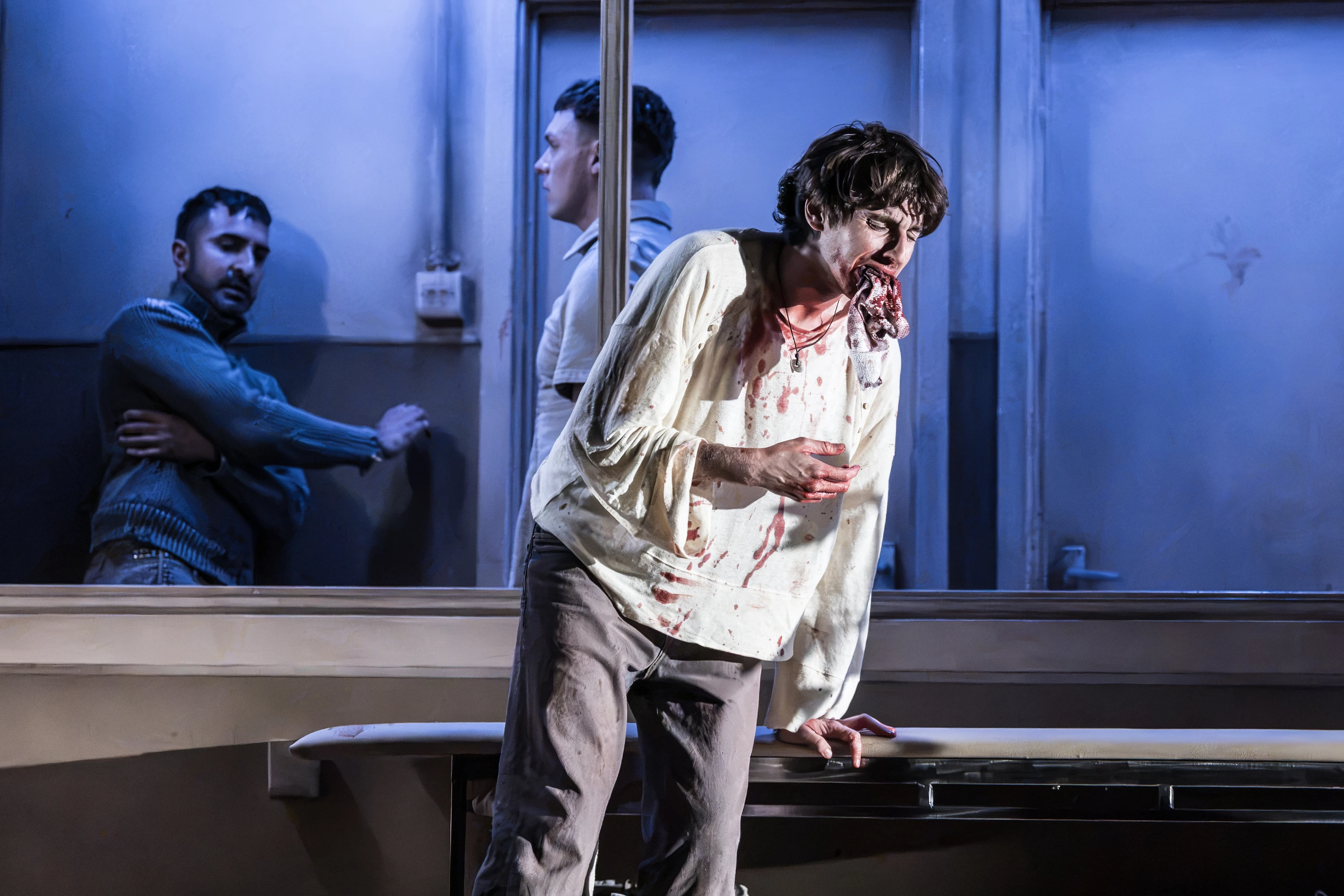
That’s the nice stuff. Back to brutality: Parth Thakerar’s Rod contorts his face into various rictuses of horror. As Grace, Pearl Chanda turns her initial desperation into a blank despair as she’s subjected to sexual violence.
It holds so hard to its extreme bleakness that it occasionally risks becoming comical. It does often feel like an experiment in the extremes of what can be staged, and a saggy middle doesn’t always hold the attention. But maybe that’s Kane’s point too: yawning while a bloke has his feet cut off… it’s like she’s daring us to be desensitised.
Kane’s idea is that love persists, maybe, even when twisted and degraded. Some argue for the greatness of the play, some dismiss it still. Frecknall’s production plants it somewhere in the middle. Its shortcomings are not because it’s a horrible play – it is, but theatre doesn’t always have to be enjoyable, and that horror is clearly in the service of something – but because it’s an imperfect production. Frecknall can’t seem to decide whether to show us the extremes, or to abstract them, and the result is only sometimes extraordinary, never quite living up to the version of the play that runs through your perplexed head when reading it.
Almeida Theatre, until Aug 29.
The best new London theatre shows to book for in 2026.
Rebecca Frecknall on Cleansed: ‘You can have empathy for anyone’.