

[title]
★★★
In theory, Kip Williams’ Dracula is the perfect homecoming vehicle for Cynthia Erivo. Having spent her twenties making a name for herself on the London stage, she hasn’t trodden our boards since a Menier Chocolate Factory production of The Color Purple kicked her career into overdrive a decade ago.
But the Stockwell-born Wicked star was always going to come home at some point, and Dracula offers the chance to show her range: taking on 23 roles in a stage retelling of Bram Stoker’s classic vampire novel. And let’s be honest, it has the air of awards bait. Auteur Aussie director Williams’ aggressively techy, film-heavy style is pretty out there. But Dracula follows his wildly acclaimed one-woman Dorian Gray, which won its star Sarah Snook a Tony and an Olivier.
However, in Dorian Gray, Snook’s live performance always felt like the main event. In Dracula, Williams’ virtuoso use of film gets in the way. There’s a lot of debate over whether ‘live video’ – that is to say, a performance relayed via video feed to a big screen on the stage – counts as theatre, and the answer I will give anybody to this is ‘yes’.
The problem with Dracula is that as it wears on, Erivo has to portray multiple characters of roughly the same importance at the same time. Williams’ solution to this is to make heavy use of pre-recorded Erivos, who we can see on the screen, impressively blended with a live feed of the set and the ‘real’ Erivo.
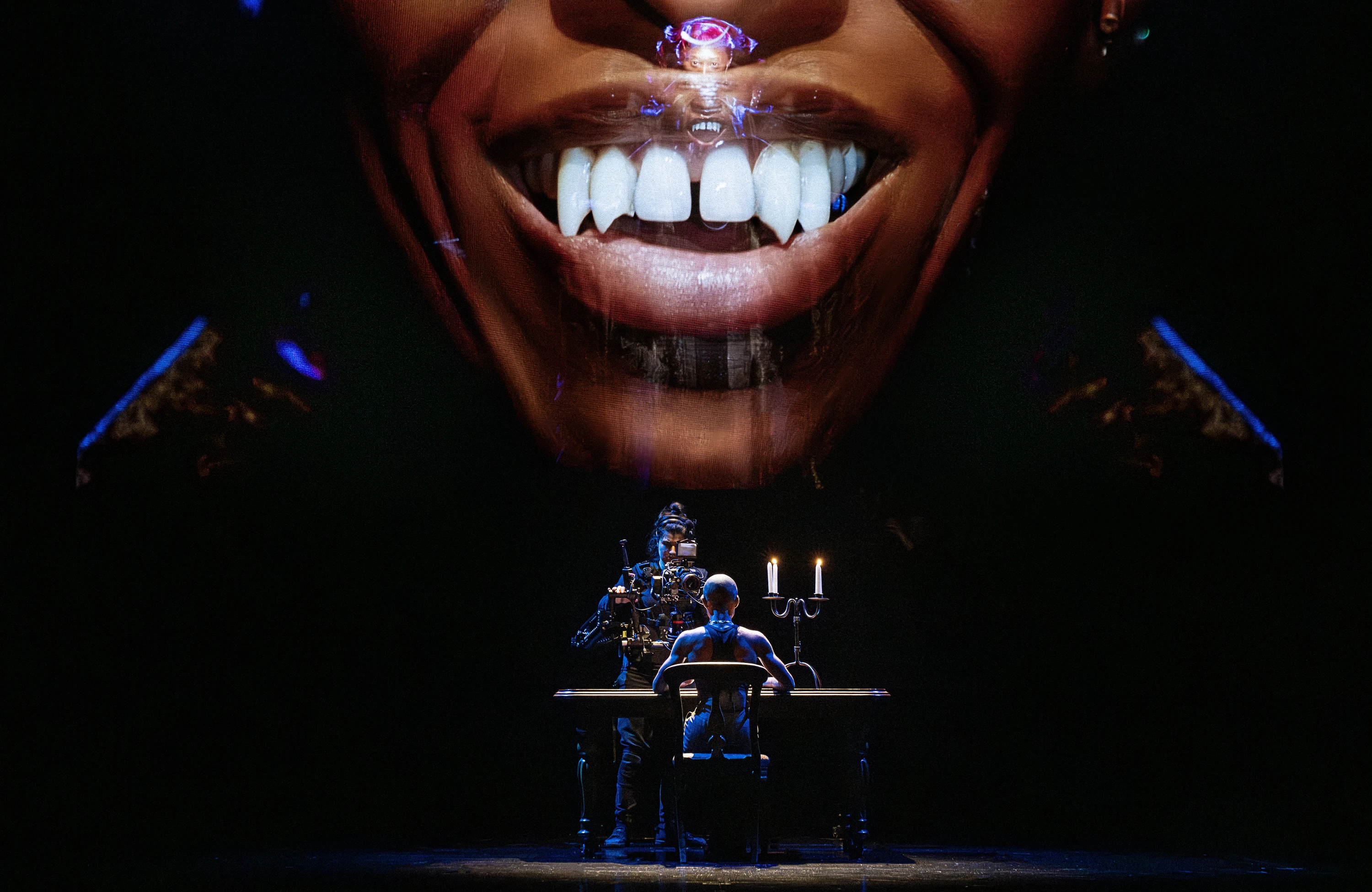
The thing is, there is far more pre-recording than in Dorian Gray. And these group scenes rarely put the live performance at their centre: quite the opposite, as the ‘real’ Erivo usually plays the straight-laced Dr John Seward, who mostly just stands in the background goggling in astonishment. Erivo is tiny and the screen is massive, and the pre-recorded stuff is so dominant – as many as four gigantic versions of her on screen – that it overshadows the technically impressive work happening on stage. Aesthetically it’s harder and darker than Dorian Gray, with a thrillingly pulsing electronic score from Clemence Williams. But the ropey selection of wigs and facial hair that the pre-recorded Erivos sport adds a weirdly goofy note to proceedings.
This all accepted, Williams remains a fantastically exciting director whose bold experiments in mainstream video-driven theatre should be applauded, and are thrilling when they do work. The opening section, in which a buff, singlet-clad, RP-talking Erivo narrates Jonathan Harker’s visit to Dracula’s castle in Transylvania is superb: tight, gripping storytelling, faithful to the novel’s epistolary form by keeping things essentially focussed on a single voice. When the Count does appear, sporting luminous red hair and a West African lilt, the live Harker and video-only Dracula makes total sense, a sort of duet between the two Erivos, that neatly inverts the vampire’s invisibility in mirrors: this one can only be seen on film.
And there’s lots of great stuff throughout: Erivo is a burningly intense performer who nonetheless has some fun casting sarcastic looks or exaggerated doe eyes at the camera. Some of her characters verge on stereotypes, but her stylish, implicitly African Count is fascinating. And it’s worth saying that while Erivo has a diminutive stature, her otherworldly looks look great blown up on a giant screen – she’s a movie star! Even her trademark talon-like fake nails and shaven head offer an echo of Nosferatu that’s slyly acknowledged at one point.
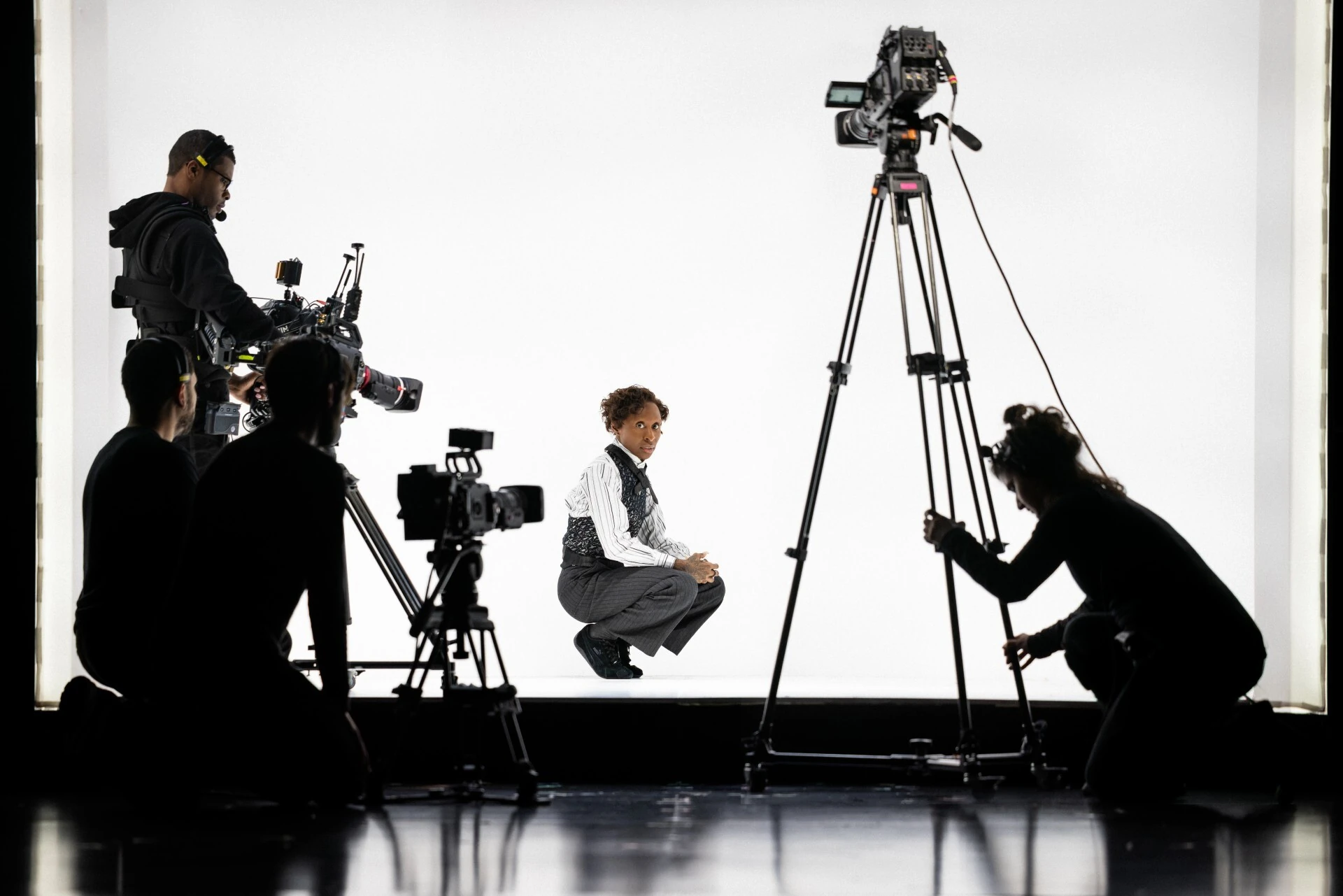
But when the action moves to London and the character count rises (but the actual Count becomes a more peripheral character) it bogs down. Not only does it become quite a lot like watching a weird pre-recorded film of Dracula, but there’s just too much plot compressed into too little space. Renfield, for instance, doesn’t really work if he’s galloped through. Even knowing the book quite well, I struggled to follow everyone’s exact comings and goings. And then, oddly, having been slavishly faithful the entire way though, Williams changes the ending quite a lot, in a way that would feel less jarring if it had been set up in any way.
Again, I refuse to treat Williams’ style like the Emperor’s new clothes. He’s onto something! It just doesn’t entirely work here. Despite stumbling over the odd line, Erivo is charismatic, game, and essentially does her best as a cog in Williams’ elaborate machine. But if you agree to tie your big comeback to a very specific directorial vision, there’s not much even a superstar actor can do if that vision is faulty.
Dracula is at the Noël Coward Theatre, until May 30.
The best new London theatre openings to book for in 2026.
The National Theatre has announced its celebrity-filled 2026 season.