

[title]
★★★
Endeavours don’t get much more quixotic than the Zambian space race, wherein the poor, landlocked southern African country notionally duelled with the USA and USSR to see which could be the first to send a human to the Moon.
And when I say ‘Zambian’: the programme was the brainchild of one Edward Nkoloso, a private citizen and former leading light of the country’s independence movement who scraped together what funding his National Academy of Science, Space Research, and Philosophy received from – on the whole – small donations. The new government refused to fund it, reasoning that one, it was never going to happen and two, the attention it was getting threatened to turn the fledgling country into a global punchline.
It remains a point of some debate whether Nkoloso was serious or if the entire thing was a sort of grand satire on the superpower dick-swinging of the ‘main’ space race. But for his follow-up to West End hits For Black Boys… and Retrograde, rising star playwright Ryan Calais Cameron goes all in on the idea that Lucinda Msamati’s Nkoloso absolutely meant it.
It’s more complicated than that, though. For much of The Afronauts it feels like Nkoloso is simultaneously aware his project is doomed but determined to keep pushing it because the utopian dream it offers seems more important than actually getting to the Moon. Camus famously opined that ‘The struggle itself towards the heights is enough to fill a man’s heart’ and Msamati’s driven (but not deranged) Nkoloso manages to make it feel like the dream is more important than the truth. He inspires a mixed-sex generation of Zambians to believe that they are destined for bigger things. In particular he’s a beacon to Ama Qamata’s Matha, a young woman frustrated at her lack of prospects in life until Nkoloso not only takes her under his wing but decides she will be his first true ‘afronaut’.
Directed by Cameron and Monique Touko, the first half is a largely gentle, lightly quirky drama that follows the hopes and dreams of Matha and her fellow afronauts, and also the mounting tension between the affable but unstoppable Nkoloso and his chief engineer Simon (Ivanno Jeremiah), who used to work for NASA.
This is all good entertaining stuff. But in not positioning itself as Nkoloso’s bio drama – a shame when you have as good an actor as Msamati in the role – the story should theoretically run out of road by the time the government forcefully demands the programme is shut down about two-thirds through the first half.
Calais Cameron goes all in on the idea that Lucinda Msamati’s Nkoloso absolutely meant it
But as with Retrograde, Cameron has unashamedly embellished a true story. And there’s nothing wrong with that in principle: it’s theatre, baby! This is a play not a documentary.
There’s something clanging about his approach, though, injecting overwrought Hollywood-isms that overshadow the heart of the story. In the second half, Nkoloso and the gang crack on with the project without funding and suddenly… seem to have a working spaceship. Indeed we arrive at a point in the plot where the big tension in The Afronauts is whether Nkoloso will persuade Matha to go on what will be a one-way journey to the Moon without the means to return home. We’re one countdown away from this actually happening!
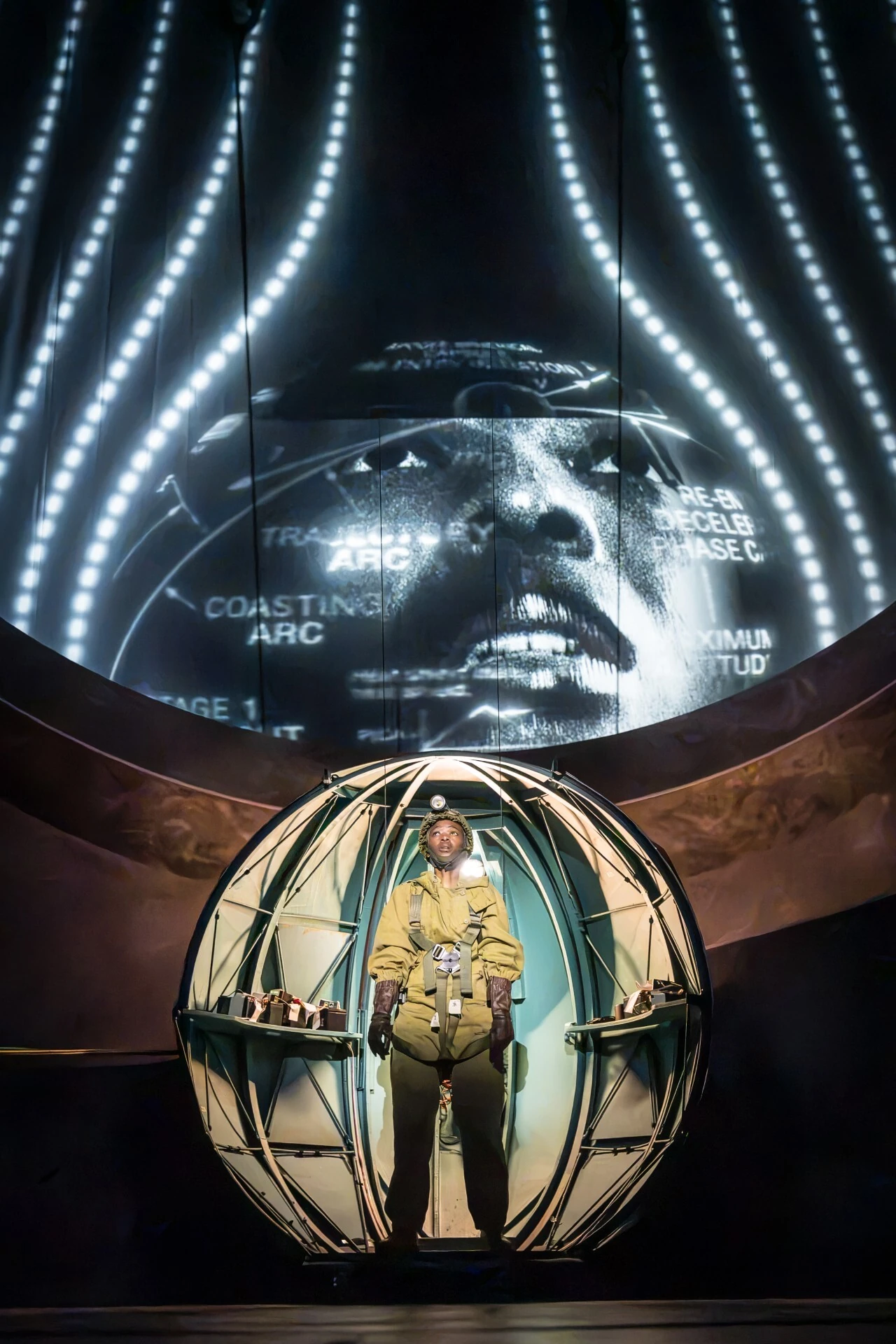
Again, I don’t think storytelling needs to be a slave to facts and a version of this story where, say, Zambia won the space race would be pretty cool I think (it’s an idea at least nodded to by the production’s fantastical final image). But on the whole Cameron’s additions to the story feel like he’s jangling blockbuster underdog movie tropes at us. Which feels patronising to both audience and subjects: whatever the Zambian space programme was, it wasn’t a serious contender that almost beat America to the stars. Suggesting it was is glib, and even disrespectful, showing a lack of interest in what these people actually did accomplish. The second half feels like it’s abandoning responsibility for the more grounded characters of the first half.
Cameron is, of course, a gifted writer. I’m pretty sure the character of Simon is made up, but Jeremiah does a great job with him: an anxious nerd genuinely dedicated to the science of the cause, who has a profoundly complicated relationship with Nkoloso. He knows early on that the responsible thing to do would be to shut the programme down – instead he allows himself to be caught up with the older man’s fervour because that seems better than giving up.
And Cameron has written some great, rounded female characters, pouncing smartly on the fact the intended first afronaut to space was indeed a young girl named Matha and running entertainingly with it. Soutra Gilmour’s set is gorgeous, an iris-like steel aperture whose ‘eye’ periodically fills with dazzling heavenly vistas. There is some very cool afrofuturist design generally, and it would be great if the show leaned into this stuff: weirder and wilder and relying less on borrowed plot beats. An entertaining play, but it feels like Cameron lacked the patience to write a great one.
Royal Court Theatre, until Dec 19. Buy tickets here.
The best new London theatre shows to book for in 2026 and 2027.
The best Christmas pantomimes in London.
Get the latest and greatest from the Big Smoke – from news and reviews to events and trends. Just follow our Time Out London WhatsApp channel.
Stay in the loop: sign up for our free Time Out London newsletter for the best of the city, straight to your inbox.