

[title]
★★★★
After a recent spate of pretty weird London Chekhovs - see Jamie Lloyd and Thomas Ostermeier’s Seagulls and the Donmar’s very eccentric Cherry Orchard - here’s reliable old master of naturalism Ian Rickson with a typically elegant take on the latter play. Although that’s not to say this Cherry Orchard is a bog standard linen suits and samovars job. Far from it.
Adapting playwright Conor McPherson cranks up both the bitter and the sweet as he massages the plot and dialogue for some big laughs - see Karl Johnson’s delightfully OTT old codger servant Firs, who is mad as a hatter and swears like a trooper.
More importantly, there an absolutely storming performance – dare I say career best – from the perennially underestimated Stephen Mangan as Yermolai Lopakhin. A self-made man of humble origins, his relationship with the lofty but impoverished household of Lyubov Ranevska (Kristin Scott Thomas) is the complicated heart of play.
Mangan’s Lopakin starts off as the usual fish out of water, condescended to by Ranevska and her pompous brother Goev (Peter Wight) when he presents them with a pragmatic plan to monetise their indebted estate. But where the character tends to properly lose patience with them in most interpretations, that’s not really the case here. Yes, he gets frustrated at their refusal to admit they must change or lose their home. But he remains genuinely awed by them, almost a sort of stan. When he throws in his hat to try and buy the estate it’s a curiously vulnerable gesture, putting all his wealth on the line for emotional, not cynical reasons. His exact feelings for Ranevska and her nervy adopted daughter Varya (Vinette Robinson) – who Lopakin is expected to marry, but who he feels forever awkward around – are never really clarified. But it’s clear that rather than simply being an embodiment of Russia’s future, he is bound to these people, forever cowed by them.
Biggest name Scott Thomas is very good as the bright, brittle Ranevska, whose inability to adapt to the times often feels like a matter of stubborn choice rather than actual inability to change – she prefers to play her old life to the last rather than plan a new one. As the sun rises over the estate’s beautiful old cherry orchard she declares that no moment has ever been more perfect: and she’d be right if time stopped right there. But she knows full well it won’t.
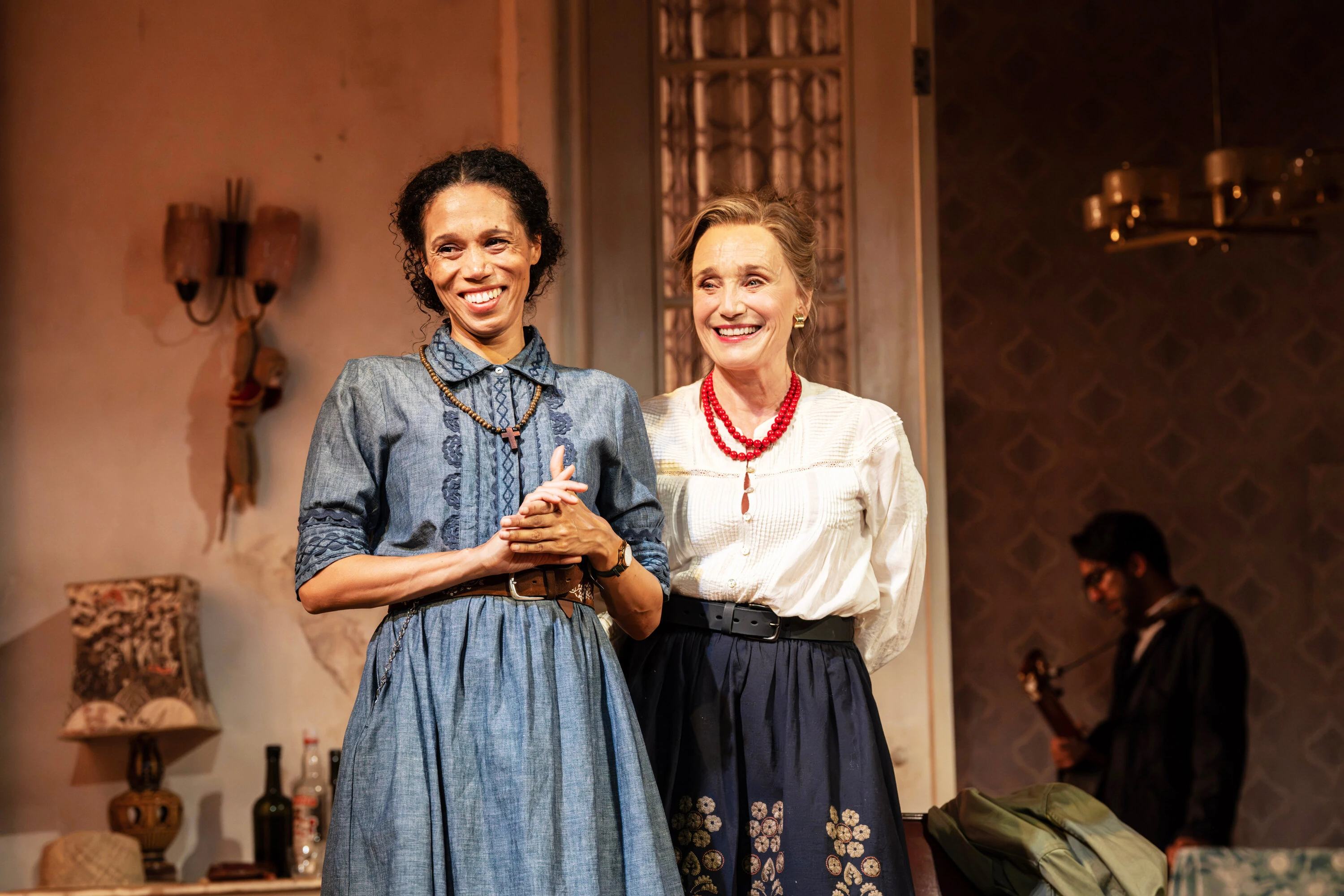
It’s a play about change and the end of an old world, but here it’s also a profoundly moving treatise on the impossibility of letting go of the past – nobody here can do it.
You do really know where you are with Rickson and his team: there’s a poignant semi-dilapidated set from Chloe Lamford and absolutely world class shifting of the light from lighting designer Bruno Poet. The oddest innovation is the anachronistic costumes from Sussie Juhlin-Wallen. I think the characters’ dress sense is supposed to be changing as the show wears on, presumably to hint at the encroaching future. The first scene’s clothes seems true to the play’s 1904 era; by the end people seem dressed like it’s the ‘60s. (It may also be the case that the costumes are simply ‘mid-century’ – I'm not a fashion guy!). There is certainly no need to be slavish about Russian period detail in an English-accented 2026 adaptation by an Irish playwright. But if there’s a specific meaning behind it the way the cast were dressed I didn’t get it.
This is hardly a problem, just an oddity in what is ultimately another Rickson/McPherson Chekhov banger (following 2020’s Uncle Vanya). There are some very funny performances. But really it’s the more painful emotions that linger in the splendid central turns from Scott Thomas and Mangan, the sense of people too in love with a perfect past to ever truly embrace an imperfect future.
Harold Pinter Theatre, until Jan 9 2027. Buy tickets here.
The best new London theatre openings in 2026 and 2027.
Sacha Bardon Cohen will make his stage debut in Quentin Tarantino’s The Popinjay Cavalier.