[title]
Theater review by Adam Feldman
Rating: ★★★★ (firmly recommended)
Ticketing: Buy tickets here
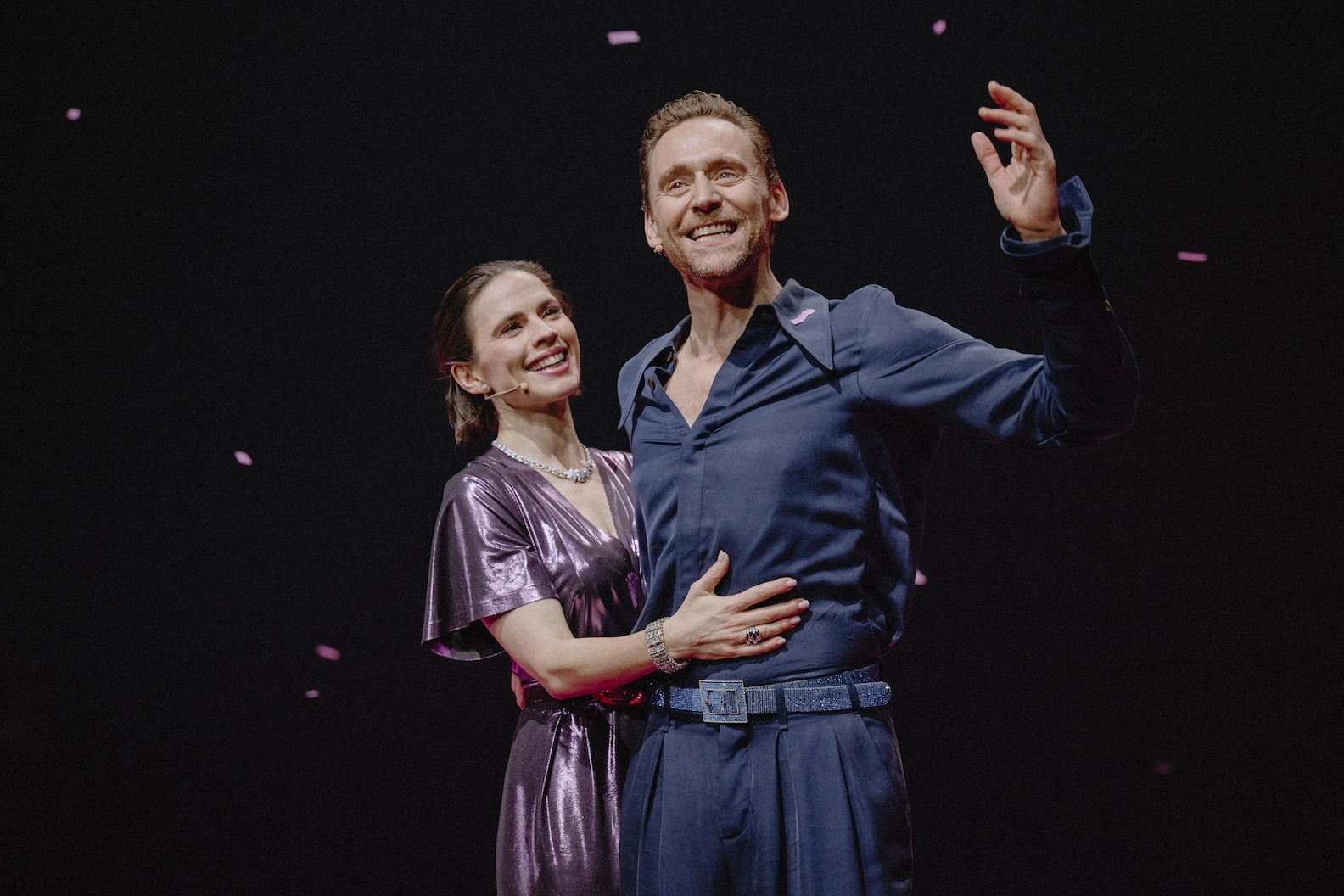
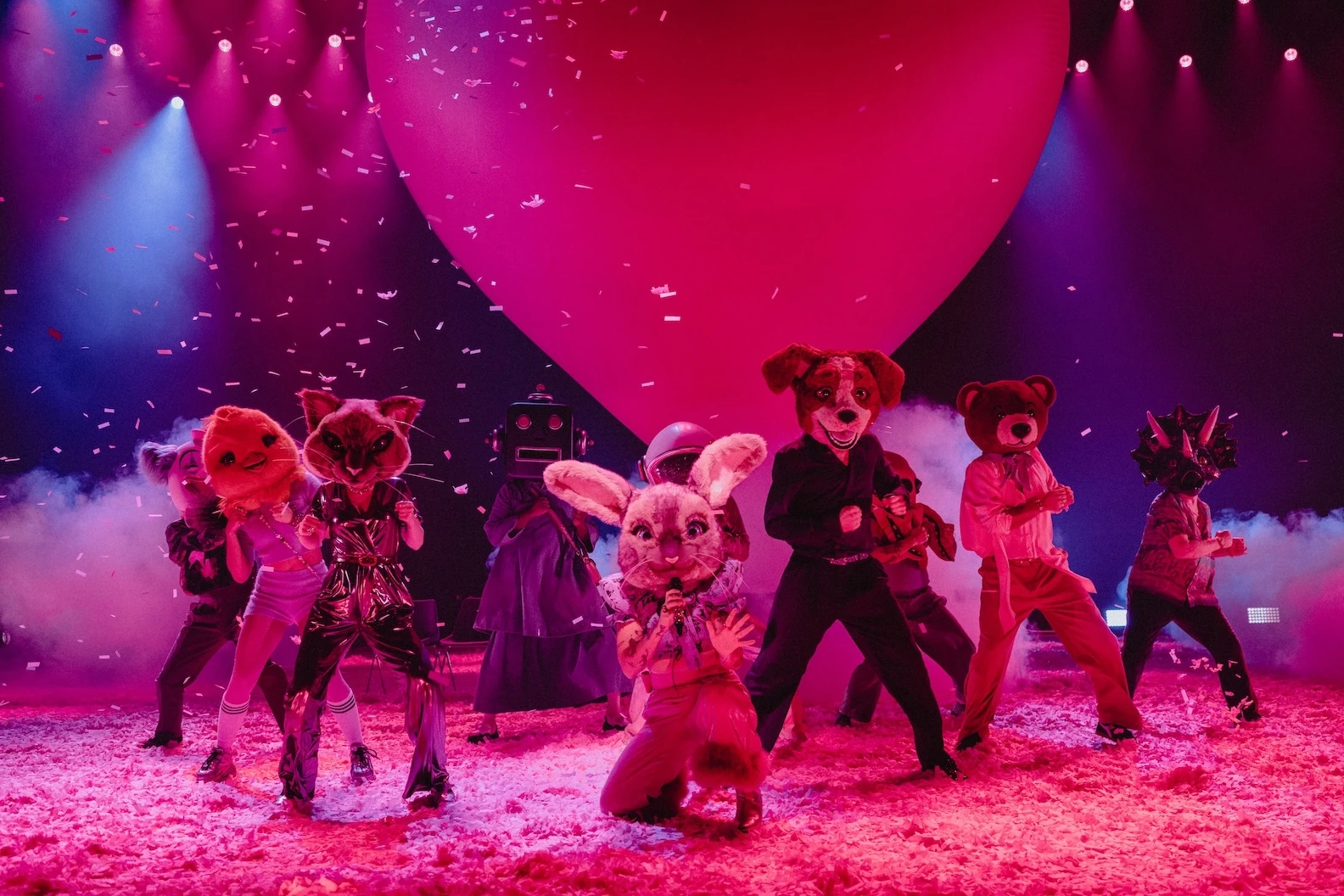
Jamie Lloyd’s ebullient, delirious production of Shakespeare’s Much Ado About Nothing is quite literally big-hearted: A giant red Valentine balloon hovers toward the back of the playing space, descending on occasion to nearly swallow someone whole, as feelings that size sometimes threaten to do. Soutra Gilmour’s set consists of almost nothing else but a table, a set of simple molded-plastic chairs and a massive quantity of pink tissue confetti, which coats the floor and often rains from the ceiling. Love is all around! But it is concentrated, too, in the highly attractive form of Hayley Atwell and Tom Hiddleston as the main couple, Beatrice and Benedick, whose bickering, capering and eventual surrender to each other’s charms could make the stoniest audiences swoon.
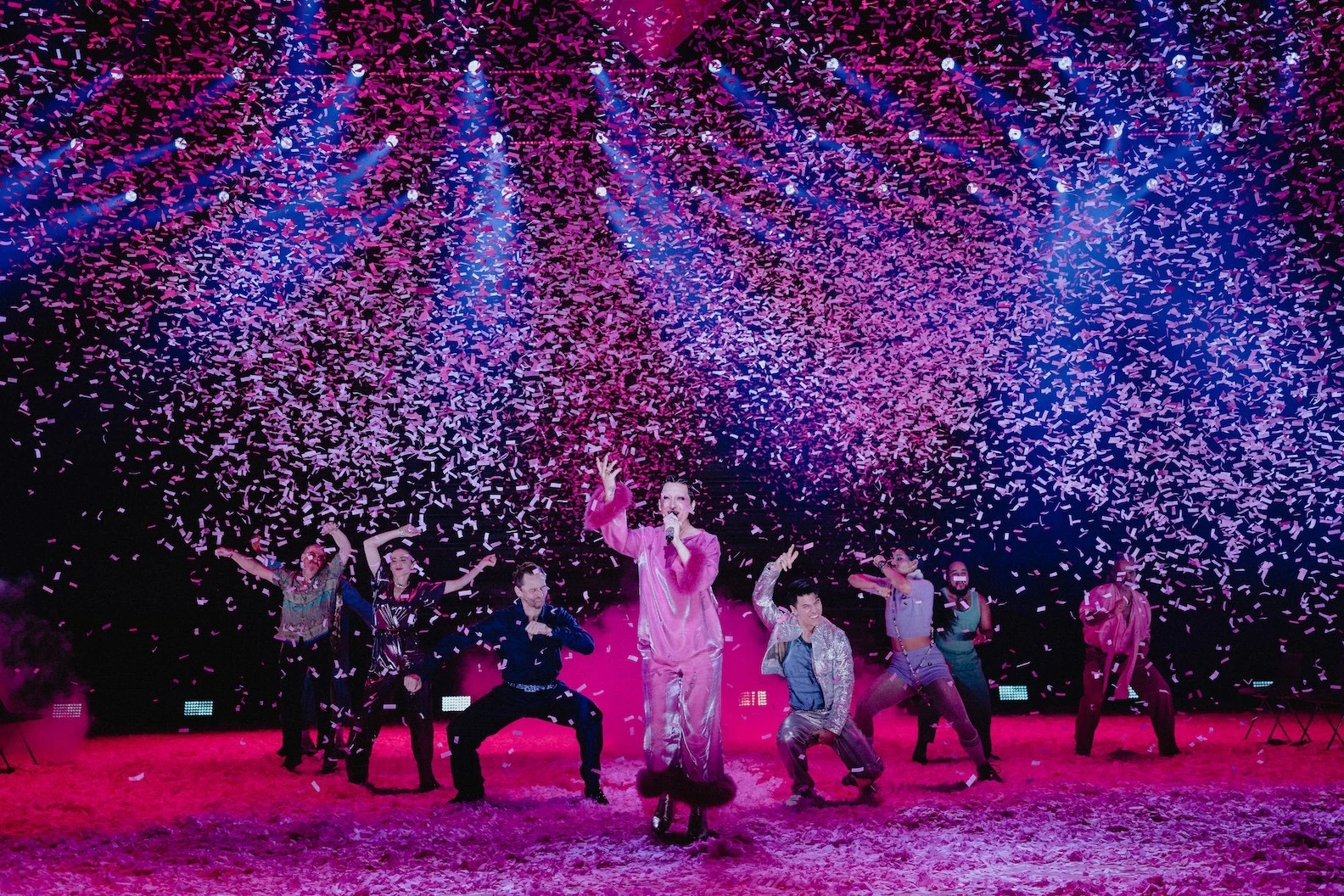
Taking your seats for this show feels like joining a revel already in progress. Music is pumping; the stage is already piled with pink litter; young women have been hired to dance in the aisles, like party motivators at a bar mitzvah. As my Time Out London counterpart Andrzej Lukowski noted of the West End version last year, Lloyd’s Much Ado is “set somewhere between heaven, Ibiza and a novelty Instagram backdrop,” and has the vibe of “an endless, hedonistic holiday, its wild romantic currents mirroring the internal melodrama of a week away with a group of friends.” It’s a costume ball, a rave, a stag night, a hen do, two weddings and a funeral all rolled into one. This not only lifts the play’s energy but also helps to sustain our goodwill. (For the masquerade ball, Gilmour hides everyone in giant mascot-style heads: a puppy, a bunny, a robot, a chick.) The confusions, betrayals and false accusations of Shakespeare’s plot are easier to accept—and, in some cases, to forgive—with the understanding that the characters are viewing their world through a smeary lens of perpetual intoxication.
Scholars have pointed out that the nothing of Shakespeare’s title may be a pun on noting, which was pronounced similarly in Elizabethan days. And certainly, the play suggests that our perceptions, especially from afar, can be of limited value. Much Ado is powered by gossip, which can be deployed for good or for evil. Beatrice and Benedick’s friends conspire to trick them into believing—by “overhearing” gossip about them—that the other is pining for them, which of course is secretly true; their longstanding animosity, expressed in flaming volleys of wit, is a cover for deep mutual attraction that they can now express without fear of humiliation. Meanwhile, in the play’s darker parallel plot, the scheming Don John (Tim Steed) fools Benedick’s friend Claudio (the well-favored James Phoon) into believing that his virtuous fiancée, Beatrice’s cousin Hero (Mara Huf, fetching in a sporty Y2K outfit), has been sleeping around on the eve of their wedding.
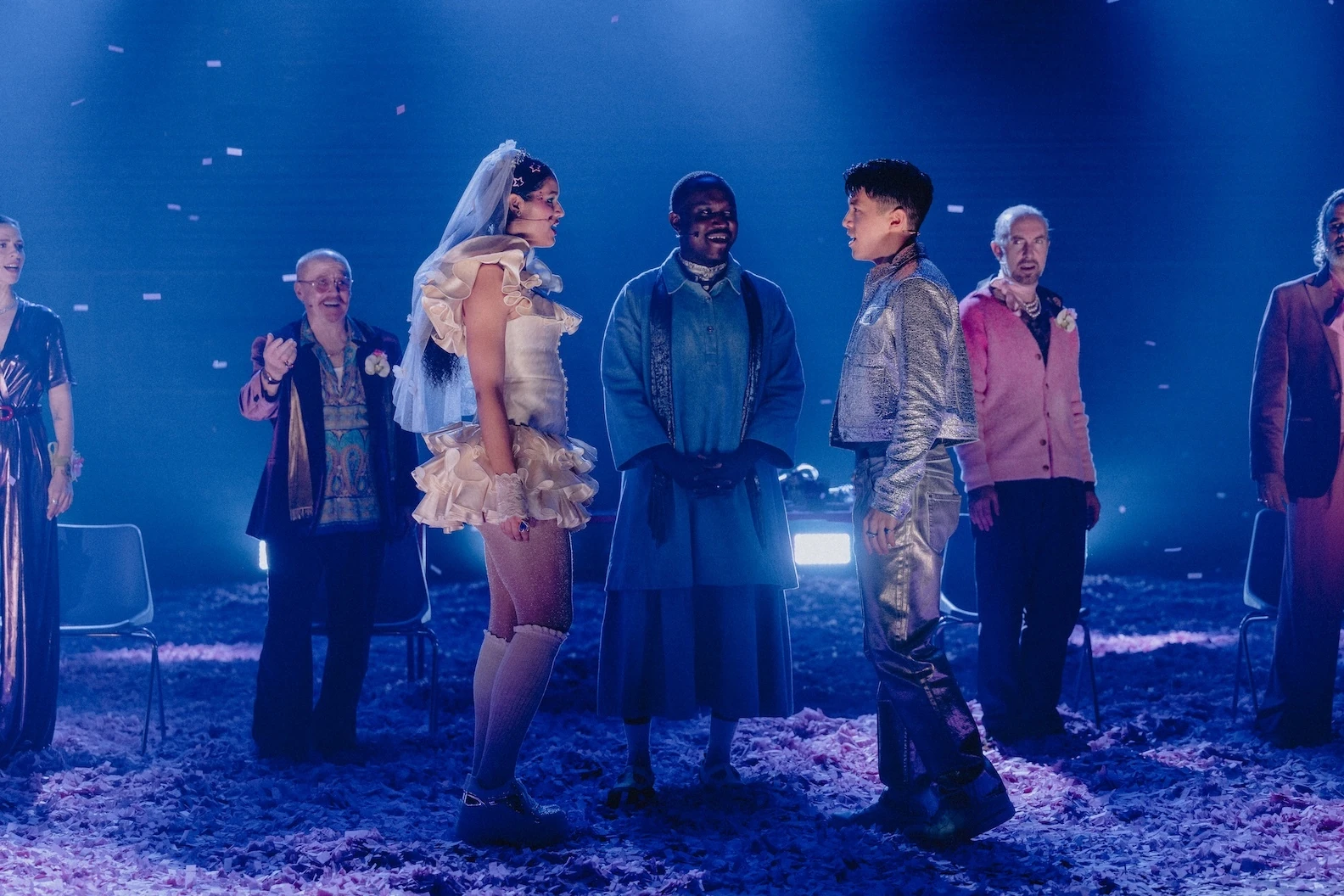
Don John’s plot engenders a doozy of an ado before the final “I do”s and adieus. But he is less a sinister Iago figure than a semi-comical bitter queen, jealous of the “exquisite” Claudio and resentful of his half-brother, the prince Don Pedro, played by Gerald Kyd as a suave older fellow—c.f. Dos Equis’s Most Interesting Man in the World—with a touch of loneliness poking out like his hairy chest from his low-buttoned shirt. (When he hints at an interest in Beatrice, she must manage it with delicacy.) Don John may be a villain, but even by the end, he still somehow seems like part of the friend group—as does his accomplice Borachio (Mike Onyx Johnson, sweet in contrition) and their unwitting dupe, Hero’s friend Margaret (Mason Alexander Park).
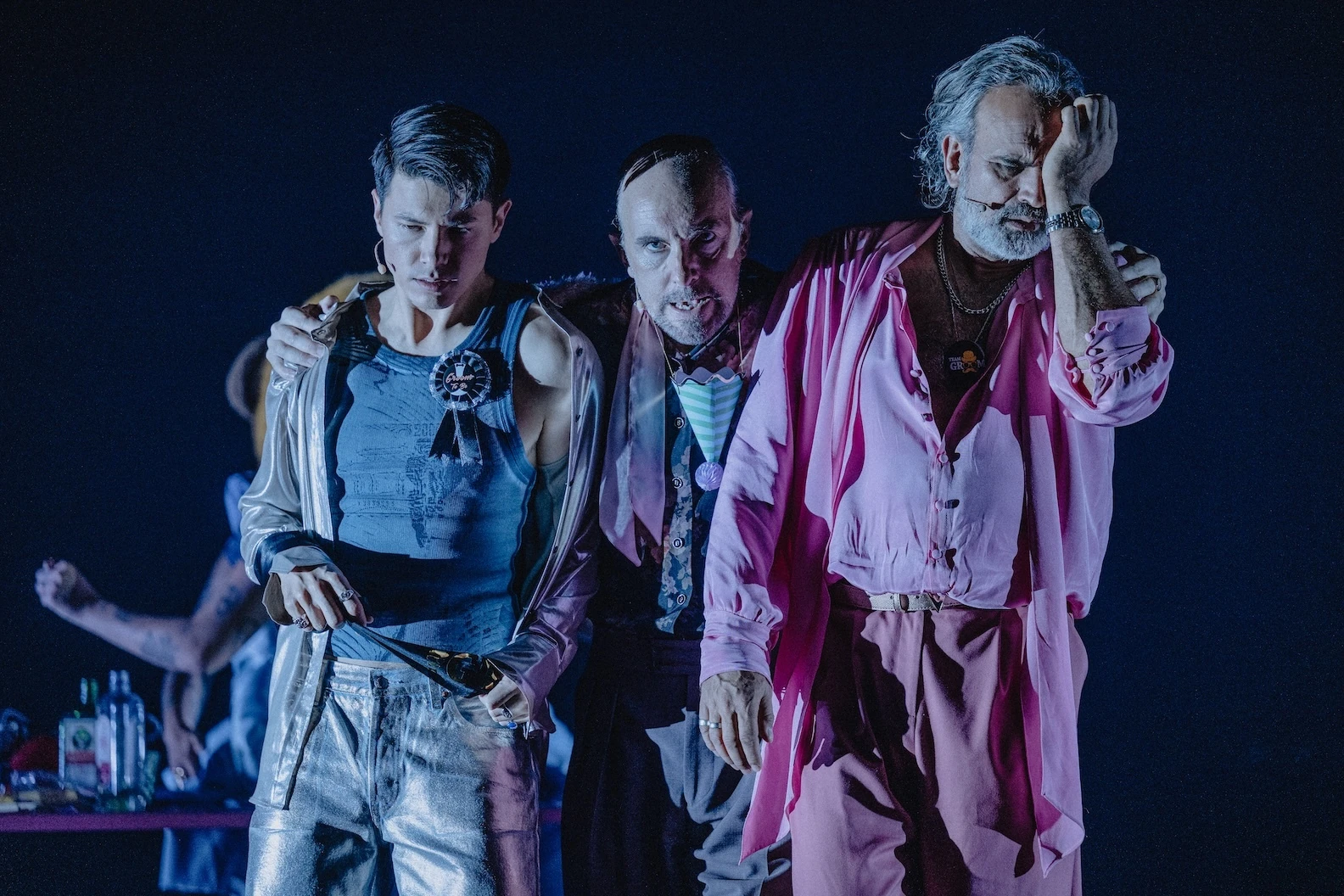
That is not to say that this Much Ado doesn’t take Hero’s journey seriously: It favors the exuberant, but it also knows when to change the mood and tighten the focus. For all the pink confetti, the directorial view stays exceptionally clear, and the storytelling is precise, thanks in part to prudent pruning of the text: The number of the characters is reduced to ten, including the Leonato (Forbes Masson) and Friar Francis (Philip Olagoke); this edit junks the whole subplot with the bumbling constable Dogberry (which is nearly always, let’s face it, a bit of a dog’s dinner). The main beneficiary of this pare-down is Margaret, who inherits lines from several of the cut characters; adding to her centrality, Park periodically whips out a bedazzled karaoke microphone to sing the nostalgic pop bops—Taylor Dane’s “Tell It to My Heart,” All-4-One’s “I Swear,” David Guetta and Kelly Rowland’s “When Love Takes Over”—that have replaced the play’s originals. "Sigh No More, Ladies” is, sigh, no more; instead, there are party songs by the Beastie Boys and C+C Music Factory.

Such changes may make it seem like Lloyd’s Much Ado is besotted with pop culture, as might the fact that Hiddleston and Atwell have played major roles in the Marvel Cinematic Universe. But they are also trained and experienced stage actors; they deliver the language beautifully and complement it with vigorous action. (Hiddleston actually rolls across the stage.) They harness their star power when they address the audience directly, recruiting our sympathy to their sides, but when Lloyd zooms in for tonal shifts—as he proved with A Doll’s House, he has a gift for creating stage moments that somehow feel like cinematic close-ups—both of them can turn on a dime without saying a word. You see it in their first exchange, when there’s a break in their sparring and a just-too-long silence speaks of history and hurt. You see it on their mute, changing faces as they eavesdrop on their friends. And you feel as much in what they don’t say as what they do. Ensconced at the heart of this production, as ado swirls all about it, is a core of such sweet nothings.
Much Ado About Nothing. Winter Garden Theatre (Broadway). By William Shakespeare. Directed by Jamie Lloyd. With Tom Hiddleston, Hayley Atwell, Mason Alexander Park, Forbes Masson, Gerald Kyd, James Phoon, Mara Huf, Mika Onyx Johnson, Tim Steed, Phillip Olagoke. 2hrs 20mins. One intermission.
Follow Adam Feldman on X: @FeldmanAdam
Follow Adam Feldman on Bluesky: @FeldmanAdam
Follow Adam Feldman on Threads: @adfeldman
Watch Time Out’s theater podcast on YouTube: Sitting Ovations
Follow Time Out Theater on X: @TimeOutTheater
Keep up with the latest news and reviews on our Time Out Theater Facebook page