[title]
Theater review by Adam Feldman
Rating: ★★★ (three stars)
Ticketing: How to get tickets to Shakespeare in the Park
“¿O Romeo, Romeo, por qué eres Romeo?” asks Juliet in Shakespeare in the Park’s new production of Romeo & Juliet, and some in the audience may wonder the same. Why, in director Saheem Ali’s adaptation of this quintessential lover’s tragedy, is the hero’s name often rendered in Spanish—as Romeo, that is (as in Alfa Romeo), instead of plain old regular Romeo? And not just his name: In this telling, Romeo (Daniel Bravo Hernández) delivers many of his lines in Spanish, and in the scenes he shares with Juliet (the gorgeous Ra’Mya Latiah Aikens), so does she. No English translations are provided in those moments; the show entrusts their meaning to the international language of love.
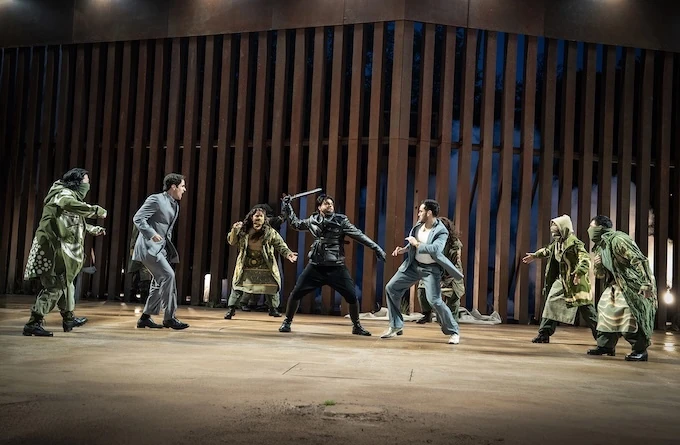
Ali’s choice reflects his overarching concept for the production, which he sets in a modern American-Mexican border town called Nueva Verona. Shakespeare’s feuding families, “both alike in dignity,” now represent two sides of a political and cultural divide. Juliet’s relatives, the Capulets, are rich and brutal, in border-patrol black uniforms; Romeo’s people, the Montagues, mostly wear bulky, identity-hiding togs and scrawl slogans urging the end of ICE and the destruction of the tall, angled metal wall that dominates Maruti Evans’s set. (Behind it are two giant statues: one of a beautiful young woman, the other of a skeleton.) Romeo’s Spanish marks his belonging to one side of this conflict, and Juliet’s efforts to engage him in his own tongue marks her as different from the rest of hers.
Ali’s use of Spanish may serve another purpose as well. Many people, after all—especially those whose native language isn’t English—find it difficult to follow Shakespearean speech in the original text. Putting some of it in Spanish, which roughly a quarter of New Yorkers use at home, reverses that problem: It makes the dialogue more accessible to Spanish speakers, and puts the rest of the crowd in the position of having to figure it out for themselves. This comes at the not-insignificant cost of Shakespeare’s poetry, which is one of the principal reasons we continue to stage his works in the first place; some of the play’s most famous lines are missing. But the well-crafted Spanish text, by Alfredo Michel Modenessi, minimizes the sense of interruption by hewing to the meter of the original text, and there’s a pleasingly inclusive, democratic feeling to the enterprise that is consistent with the mission of Shakespeare in the Park.
RELATED FEATURE: At Shakespeare in the Park, Romeo and Juliet gets a happy ending
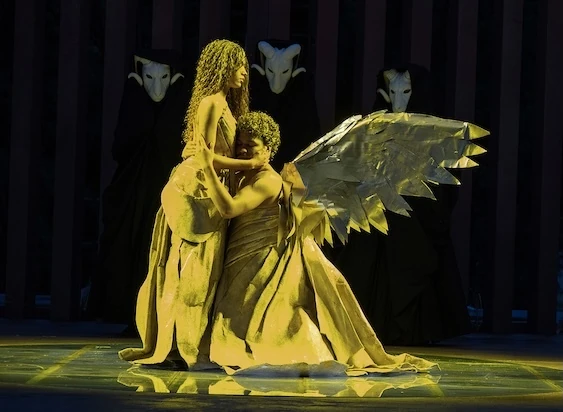
Though well-intended, however, the Nueva Verona concept is dramaturgically shaky. It’s central to the plot that Romeo & Juliet takes place in a single city governed by one prince (Jessica Pimente); splitting it in two loses that dimension, and makes the prince’s role confusing. And the specifics feel muddled: Why does only Romeo speak Spanish, and no one else in his family or circle? Why does Juliet sometimes speak it very fluently and at other times struggle for basic words? And that’s not to mention some regrettable edits that Ali and his co-adapter, James Shapiro, have made to the text. Perhaps to make their decidedly non-alpha Romeo more of an innocent lamb—the show's opening scene puts him in angel wings—they have reduced his murder of Tybalt (Ariyan Kassam) into a reflex and excised his killing of Paris (Martin K. Lewis) completely; in a similar prettification, Juliet now dies with a poisoned kiss instead of stabbing herself.
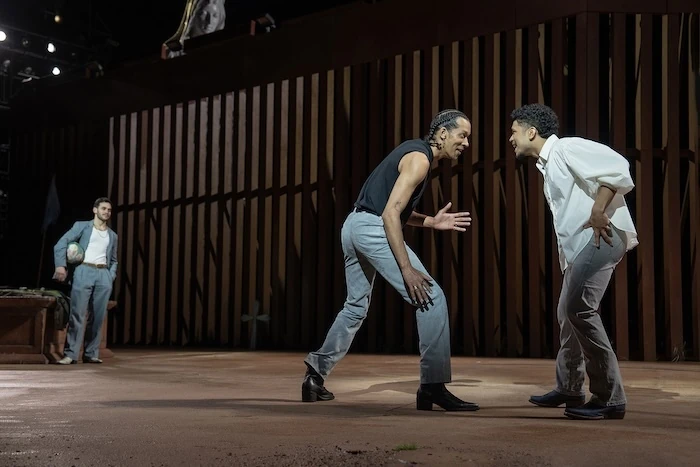
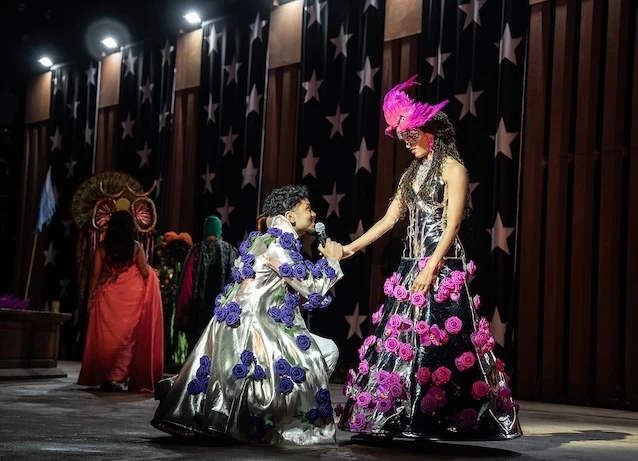
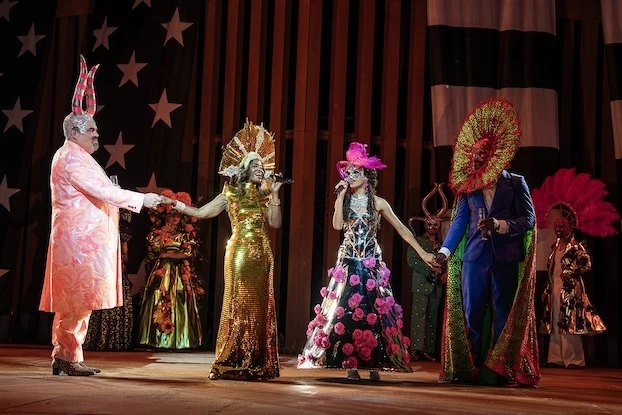
While it may not all hang together, though, this Romeo & Juliet offers much to savor. Principle among them are Deirdre O’Connell’s magnificently world-weary, knowing and bawdy Nurse and Glenn Fleshler’s commanding Lord Capulet, whose paternal tenderness in the first half makes his explosive fury in the second all the more harrowing. Caleb Joshua Eberhardt pulls off Mercutio’s long and tricky Queen Mab monologue through his force of energetic invention. Michael Thurber’s music is well-served by Francis Jue’s high-strung Friar Lawrence and LaChanze’s Real Housewives-ready Lady Capulet. Although Hernández’s Romeo is frequently overeager, Aikens's Juliet has some very fine moments, such as in her mausoleum speech. And Oana Botez’s costumes are a delight, particularly at the colorful Capulet costume ball, and the prevalence of floral imagery—Juliet sleeps in a flower bed—evokes a beauty that is vibrant but ephemeral.
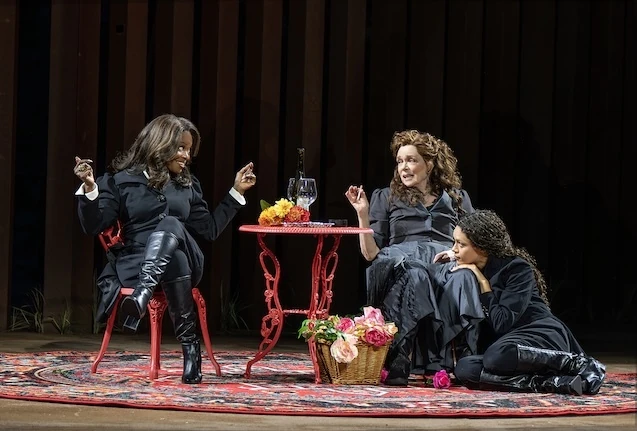
Structurally, Romeo & Juliet turns tragic with incredible speed; until Mercutio’s death at the start of Act III, it could easily be a comedy. Ali emphasizes this aspect by putting the play’s intermission at the end of Act II, with the young lovers’ secret wedding. Ominous goat-faced figures in black robes portend evil to come, but this moment allows for a measure of hope. So, too, does the wedding that, after the curtain call, put a button on the production: a real wedding, every night, between two members of the audience, performed by Jue, who has become a minister for the occasion. The implicit optimism of this gesture extends the sad peace of the play’s finale into a world where, for all our divisions, love is possible again. Watching it under the stars of Central Park, surrounded by a community of fellow New Yorkers, you want very much to believe it.
Romeo and Juliet. Delacorte Theater (Off Broadway). By William Shakespeare. Spanish text by Alfredo Michel Modenessi. Directed by Saheem Ali. With Daniel Bravo Hernández, Ra’Mya Latiah Aikens, Deirdre O’Connell, Glenn Fleshler, LaChanze, Francis Jue, Caleb Joshua Eberhardt. Running time: 2hrs 35mins. One intermission.
Get tickets to Romeo and Juliet: Info here
Follow Adam Feldman on X: @FeldmanAdam
Follow Adam Feldman on Bluesky: @FeldmanAdam
Follow Adam Feldman on Threads: @adfeldman
Watch Adam Feldman's theater podcast on YouTube: Sitting Ovations
Follow Time Out Theater on X: @TimeOutTheater
Keep up with the latest news and reviews on our Time Out Theater Facebook page