[image]
[title]When Saheem Ali was in college, years before he became the associate artistic director of the Public Theater, he fell in love with Shakespeare in the Park. “I took the Chinatown bus down to New York, and I couldn’t afford to see any Broadway plays,” he says. “I found out there was something called Shakespeare in the Park, for free, and I could not believe what I was seeing. It was such a fantastic production, and I could not comprehend how something so glorious could be free and available to residents of the city. I made it my mission to move to the city to work at the Delacorte Theater.”
That dream came true in 2021, when Ali helmed Jocelyn Bioh’s Merry Wives at Central Park’s legendary open-air theater. He returned to the newly renovated venue last year with a star-studded production of Twelfth Night that featured Lupita Nyong’o, Sandra Oh and Peter Dinklage. And this summer he is back again with a fresh take on Romeo and Juliet, which runs at the Delacorte through June 28.
RELATED: How to get free tickets to Shakespeare in the Park
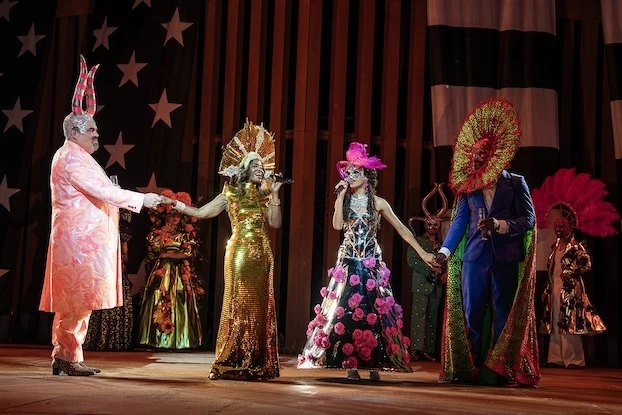
Ali’s personal experience as an immigrant—he moved to the U.S. from Nairobi, Kenya—has deeply informed this production, which is set on the American-Mexican border and infuses Spanish into Shakespeare’s dialogue. And while the young lovers’ story ends in tragedy, this version ends with a celebration: a real wedding, live on stage, between a different pair of audience members each night.
We talked with him about the thoughts behind his staging and that final moment of bliss.
You traveled to a border town that inspired your version of Romeo and Juliet. Can you speak about that experience?
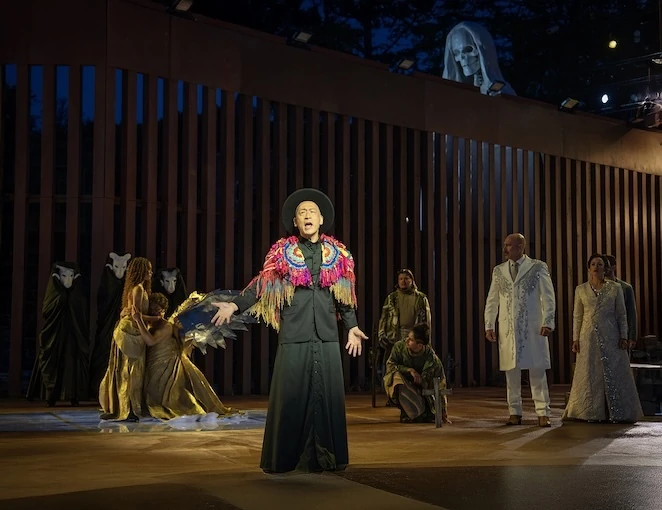
The way that I’ve constructed the world is that we're on the American side of the border wall, in a fictional border town that we’re calling Nueva Verona. I visited the city of Laredo in Texas, which is divided by the border. One side is Laredo and one side is Nuevo Laredo, so I was interested in the tensions that exist in such a community that has been divided by the wall.
When I set out to do Romeo and Juliet, I wanted to find a way to speak to the current moment in a very direct way. We know this play as a tragic love story, but really the specific pressure that is applied to these people is because of the circumstances of their society and this familial feud. Shakespeare doesn’t tell us what the families are fighting about. A lot of times there is a racial distinction between the Capulets and the Montagues; I wanted to say something about the American condition right now from my perspective as an immigrant who is horrified by ICE’s violent tactics to identify and weed out undocumented immigrants.
This is a bilingual production: It is mostly performed in English, but Romeo and Juliet often speak to each other in Spanish. Can you discuss that impulse?
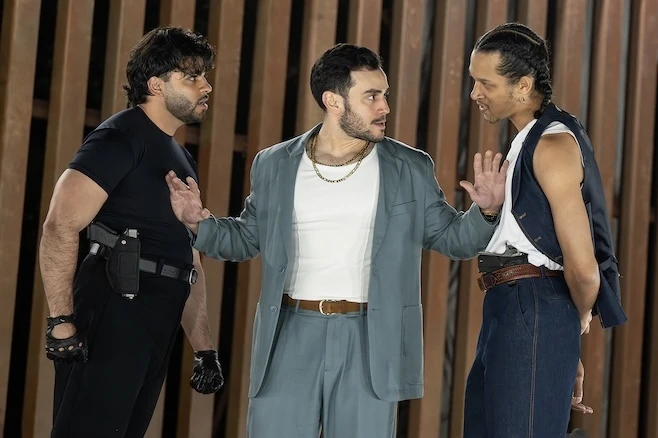
I wanted the Spanish language to exist in this border town with the tensions that exist now. I discovered that in some schools, students have been sent to detention for speaking Spanish; Spanish has become a language of danger and volatility. So amidst the tensions between the Capulets and the Montagues in the play, I wanted Spanish to be something that connected the two lovers.
There is something powerful in how that broadens access—to Spanish speakers, of course, but also to all audiences. Those who do not speak Spanish may feel invited to imagine their own dialogue. That’s exciting.
English is my second language, so I navigate the world that way. Swahili is my first language; I was born and raised in Kenya. I love watching movies and plays and listening to music in other languages because the most powerful aspect is the conveyance of emotion. You can fill in the gaps, and I find that exciting to do. Onstage, when a play is performed in a different language, if you have enough context cues, you’re still sucked into the world and understand the emotional communication that is happening.
Alfredo Michel Modenessi is executing those translations. How do they work?
Alfredo’s translation is inspired by the Shakespare text. He’s taking the poetic cues and translating it into Spanish language, so it’s contemporary but also has a poetry to it that is aligned with the original. He’s keeping the meter and the scansion of the phrases.
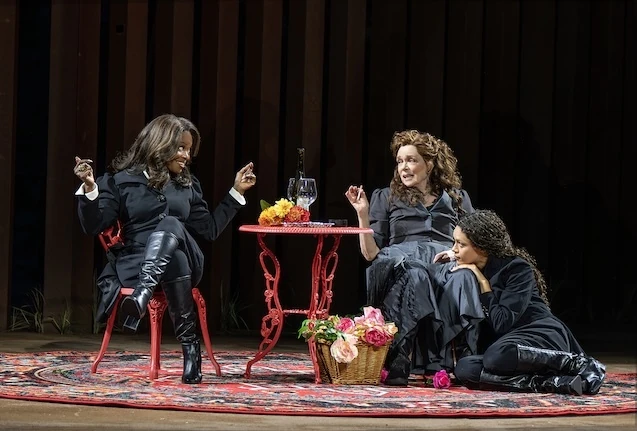
The cast features theater stalwarts like Francis Jue, LaChanze and Deirdre O’Connell, but also many rising talents. Is it special to work with an intergenerational cast?
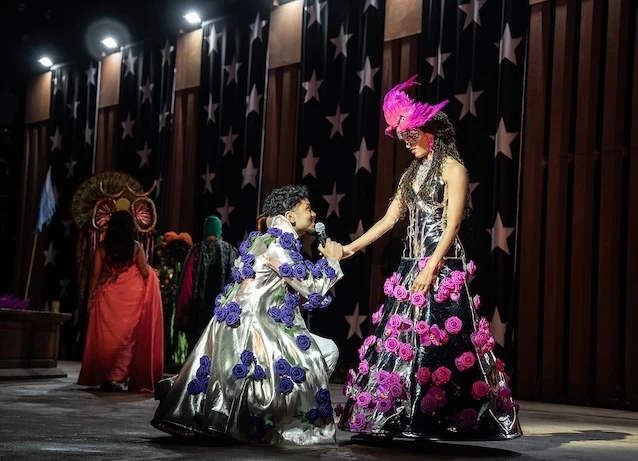
Absolutely. Last year, we had a cast of celebrity superstars who the audiences were excited to come and see because they knew their work in film and screen. But this year we wanted to take a hard swing at honoring the deep traditions of the Public—to elevate performers who are in the beginning of their career alongside theater stalwarts. The play is about the different generations listening to each other, and that is a beautiful aspect of the play we can reflect in the process. So people like Francis and Didi were just extraordinary company members and guides for young people like Ra'Mya Latiah Aikens [as Juliet] and Daniel Bravo Hernández [as Romeo], who are starting out in their careers.
Your work often brings marginalized stories to the spotlight. Is Romeo and Juliet a play you always saw yourself directing or adapting?
Romeo and Juliet was the first Shakespeare play that I ever did growing up in Kenya. I played Mercutio when I was 16 or 17 years old, so the play has really stuck with me because of my experience being in it. It also informed my approach to Shakespeare: We were young black and brown African kids being in Shakespeare, which for me fundamentally defined my approach when it comes to identity and language and people of color being in the center.
Your trip to Laredo informed not just the play, but the celebratory way in which you end it, right?
I met a couple there who were very influential on my production. We now end the production with a wedding each night, and that was inspired by this concept of border marriages, where a couple—if they fell in love but were on opposite sides of the border—would meet at the border to have a wedding that was officiated by a priest to kick off the process of immigration for the couple. I thought it was such a beautiful thing. I end the first act with the wedding of Romeo and Juliet, which we know does not turn out well, but I wanted something uplifting at the very end. So on each night there is a wedding [officiated by] our Friar Lawrence, Francis Jue, who got ordained.
So you have dozens of people getting married this summer!
Yes! We have 32 couples: 27 marriages and five renewals.
How do you make that happen?
We didn't want to do some kind of social media blast, shouting out into the world, so we used our contacts and our communities. We reached out to the public works community, we reached out to performers, artists who had worked on previous productions here, staff members of the Public, and through this small outreach, we managed to fill every wedding slot.
This is a tragedy that ends in a double suicide, but I didn’t want that to be the energy that the audience walks out into the world with. The wedding feels like a jubilant expression of hope that mirrors what the play has provoked. I always want an audience to leave with some hope for the future.
Romeo and Juliet is playing at the Delacorte Theater in Central Park through June 28. This interview has been edited and condensed for clarity.