[category]
[title]
The new David Geffen Galleries span both sides of Wilshire Boulevard, and somehow it always feels like a surprise when you get to the other side.


Move over, Mystery Spot: There’s a new California icon ready to trick your brain, and this one isn’t even trying. In fact, it’s not really fair to call the curvilinear street-crossing design of LACMA’s bright new David Geffen Galleries an optical illusion because it’s not actually hiding anything. And yet, time after time, I’ve found myself thinking, wait a minute, did I just unknowingly cross Wilshire Boulevard?!
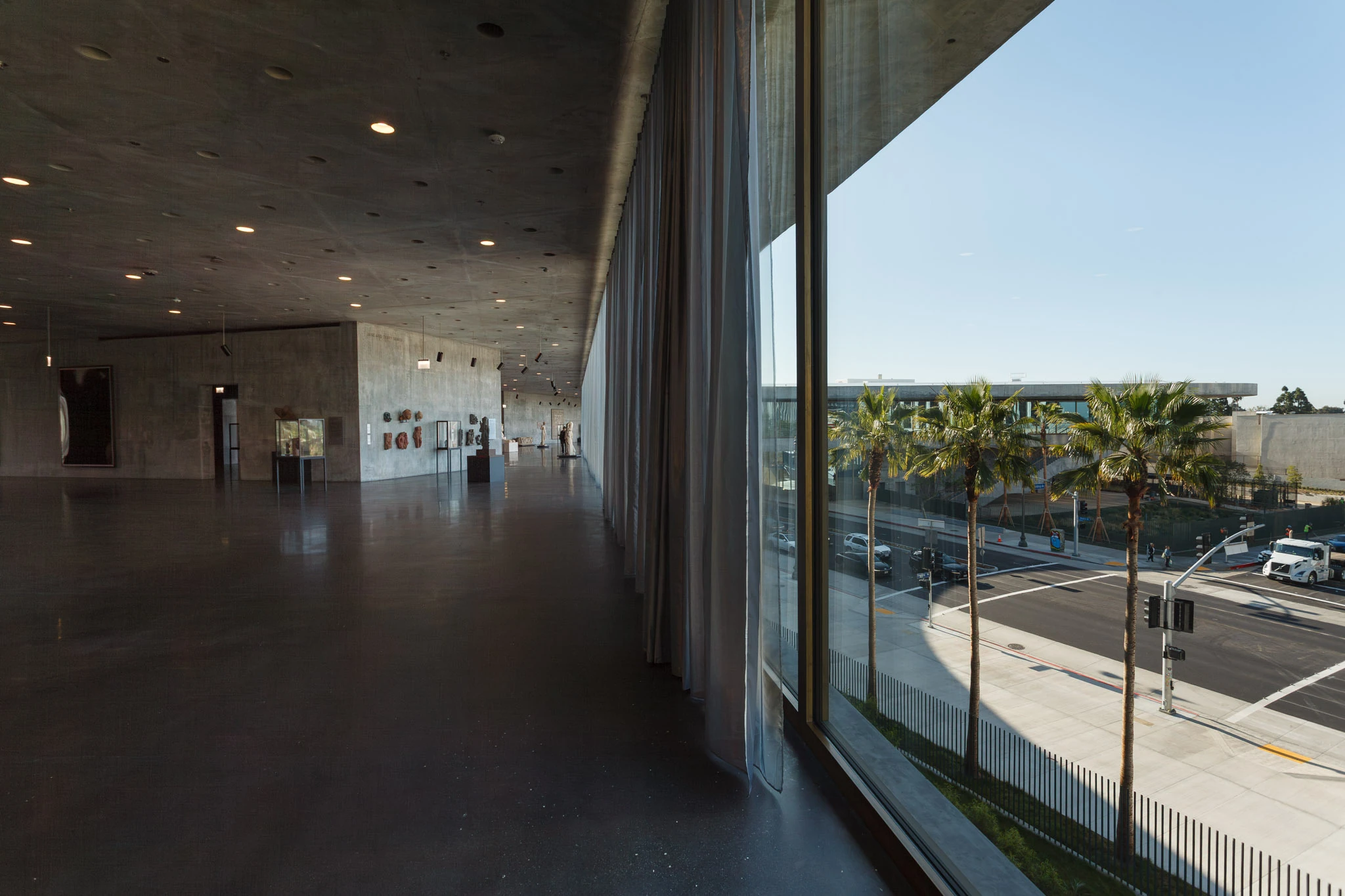
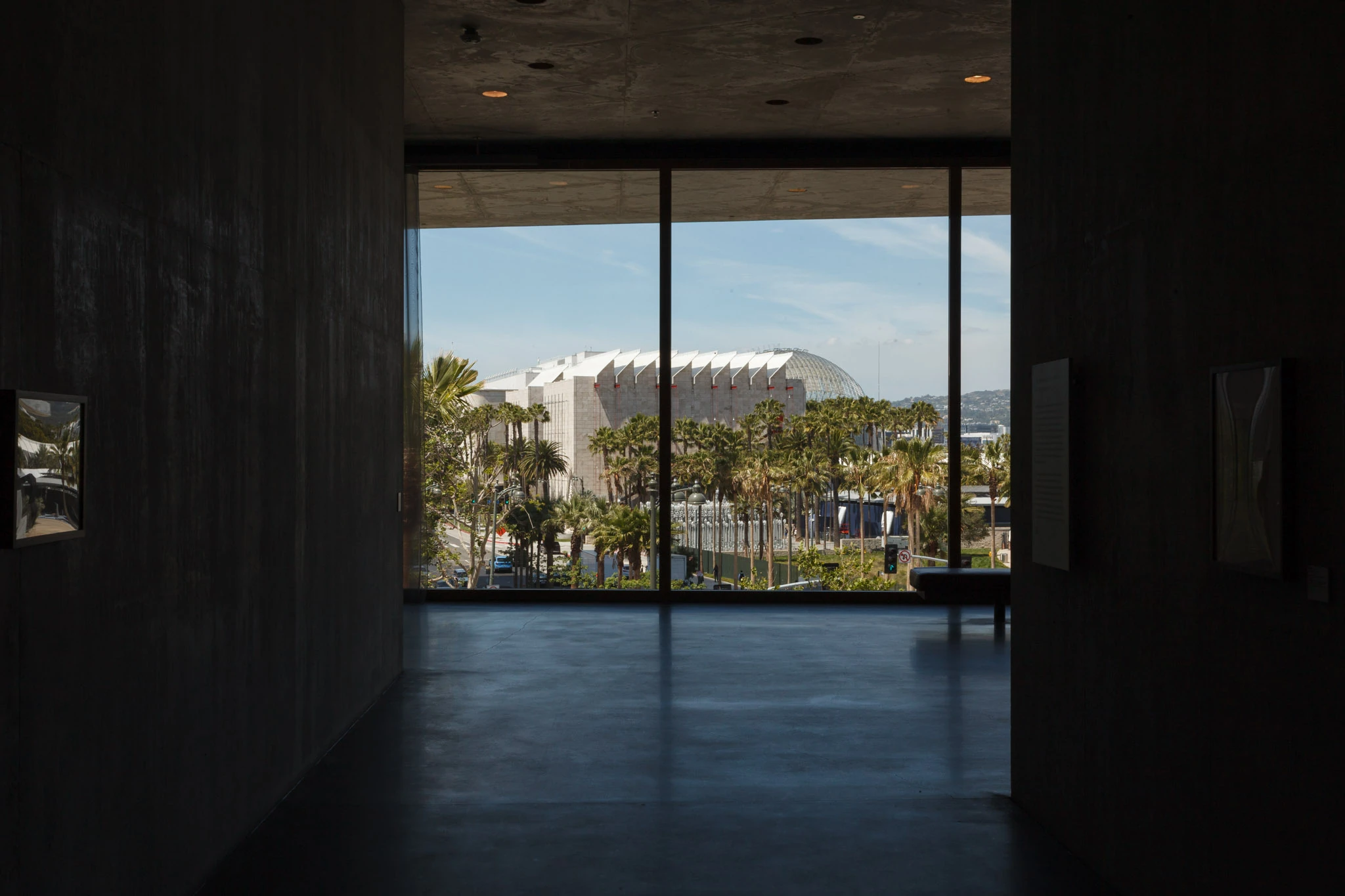
It’s completely surrounded by floor-to-ceiling windows with exterior landmarks visible at almost every turn. But somehow, crossing the road—just about the most mundane daily activity you can think of—feels like a sleight of hand inside of LACMA’s 110,000-square-foot elevated assemblage of galleries.
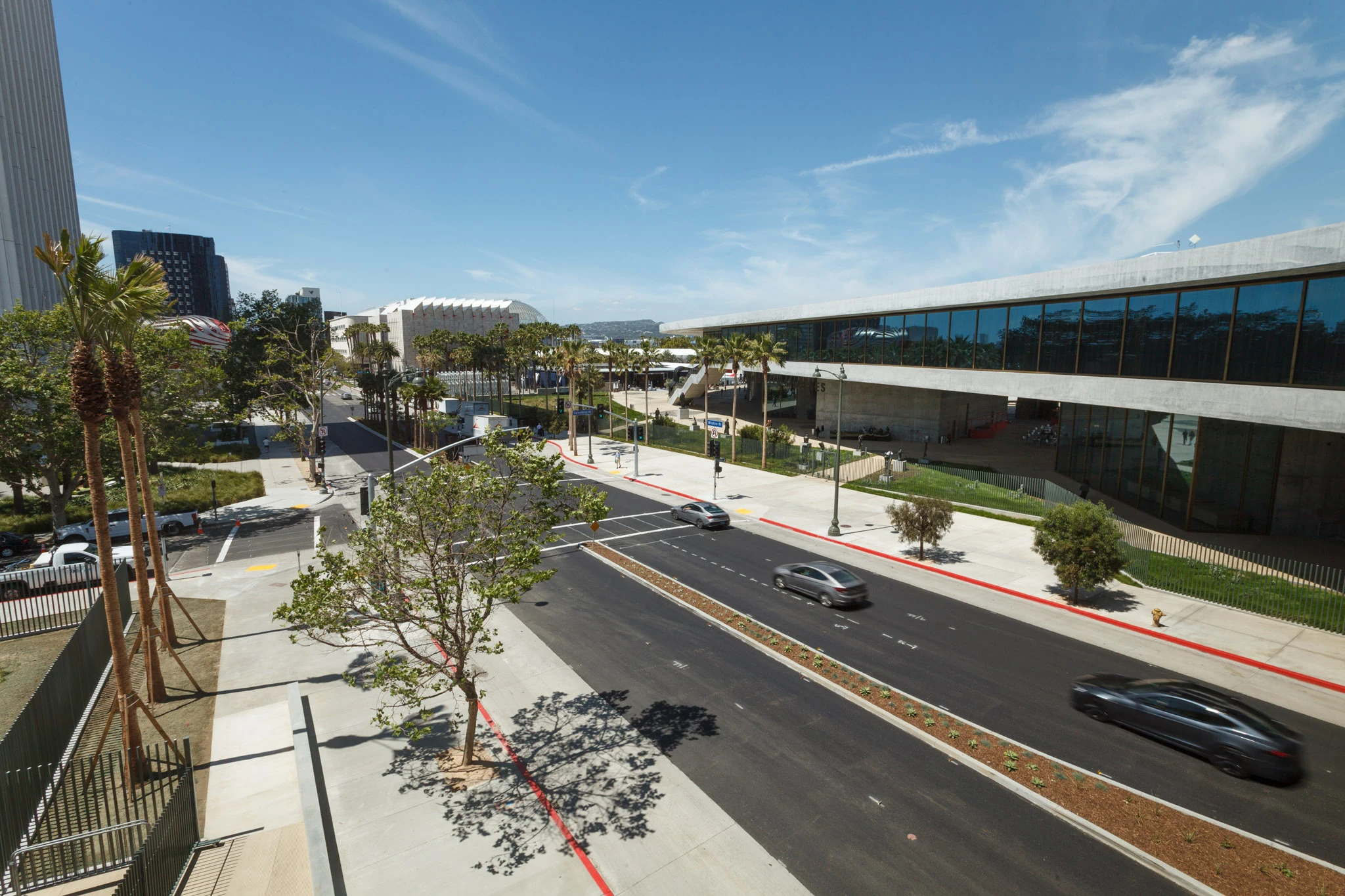
So why did the Miracle Mile museum cross the road? To take the former eastern campus, which divided its collections into a handful of mostly discrete multistory buildings, and transform it into an unbroken building that unites the 3,000 or so pieces on display onto a single floor. But rather than rest on the ground, the Peter Zumthor–designed David Geffen Galleries are elevated nearly 30 feet above street level; the majority of the footprint stands above the old eastern campus, but a sizable slice extends above the four or so lanes of traffic on Wilshire Boulevard and toward the corner of Spaulding Avenue, where the museum once operated a surface parking lot.
The result is a panoramic space that seems to float above L.A., as if a spaceship decided to hover just above Wilshire in order to get the best possible views of the Academy Museum and the La Brea Tar Pits. There’s no single proper path through the galleries, instead you’re free to wander their nonhierarchical, achronological layout however you please (though the museum’s guidebook does broadly group the collections by four oceans). The westernmost tip, where you’ll find Henri Matisse’s La Gerbe (The Sheaf), offers by far the dreamiest vantage point. But the midsection above Wilshire affords a SimCity perspective on the world where you can watch car traffic whiz (or crawl) past, Ubers pull up to the curb and pedestrians pose for photos.
So where’s the magic trick here? How is it possible that, after I logged thousands of steps criss-crossing the galleries for a video shoot, it still seemed like a surprise each time I ended up on the other side of Wilshire? (Even after already experiencing the same phenomenon almost a year ago, before any art had been installed.) And it wasn’t just me: During my pre-opening visit, I heard at least three other people voice similar bewilderment.
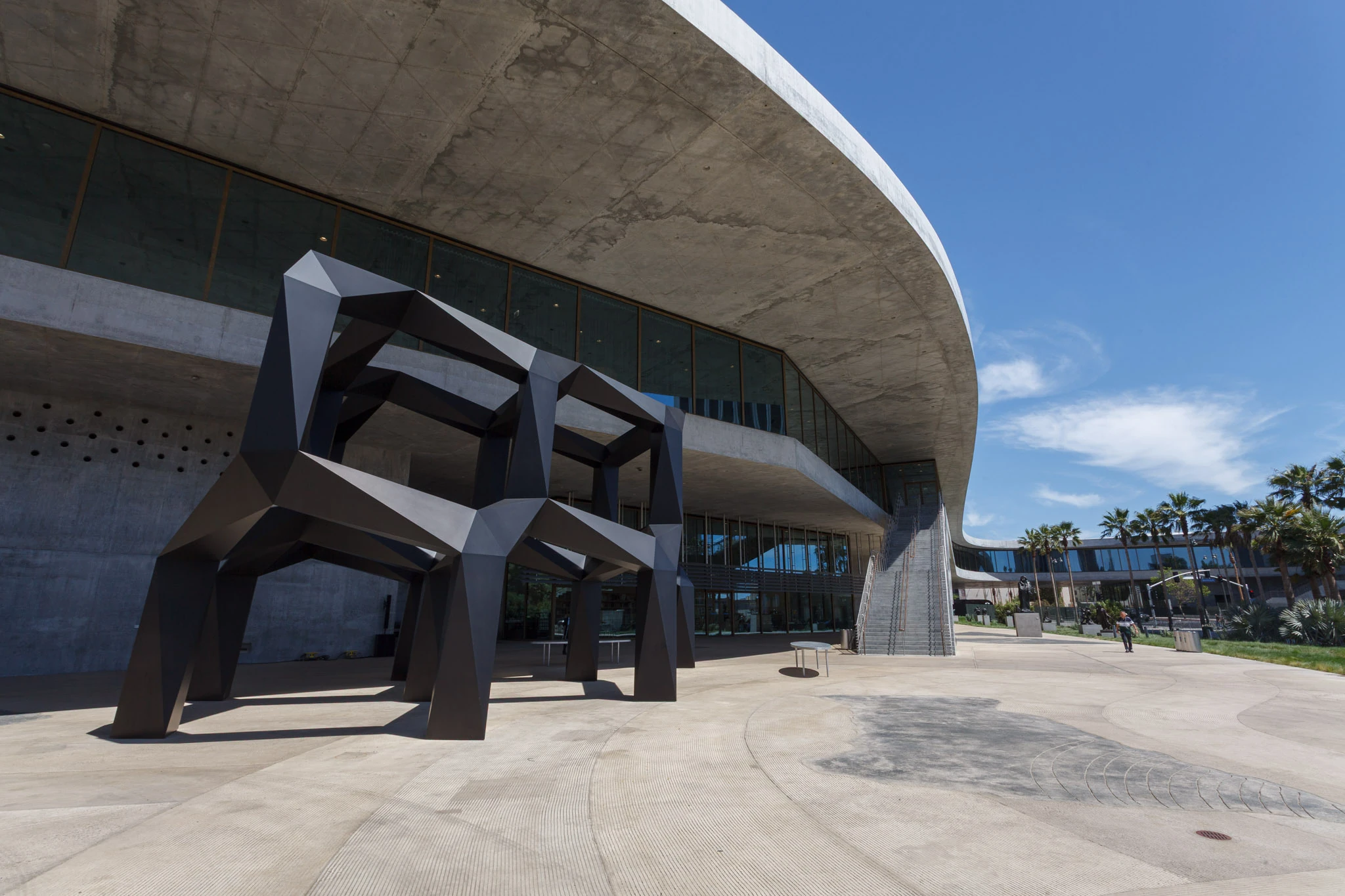
I have a few thoughts here that I think all add up to a sensible explanation. First, let’s talk about scale. LACMA says there’s no front door to the new building, but the large staircase near Tony Smith’s Smoke feels like the closest thing to a main entrance. From that first indoor landing, you can gaze outside the windows and follow the Wilshire-jumping curve of the building. That opposite end seems far, but it’s only about a football field away; you’ll move much quicker than you anticipated, and once you approach the tight bend in the building, you’re basically halfway across the street. It’s a similar story on the eastern side of the structure, where a sharp switch in direction swivels you from staring at the La Brea Tar Pits to eyeing the other end of the street.
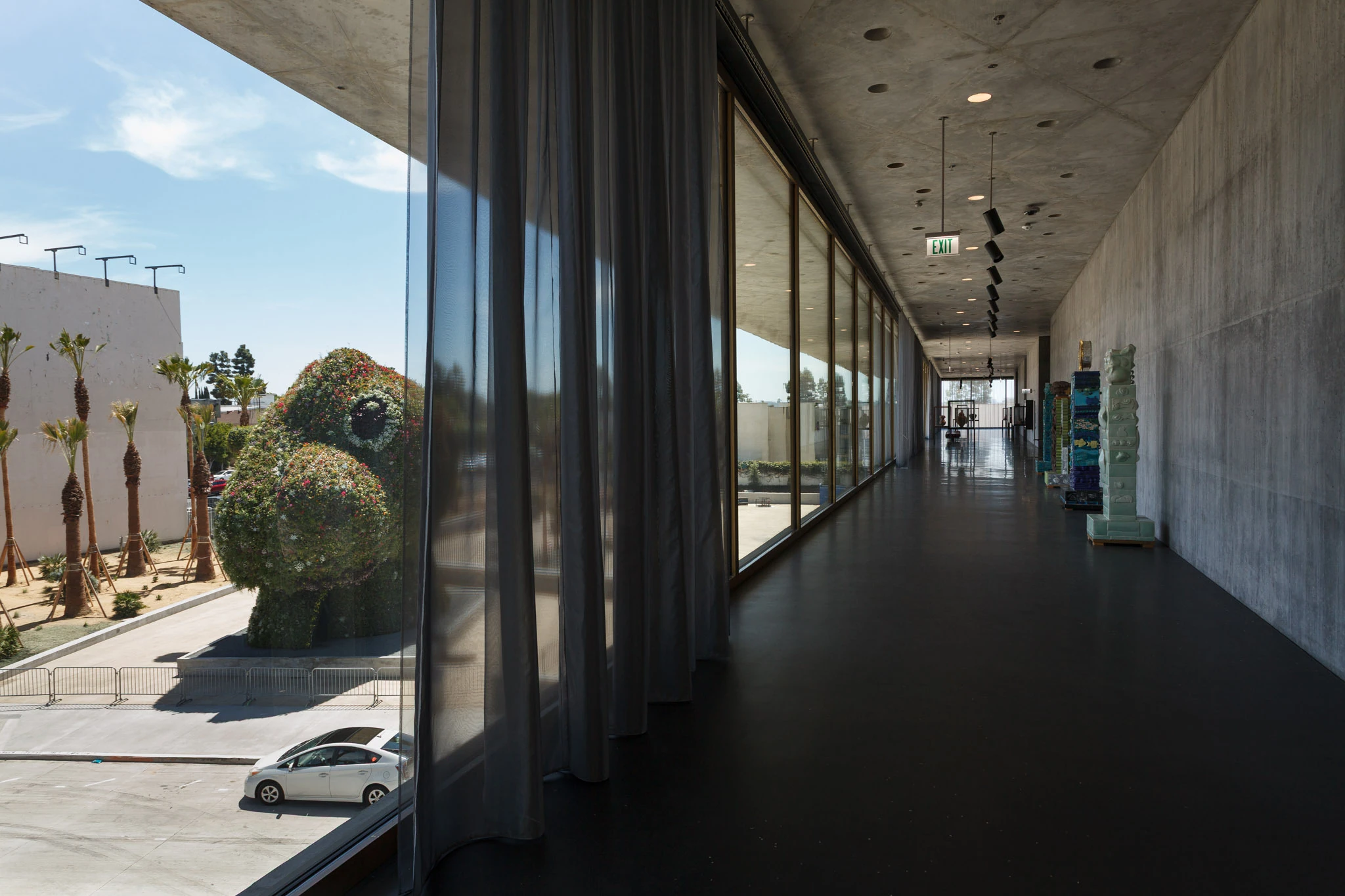
This is where visual distractions come into play—or, you know, the art that you’re actually here to see. Along that same walkway, Jeff Koons’s floral Split-Rocker beckons you to the south side of the street. On the western side, you’re constantly pointing your gaze inwards as you admire a Lauren Halsey sculpture and ancient Greek vases one second and Francis Bacon paintings the next. And even if you are peeking out the windows, you’re possibly getting caught up in the gauzy haze of the curtains, which lend a chromatic aura to outside sights. (You know those festival photographers who shoot concert photos through a crystal to get a bit of rainbow fringing? It looks a little like that.)
There’s also the novelty of it all. I don’t think there’s any other street-spanning structure in L.A. quite like the David Geffen Galleries. You have Downtown L.A.’s California Plaza, the mall-meets-park at the top of Angels Flight—but very few of the vantage points there make it clear that you’re hovering over Olive Street. And then there’s the M.C. Escher–like labyrinth of pedestrian bridges near the Westin Bonaventure Hotel—but those are just open-air bridges.
Along those lines, I do think you can chalk some of it up to confusion: There’s certainly some (intentional and unintentional) disorientation at play here. The irregular, serpentine shape of the galleries means there’s no rigid grid, and the width of the floor is always in flux. You’re encouraged to meander the galleries on your own without much hand-holding; a chunky guidebook dubbed Wander contains the gallery labels and wall texts that you’d expect to find in this otherwise very text-lite museum. If you do consult the digital map, you’ll find 78 numbered points of interest, with barely any photos teasing what’s on display. (I’d also highly encourage pulling this up just to pinpoint the bathrooms, because you absolutely will not intuitively find them on your own.)
And finally—and probably most importantly—there’s the fact that the Wilshire-crossing section of LACMA isn’t a bridge, it’s just more gallery space. I (very fondly) remember my many college-era visits to the Art Institute of Chicago, where the original Beaux-Arts building along Michigan Avenue connects to the more contemporary wings via a corridor that spans sets of train tracks—and the architecture leaves you very much aware that you’ve just crossed between buildings. But that’s not how the David Geffen Galleries work. (At least not from inside: Outside, at street level, the roadway certainly feels like it’s inside a concrete tunnel.) It’s not like there’s the La Brea Tar Pits side and the south-of-Wilshire side. It’s just one seamless slab that could’ve been situated anywhere—it just so happens to straddle two sides of a street.
Maybe over time, strolling above Wilshire will feel as ordinary as, well, crossing the road. But for now? It as might as well be magic.
Discover Time Out original video