[category]
[title]
Authorities plan to improve the framework after record-breaking temperatures failed to trigger higher alerts


Hong Kong is planning to revamp its Heat Stress at Work Warning system by the end of August, following widespread complaints that the current alert framework is essentially useless when it matters most.
The decision comes after a blistering heatwave that saw the mercury hit 36.9 degrees Celsius at the Hong Kong Observatory (HKO) headquarters in Tsim Sha Tsui on August 9 – officially the highest temperature recorded since logging began in 1884 – while Sheung Shui reached a scorching 39.8 degrees. Despite the sweltering conditions, the warning system remained at Amber, its lowest tier.
Former Observatory director Lam Chiu-ying publicly called out the system’s flaws, slamming it as seemingly “decorative” when even record-breaking temperatures couldn’t trigger a higher alert, arguing that a heat index based on general hospital admission statistics is the wrong parameter to be used for outdoor labour.
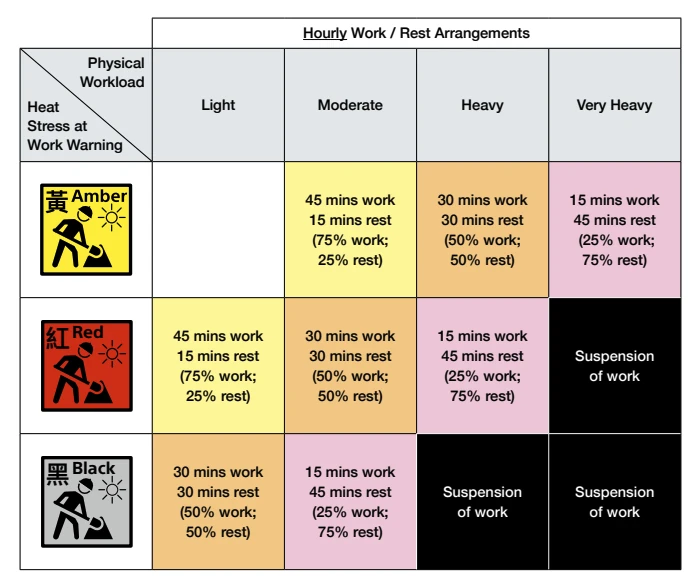
Launched in May 2023, the Labour Department’s three-tiered system – categorised into Amber, Red, and Black – was designed to protect outdoor workers by calculating heat stress using air temperature, humidity, wind, and solar radiation. When active, it advises mandatory rest breaks depending on how strenuous the job is. However, since the calculation gives overwhelming weight to relative humidity rather than direct sunlight, the higher Red and Black warnings have never actually been triggered since the system was introduced three years ago.
In response to the backlash, Secretary for Labour and Welfare Chris Sun Yuk-han and Commissioner for Labour Sam Hui Chark-shum confirmed that officials are working closely with the HKO to adjust trigger thresholds and refine parameter sensitivity. The aim is to lower the bar for escalating alerts, with authorities to implement the optimised framework by the end of August.
While office workers in Central might only feel the pinch during a humid dash for lunch, the stakes are vastly different on the ground. For construction crews, scaffolders, and sanitation workers sweating through eight-hour shifts under the sun, a properly calibrated alert system means clearer guidelines for mandatory rest breaks or even full suspension of heavy manual labour altogether.
There’s still a major catch in the framework: the code of practice is only advisory and not legally binding. Employers are expected to follow the rest guidelines in good faith under general occupational safety duties, but there are no direct fines or penalties for ignoring an Amber or Red signal alone. Until the guidelines carry genuine legal weight, any revamp mostly just offers better transparency on paper while leaving actual break time enforcement to the goodwill of site managers.
Stay in the loop: Sign up for our free Time Out Hong Kong newsletter for the best of the city, straight to your inbox
Recommended stories:
The first official Pokémon Center in Hong Kong opens this November
Hutong is launching a new cocktail menu entirely dedicated to mahjong
Messina and Mius have teamed up for a boozy gelato collab this August
Discover Time Out original video