[category]
[title]
Fresh new stats from Compare the Market show the true cost of buying property in the Victorian capital (plus how Melbourne's housing market stacks up against other cities)



If you’re lucky enough to be considering a move from Melbourne’s rental market onto the property ladder, you might want to take note. While we’re often told it’s smartest to enter the property market as soon as possible, unpredictable interest rates and skyrocketing house prices can call that guiding principle into question. To answer this age-old question “to rent or to buy”, the home-loan comparison experts at Compare the Market set out to uncover which Aussie cities have the biggest price gaps between buying a property and renting. Their research found that renting a house is cheaper than buying in every single Australian capital. (When it comes to apartments, however, there is actually one capital city where buying beats renting.)
To make it a true comparison, the researchers calculated monthly mortgage repayments – based on a 20 per cent deposit and a 6 per cent interest rate – and compared these against median rental costs.
Let's start with the housing market…
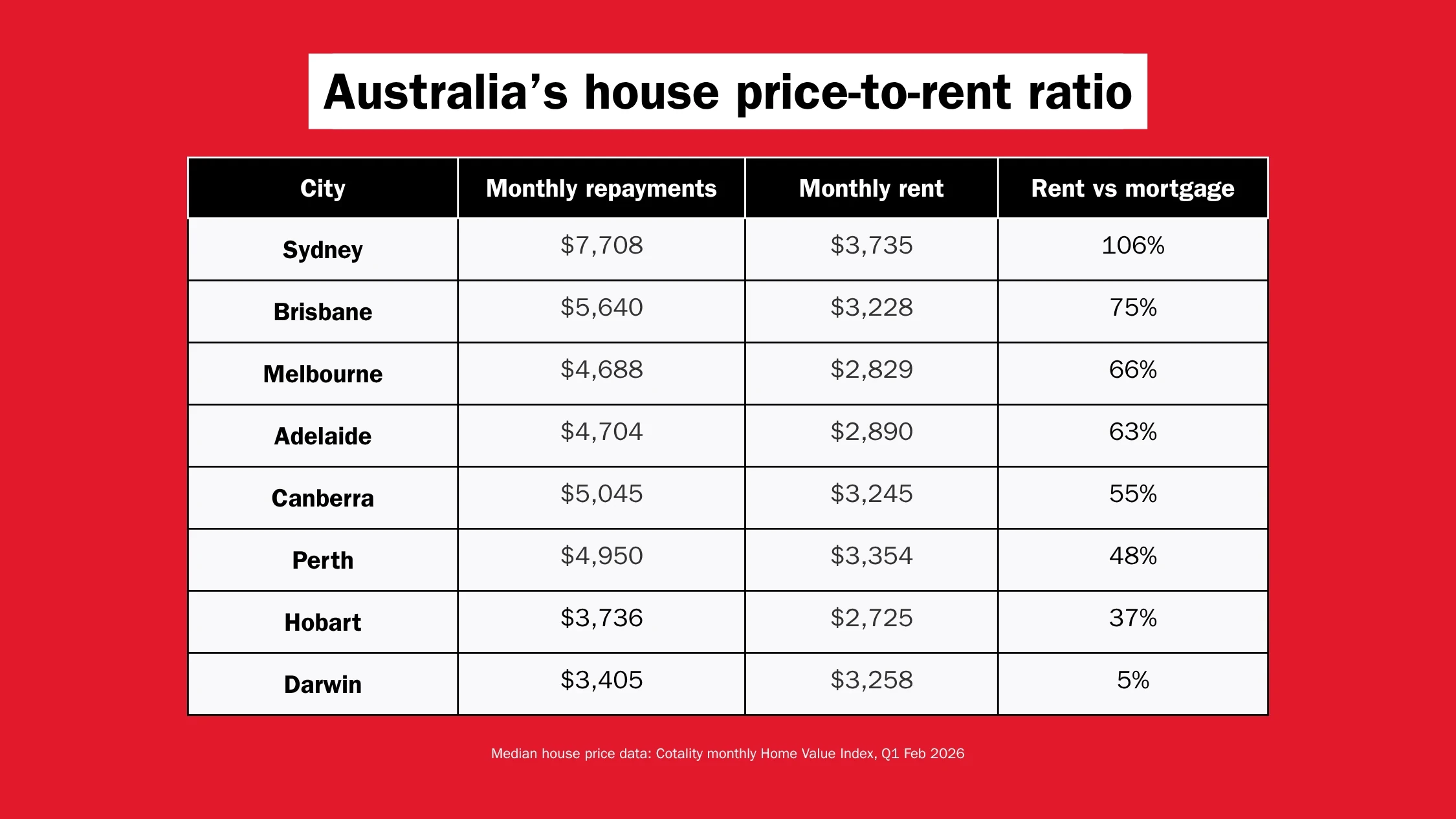
While house prices here in Melbourne aren’t as high as Sydney or Brisbane, Melbs is home to the third-highest house price-to-rent ratio in Australia. What does that look like in numbers? According to the stats, it’s 66 per cent cheaper to rent than buy here in the Victorian capital. The median house price in Melbourne is roughly $978k, with mortgage repayments averaging $4,688, compared with the average monthly rent of $2,829.
Given Sydney is Australia’s most expensive city to buy a home – with a median house price of just over $1.6 million – it comes as no surprise that the Harbour City records the nation’s biggest affordability gap. Yet, it remains one of the most sought-after places to live.
Under the study's assumptions, the typical Sydney homebuyer faces a massive monthly mortgage repayment of $7,700. Compare that to the median rent of $3,735, and you’re looking at a wild short-term affordability gap of 106 per cent.
Brisbane ranks second for the largest affordability gap, where renting is roughly 75 per cent cheaper than buying. That’s based on mortgage repayments of around $5,640 compared with a median monthly rent of $3,228. Meanwhile, Darwin holds its ground as the nation's most accessible house market, boasting a low median price tag of $709,000. Yet even here, renting wins out: a typical monthly mortgage of $3,405 is just five per cent more expensive than the median monthly rent of $3,259.
The affordability gap is far narrower when looking at apartments, especially in Darwin. The Northern Territory capital emerges as the only Aussie capital where buying a unit is more appealing than renting, with monthly mortgage repayments that are roughly 20 per cent lower than rental costs. You can compare the affordability gap in Australia’s capital cities here.
Stay in the loop: sign up for our free Time Out Melbourne newsletter for the best of the city, straight to your inbox.
Discover Time Out original video