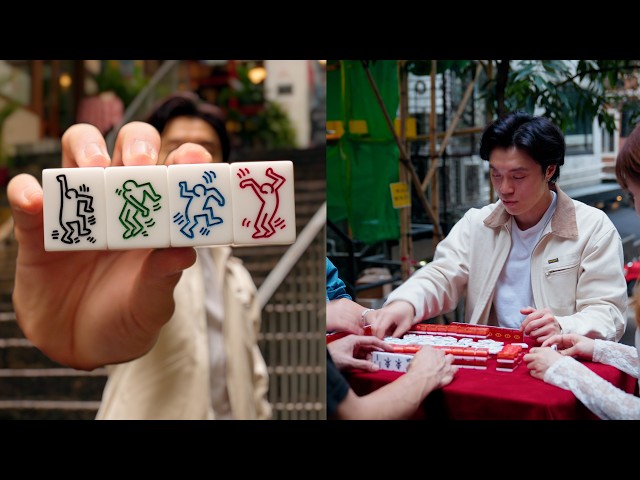
Mr Mahjong
Photograph: Joshua Lin | Mr Mahjong
Photograph: Joshua Lin

Mr Mahjong on retaining mahjong’s artistic value, normalising swearing, and meeting Colin Farrell

He went from designing railway projects to specialised mahjong pieces

Catharina Cheung
Advertising

It doesn’t really matter if your relatives hosted weekly games with their friends or whether family’s set only ever saw the light of day for a couple of days over Lunar New Year – mahjong is most definitely an indelible part of life in Hong Kong. There have even been films centred around the game (starring Andy Lau and directed by Johnnie To, no less), and it’s not hard to see why when, apart from its cultural prevalence, there is an inherent beauty in mahjong: the sharp clacking of tiles being shuffled, the deep jade green of the tile backs formed into neat rows, the curvature of the motifs in the Circles suit contrasted against the strokes of Chinese characters in the Thousands suit.

The iPad and AI generations may not care as much about this gambling game any more, but there are still some in Hong Kong who want to keep this slice of cultural heritage alive. Meet Mr Mahjong, the pseudonym of a Hong Kong artist in his early 30s called Daniel, who has dedicated his body of work to modernising mahjong in pleasingly eyecatching ways.

We hung out with Mr Mahjong before his solo exhibition on Shin Hing Street, when he took us around Coa, Out of the Brew, and Kyanbasu by Mt. Yotei, got us chatting to the friendly bar managers and proprietors Lok Cheung, Terrence Wu, and Rex Lam, and showed us his works dotted up and down the popular set of stairs. Read on to see why mahjong makes for an interesting art medium, how this culturally important game is the great unifier, and can connect us to a stronger Hong Kong identity.


Arts in Focus: Mr Mahjong

Tell us a bit about your background. Have you always created art?

Actually, my career and my previous education had nothing to do with art at all. I studied civil engineering and worked in that field as well. It’s a very logical career, so after work, I would expend my creative energy on designing mahjong pieces. It’s now a transitional period for me and I’ll probably be working on my art and designs full-time soon. I could end up starving though, so we’ll see!

So you’ve always been into mahjong?

I don’t really play it often, and when I do, I don’t play well either! We only really played mahjong around Lunar New Year, but what I like about this game is that it connects people across generations. Even relatives that you’re not really close with suddenly feel friendlier around the mahjong table. It’s something that bridges the generation gaps, and is the same when applied to different friend groups.

This whole project started as me messing around with Chinese phrases, such as my first creations with Cantonese swear words. It was just for fun when I thought about changing the Eight of Thousands design to say ‘bitch’ instead [Editor’s note: Both phrases start with the character for eight – 八萬 is 80,000 and 八婆 is bitch], or changing the Red Dragon into the Cantonese word for ‘f*ck’ – they just looked like they matched the rest of the mahjong set.

Advertising

Why did you choose mahjong as your art medium?

After my Cantonese series, I started appreciating mahjong for its unique artistic value. I started researching deeper into why the Bamboo suit tiles were those particular shapes, for example, or why the Flower tiles were designed like that, and it all feeds back into mahjong’s history. These designs have been passed down for so many years that they’re immediately recognisable across several generations – so I started thinking about creating more twists on these traditional designs. I also started making custom pieces, like names, but I would retain the style of the traditional design and typeset, and this hobby just became bigger and bigger.

You seem quite young to be interested in a traditional piece of Chinese history. Which generation are you in?

I’m a 90s kid; I was born in 1992. Back when I got interviewed for HoyTV, I thought to myself, it seems like someone my age and mahjong design don’t really go well together. Mahjong has always felt like something for older people. So before I went onto their show, I actually hired a makeup artist for movie special effects who spent three hours transforming me into a convincing middle-aged guy. Appearing on TV with an older appearance and talking about mahjong felt like it made more sense. 

The TV crew knew, of course, since I pitched my idea to them first. They were amazed that someone was willing to spend money on a fake appearance for TV. I thought the makeup effects matched my interests though, since it made the whole thing a bit more intriguing.

Advertising

Where do you get inspiration for your mahjong artwork?

It mostly comes from life. After my initial Cantonese series, I started incorporating movies and music that I like into the designs, or things that happen to be trending. For example, spin tops seem to be making a comeback these days – there are Gen Z crowds now battling with them in malls and stuff – so one of my pieces for this exhibition included drawing a One of Circles like a spin top.

I try to link up my own interests or popular stuff that’s all over social media these days by figuring out how they can be rendered in a traditional mahjong design. The process is enjoyable; I never really have a firm idea in mind, it just slowly presents itself as I’m mulling things over.

Why did you choose Shin Hing Street to feature in this series?

I’ve always liked coming here for drinks; there’s a specific vibe on this street when everyone’s chilling on the steps with their wine or beers. For this exhibition, there are nine Shin Hing Street businesses that I collaborated with, so I went through the creative process nine times. I had to find out about their stories and interesting features before figuring out how to connect these elements to mahjong, while also showing the unique aspects of each bar or restaurant.

It wasn’t always easy because I’m firm about adhering to the beauty that’s inherently present in mahjong. When I add those new elements to the mahjong tiles, I also want to preserve some of its original characteristics instead of just creating brand-new versions or designs completely unrelated to traditional mahjong. 

Advertising

Tell us about some of the new pieces you have made for this exhibition.

There are special mahjong tiles dotted all around Shin Hing Street. Some are displayed prominently, and others are in more hidden places. For some of the pieces, I mainly got inspiration from the bar or restaurant’s logo, which made the creation process quite easy. EN Coffee’s emblem is three overlapping circles, which of course brings to mind the traditional Circles suit, so since the Three of Circles was already there, I ended up just making the rest of the suit’s numbers from one to nine as well. This was an easy concept to think up; the ideation only took about 15 minutes before it all came together.

In contrast, creating the mahjong pieces for Kyanbasu by Mt Yotei was much more complicated because there were so many elements to work with. They mainly serve lamb; they’re an izakaya-style restaurant with Japanese elements; the owner really likes pop art so they have all these artworks on display. I wanted to reflect all of these elements in their mahjong design, which was tough because there’s only so much space to work with on a small tile. In the end I chose the Bamboo suit as the base design – the One of Bamboo, which is traditionally a bird, got changed into a sheep and I wrote out Kyanbasu’s name in Japanese katakana using the Bamboo typeset, so the green with blue and red accents had a bit of pop art feel as well. 

Advertising

Do you have any interesting stories from your artistic journey?

I’ve had some unexpected things happen to me, actually! I love the movie Everything Everywhere All at Once, so I made a few mahjong tiles themed after it, posted on Instagram just for some exposure, and forgot about it. But a year or so later, a crew member who works in films actually saw my work and remembered it. So last year, Netflix released a movie called Ballad of a Small Player and the principal photography was shot in Hong Kong. It just so happened that the movie was based around gambling, so this crew member actually ordered two custom sets from me as a gift for Colin Farrell and Fala Chen [who both star in the film].

I asked them in shock if I could accompany them to the shooting venue and present the mahjong sets myself, and they actually agreed. I was so overwhelmed when I met [Farrell and Chen] that I couldn’t really say anything. It was crazy that something I started doing just for fun ended up bringing me to meet some of my favourite actors in real life.

Your mahjong works are generally quite funny. What do you hope to convey with those humorous pieces?

The central idea is to be playful. A Cantonese speaker who sees the Eight of Thousands twisted into the phrase ‘bitch’ will grin and find it funny. In a heated game of mahjong, a bit of swearing isn’t uncommon anyway. I thought it would be funny if these tiles with expletives randomly appear in real games, which is why I made my tiles so that they can actually be used in gameplay.

I ended up creating sets that you can use to replace specific tiles like the Dragons. They can be customised into other swear word phrases or even people’s names. I’ve gifted some of these sets to celebrities before and their feedback has always been that it’s made mahjong games way funnier. That’s why I keep a close eye on quality control when making my full sets, like making sure the special tiles and actual mahjong sets come from the same batches made by the manufacturer, so they can blend in seamlessly in the game.

Advertising

Have customers outside of Hong Kong purchased your mahjong art?

Yes, I have received lots of orders from the US, the UK, Canada. There are more and more foreigners who are interested in mahjong now, so I definitely think this cultural export has hit a new high over the past couple of years. They actually already really like our traditional mahjong sets but when there’s the option for even more special tiles, that really piques their interest. These customers aren’t even Chinese people living overseas either; they are clearly Western names ordering from Western countries.

Do you think they’re actually appreciative of the art and tradition behind mahjong, or are they just Chinamaxxing?

I’m not too familiar with this internet trend! But I do know that it’s often difficult for foreign players who don’t know Chinese to read mahjong tiles. With the Bamboo and Circles suits you can just count the pattern and figure it out, but with the Thousands suit you have to know the Chinese characters. So it’s actually industry practice when making mahjong sets for non-Chinese buyers to carve little Roman numerals on the top right corner, and little letters indicating compass directions for the North, South, East, and West tiles. 

Back when I collaborated with Opera Gallery to create a custom set, I did wonder how to make it easier for foreign viewers to understand the tiles while retaining the Chinese spirit behind it. I finally presented the Thousands suit with the numbers written out in English – but the typeset was modelled after the calligraphy of the Hong Kong graffiti artist King of Kowloon. It was nice to pay tribute to a Hong Kong legend and the local culture behind mahjong, while also making it accessible to a newer unfamiliar audience, instead of just slapping the numbers on and calling it a day.

Advertising

What else is in the works?

My vision is hopefully that everyone can own their own set of mahjong that is meaningful to them. If you’re a big dog lover, you should have a mahjong set with elements of dogs in the design. I once made a custom set for someone who was really into music, where I used mostly musical notes.

Right now I’m still quite wrapped up in this exhibition, and I really hope it will help break some barriers and expectations. For example, do we truly need a “proper” venue to hold an art exhibition? In this event, my works are all out in the open, in public spaces, but sometimes also appearing in other people’s places of business too. I want to explore more untraditional ways of expression. I don’t have huge plans for what’s coming next yet, but if this art exhibition goes well, I’ll see what I can take away from it into my next projects. As an artist, I think we need time and space to live a little before creating. There is no inspiration without living. 

Recommended
    Latest news
      Advertising